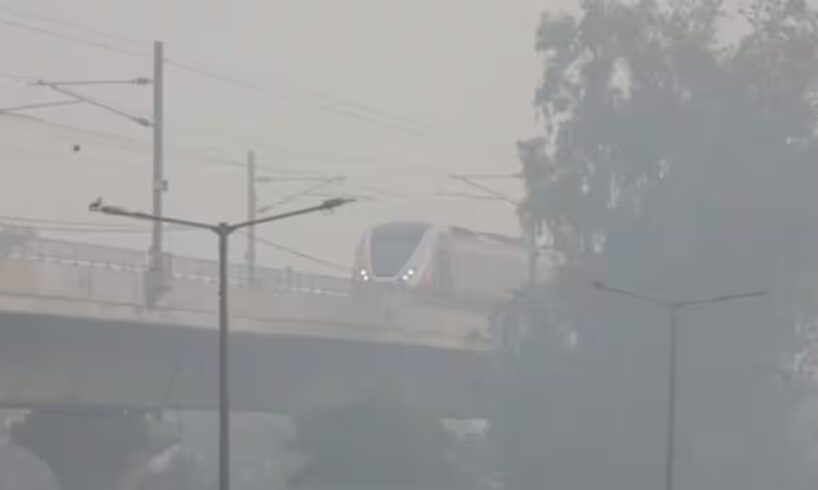
New Delhi: With Delhi’s air quality continuing to deteriorate, authorities on Sunday enforced emergency restrictions across the city as stricter pollution control measures under GRAP Stage 4 came into force to address the worsening situation.
GRAP-4 Enforced as Air Quality Worsens
The Commission for Air Quality Management (CAQM), the Centre’s pollution control body, initially imposed restrictions under GRAP-3 for Delhi and neighbouring regions on Saturday afternoon. However, as air quality deteriorated rapidly, the measures were tightened to GRAP-4 later the same evening.
Add Zee News as a Preferred Source
Following the move, Delhi’s Air Quality Index (AQI) was recorded at 431 around 4 p.m. on Saturday and rose further to 441 by 6 p.m., leading authorities to implement the most stringent restrictions under the GRAP framework.
The CAQM said all actions under Stage IV, meant for ‘Severe Plus’ air quality (AQI above 450), have been implemented across the entire NCR with immediate effect, in addition to measures already in force under earlier GRAP stages.
Schools and Offices Shift to Hybrid Mode
As reported by IANS, the Delhi government directed all government and private schools to conduct classes up to Class 11 in hybrid mode, except for Class 10. Offices were also asked to reduce physical attendance, with 50 per cent of staff instructed to work from home, while private establishments were advised to stagger working hours to curb vehicular movement.
Essential services, including hospitals, public transport, electricity, water supply, sanitation, fire services, disaster management and pollution control agencies, have been exempted from these directions.
Residents Express Health Concerns
As per ANI reports, residents across Delhi expressed serious concern over the deteriorating air quality, citing breathing difficulties, eye irritation and health discomfort. Many highlighted the increased risk faced by children and the elderly.
Speaking to ANI, residents urged the government to implement stronger measures to tackle the pollution crisis and prevent further health impacts.
“Good air quality and a clean environment are very important for a healthy life. For a healthy life, the AQI should be around 100-120, but in Delhi, it is mostly over 300. The elderly and young children face a lot of difficulties because of this,” Suresh, a Delhi resident said.
Another resident, Harsh Vardhan from Dwarka, told ANI that he is experiencing breathing difficulties due to increased air pollution and urged the government to take stronger measures.
“Pollution has only increased. I am having difficulty breathing. The government should take stronger measures. It is good that GRAP 4 has been invoked in the national capital. I suggest the ‘odd-even’ scheme should also be implemented,” he said.
Experts Term GRAP a Short-Term Measure
Environmentalist Bhavreen Kandhari on Sunday criticised the Graded Response Action Plan (GRAP), calling it a “reactive measure” rather than a long-term solution, following the imposition of Stage-IV restrictions in the national capital amid worsening air pollution.
“GRAP, as we know, is a reactive measure. After seeing terrible numbers, GRAP-IV is invoked. What has been done over the years, the decisions taken by the policymakers, is the result we are seeing; it is not an overnight situation… After a few days, when the AQI numbers drop, GRAP will be revoked. This is not the solution…,” Kandhari told ANI.
According to ANI, environmental experts criticised the situation, calling GRAP a reactive approach rather than a long-term solution. They stressed the need for sustained and consistent policy measures to address Delhi’s recurring air pollution problem.