We go where washi dare.
Although located far south of the rest of Japan, Okinawa Prefecture’s Miyako Island is still very well known for its pristine beaches, oceans, and statues of police. It’s a great place to enjoy some sunbathing, water sports, and interesting food, but not so famous for any sort of tourist attraction facilities. That’s why many people would be surprised to learn it’s home to an authentic German castle.
It certainly came as a surprise to our reporter Saya Togashi, who was recently driving along the coast only to see those distinctively German towers surreally emerge from the tropical surroundings. They’re actually a part of the Shigira Seven Miles Resort called the Ueno German Cultural Village. Saya checked online and found many mentions of it in travel websites about Miyako Island, but user reviews only said that it’s a nice place to take a stroll around, without touching on million-dollar questions of what this place is, what’s inside it, and, most importantly, why there’s a German village/castle in Japan?
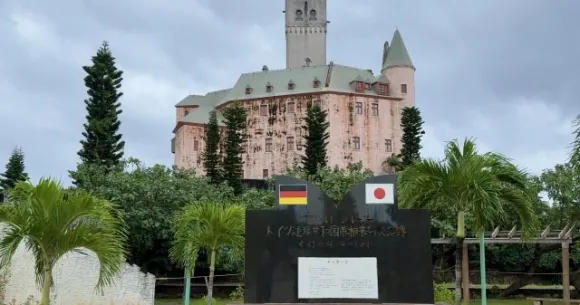
First, let’s take a look at what Ueno German Cultural Village is. It’s a small cluster of facilities, all built in a very traditional German style, with its centerpiece a replica of Marksburg Castle in Braubach, Germany. The Miyako Island castle is actually called the Hakuai Memorial Hall, and admission is 750 yen (US$5) for adults and 400 yen for kids.
It was built in the ’90s, so you might assume that highly weathered look is all artificial. But as anyone who’s been to the islands of Okinawa can attest, that salty ocean breeze really does a number on buildings there. The inside of the castle is completely different, however, with well-maintained displays and exhibits. It has classic castle architecture, like high ceilings and stone walls, but the facilities are all modern and accessible.
Saya took an elevator to the main tower, which overlooks the ocean. Since she had already taken in a lot of ocean views during her visit, she quickly passed by this part, not knowing how relevant this particular part of the ocean was to Ueno German Cultural Village, but we’ll get to that later.
She then made her way down through the second and third floors, each one filled with exhibits of German culture and history. There was one highlighting Germany’s long love affair with beer.
Another one showcased German cuisine, which confirmed Saya’s suspicions that the people there really like lots of meat and bread.
As a fan of fairy tales, she was delighted by the display of a traditional rural German kitchen that looked straight out of a Brothers Grimm story. It was also like stepping into a life-sized dollhouse.
There were mannequins displaying traditional clothing and posed in authentic situations, like this traditional German man being way too sassy for the traditional woman to handle.
She wouldn’t describe this as a cutting-edge museum, but what it lacked in technology it more than made up for in sheer quantity and authenticity of items on display. There were some wonderful examples of German art and antique furniture.
It also had some large models and dioramas, showing the Rhine region that surrounds the actual Marksburg Castle.
They were all very good exhibits on the level of any major museum in Japan, and Saya never would have expected all of this was inside a replica castle in Okinawa.
Her favorite parts were the sections set up to also replicate the interior of the real Marksburg Castle. The extra-tall canopy bed looked perfect for German nobility.
Mannequins again helped to set the scene here, such as this German knight, chivalrously averting his gaze while his Roman counterpart zipped up the fly under his pteruges. In case you’re wondering what a Roman soldier is doing in a castle built centuries after the fall of the Roman Empire, this exhibit is simply illustrating the evolution of armor.
But the very best of the best was the place pictured below.
It might be hard for some to recognize, but Saya smiled with glee to finally see a real German castle toilet. As a hardcore player of the Kingdom Come: Deliverance game, she fondly remembered a mission in the second one that involved a toilet just like this one, and was amazed to see a non-digital one.
Now that we’ve learned what this place is and what’s inside, it’s time to look at why it’s here of all places. At first, Saya assumed it was one of those theme parks based on a certain country, like the Dutch Huis Ten Bosch in Nagasaki, that were really popular at the height of Japan’s bubble economy era.
But Germany’s connection to Miyako Island goes much deeper than that, and like we mentioned earlier, the nearby coastline is culturally significant. In 1873, a German ship wrecked at this very spot, and its crew were helped by the local fishermen. A few years later, Emperor Wilhelm I set up a monument there. At about the same time, Japan was in the process of annexing Miyako and all the other islands of Okinawa, which was then known as the Ryukyu Kingdom.
Some time after the annexation, the Japanese Empire came across Wilhelm’s monument and used it as a sign of Japan and Germany’s friendship, building their own monument as well to really drive the point home in 1936 in the hopes of forming an alliance. The rest is, as we say, really horrible history, and because of that, the monuments, along with their reason for being there, were largely forgotten for decades after World War II.
After enough time passed, the Berlin Wall fell, and both countries evolved into considerably different versions from their wartime selves, it was time to once again celebrate good relations between them in the form of Ueno German Cultural Village. Former Chancellor Gerhard Schroder even visited during the 2000 G8 summit in Okinawa and had a street named after him.
So, if you’d like a change of pace from the usual sun and fun of Miyako Island, you probably can’t change the pace much more than visiting a medieval German castle.
Castle information
Ueno German Cultural Village / うえのドイツ文化村
Address: Okinawa-ken, Miyakojima-shi, Ueno Miyaguni 755-1
沖縄県宮古島市上野宮国775-1
Open: 9:30 a.m. – 5:30 p.m.
Closed on Tuesdays and Thursdays
Website
Photos ©SoraNews24
● Want to hear about SoraNews24’s latest articles as soon as they’re published? Follow us on Facebook and Twitter!
[ Read in Japanese ]
Like this:
Like Loading…