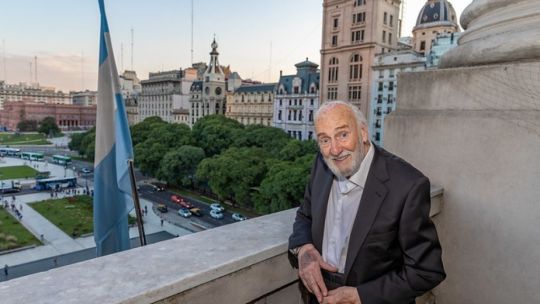
Beloved Argentine-born actor Héctor Alterio has died in Madrid at the age of 96, his family announced on Saturday in a statement released by the producers of his final production Una pequeña historia (“A Small Story”).
“With profound sorrow we want to tell you that today, the morning of 13 December, Héctor Alterio has left us,” the actor’s family said in the message published by Pentación Espectáculos on social media.
“He went in peace after a long and full life dedicated to his family and to the arts, remaining professionally active until today. May he rest in peace,” it concluded.
Alterio, who also held Spanish nationality, was described by the Spanish film academy as “one of the most outstanding performers of his generation.” In 2004 he was awarded the Goya Award for Lifetime Achievement for his career.
Spanish Prime Minister Pedro Sánchez wrote on X that he was “deeply sorry” at the actor’s passing, calling him an immense and beloved performer whose talent and humanity will live on in his work.
Argentina’s Culture Secretary Leonardo Cifelli similarly lamented Alterio as “one of the greatest actors” in the country’s history.
“His legacy will live on in his work and in the cultural memory of our country. We extend our heartfelt condolences to his family, loved ones and the entire artistic community at this time of grief,” said the official.
Born in Buenos Aires in 1929, Alterio made his stage debut in 1948 and, although he achieved fame on screen, the talented actor continued to perform in theatre until shortly before his death.
In 1975, just before the onset of Argentina’s brutal military dictatorship, he went into exile in Spain after receiving death threats from the Argentine Anti-Communist Alliance, or Triple A.
In exile, he began a long association with Spanish cinema, appearing in films such as El crimen de Cuenca (“The Crime of Cuenca”) and A un dios desconocido (“To an Unknown God”), his performance in the latter winning him the Best Actor award at the San Sebastián International Film Festival.
Despite settling in Spain, he never stopped performing in Argentine films. He starred in four national films nominated for Academy Awards, including La tregua (“The Truce,” 1974), Camila (1984) and El hijo de la novia (“Son of the Bride,” 2001).
Most notably, Alterio appeared in La historia oficial (“The Official Story,” 1985), which won the Oscar for best foreign language film.
Other memorable performances included starring roles in La Patagonia rebelde (“Rebellion in Patagonia,” 1974), a politically charged historical drama set against the repression of striking workers in the south, and later Plata quemada (“Burnt Money”), which inspired a new generation of filmmakers and audiences.
These roles, among many others, helped cement his reputation as one of the most versatile and authoritative actors in Argentine history.
Beyond his screen work, Alterio played a decisive role in reshaping Argentine theatre during the 1960s. Having already built two decades of stage experience, he co-founded the Nuevo Teatro company, which created challenging works at a time of intense social and artistic change.
Indeed, theatre remained a constant throughout his life: in 1992 he premiered a one-man show Como hace 300 años (“As if 300 Years Ago”), a poetic performance accompanied by live music that he toured across Argentina and Spain for more than 25 years, well into his 90s.
In 2023, he was recognised as a Distinguished Personality of Culture by the Buenos Aires City government.
In this news