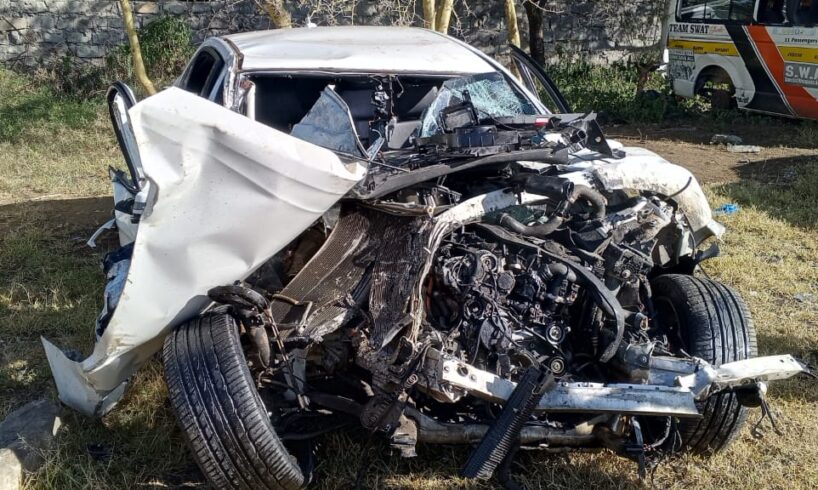
Long before the crash that claimed the life of former Lugari MP Cyrus Jirongo, the Nakuru–Naivasha Highway carried a reputation that motorists spoke of in wary tones. It is a road of movement and momentum — trucks grinding up the escarpment, buses racing to beat dawn, private cars weaving through the Rift Valley — but also a road of tragedy, where a single mistake can turn fatal within seconds.
On Saturday at about 3am, at a dark stretch in Karai, Jirongo’s white Mercedes-Benz E350 met a Climax bus head-on. The violence of the impact was clear from the wreckage that lay twisted on the roadside. But for many who know this corridor well, the accident did not come as a surprise. It was yet another catastrophe on a road where danger lives quietly in the shadows.
A Highway That Never Sleeps
The A8 corridor is the beating artery of the region — linking Nairobi to Nakuru, Eldoret, Western Kenya and international borders. It is busiest when the rest of Kenya sleeps. Truck drivers hauling cargo through the night. Long-distance buses inching toward Busia, Kisumu, Kakamega. Private motorists rushing to make up time.
By midnight, the road becomes a long river of headlights moving through fog, dust and darkness. With every kilometre, the margin for error narrows.
Karai: A Stretch With a Dark Memory
The crash that killed Jirongo happened in Karai, a section long known to police and NTSA officers as a recurring blackspot. Here, the highway subtly narrows and curves, the shoulders crumble into loose gravel, and at night the darkness feels thicker than elsewhere.
Many fatal crashes along this corridor share eerily similar descriptions: minimal lighting, poor visibility, a driver drifting from their lane, a sudden overtaking manoeuvre, or a vehicle attempting to join the highway from a petrol station or trading centre.
Karai is one of those places where the quiet of night masks the danger waiting on the tarmac.
The Bus Driver’s Split-Second Choice
Behind the wheel of the Climax bus that collided with Jirongo’s car was Tirus Kamau, a veteran driver transporting 65 passengers to Busia. He recalls seeing the Mercedes appear unexpectedly from the side of the road and move into his lane.
In that moment, Kamau had to decide. Avoid the Mercedes and risk overturning a fully loaded bus into an embankment — or brace for impact and try to keep the vehicle upright.
He chose the passengers.
Minutes later, he would be told that the man in the crushed Mercedes was Cyrus Jirongo.
Cyrus Jirongo died in a road accident in Naivasha on December 13, 2025.
When Night Falls, the Risk Multiplies
Crashes on the Nakuru–Naivasha road often occur between 11pm and 5am, when drivers battle exhaustion and the black ribbon of unlit road ahead. Markings fade into the shadows. Bends emerge without warning. A slow-moving truck or pedestrian appears too late to avoid.
At 3am, it becomes a different world — one where small errors become deadly.
Danger Hidden in Plain Sight
Even in daylight, the risks are obvious:
Petrol stations and kiosks spill directly into the highway.
Vehicles exiting improperly force others to swerve or brake suddenly.
Long straight stretches tempt drivers to overspeed.
Narrow, poorly maintained shoulders leave no room for recovery when something goes wrong.
At night, these features stop being mere design flaws and become traps.
The Kenya National Highways Authority and NTSA have flagged Karai, Kinungi, Gilgil, Elementaita and the Delamere stretch as among the most dangerous segments. Their warnings have repeated for years.
Still, the casualties rise.
A National Crisis Reflected in One Road
Kenya is in the grip of a wider road safety crisis. This year alone, more than 4,100 people have been killed on Kenyan roads, according to NTSA — the highest figure in years. Thousands more have been left with life-changing injuries.
Pedestrians, motorcyclists, pillion passengers and long-distance travellers continue to pay the highest price.
Globally, the World Health Organization estimates that road crashes cost countries about 3 per cent of their GDP, with low- and middle-income nations carrying 92 per cent of the world’s road deaths.
During the World Day of Remembrance for Road Traffic Victims, NTSA Acting Director-General Angela Wanjira reminded Kenyans that behind every statistic is a family thrown into shock, grief and financial hardship.
The Nakuru–Naivasha Highway is one of the starkest mirrors of that reality.
A Road Being Rebuilt — On a Deadline
Under growing pressure to improve safety and ease chronic congestion, the government has begun to reimagine the corridor itself.
Most recently, President William Ruto launched the Rironi–Mau Summit Road project, which is expected to be completed by June 1, 2027. The upgrade is designed to transform the highway from a narrow, unforgiving two-lane stretch into a modern dual carriageway.
Under the plan:
The road will feature a four-lane dual carriageway from Rironi to Naivasha, and
A six-lane dual carriageway between Naivasha and Nakuru.
Engineers and planners say the project should ease chronic traffic jams, cut travel time and significantly reduce the number of points where vehicles heading in opposite directions meet head-on — which is how many of the deadliest crashes occur.
For regular users of the highway, the hope is simple: that the redesign will turn a corridor associated with grief into one that is safer and more predictable.
A Deadly Road, A Familiar Tragedy
For many Kenyans, the story of the Nakuru–Naivasha Highway is not just about one night or one crash. It is about a road that mirrors the country’s growing pains, booming traffic, overstretched infrastructure, risky habits and an enforcement system struggling to keep pace.
The death of Cyrus Jirongo is the latest reminder of a long-standing truth: on this highway, tragedy is never far away. How much the new Rironi–Mau Summit project changes that story will be watched closely in the years to come.