Growing up in Alberta, Julia Sawatzky heard talk of the oilsands her entire life. But she hadn’t actually traveled much farther north than Edmonton before she went to Fort McMurray to complete a month-long residency as part of her physician training in March.
The 30-year-old, who is specializing in emergency medicine, wants to address the health impacts of environmental issues and climate change. She saw the heart of oilsands country as the perfect place to see how those forces are converging close to home.
“I was starting to have this reckoning as I learned more about the impacts of climate change in Alberta and in Canada,” she said. “I was interested to figure out ways that, as a doctor, I could help contribute to solutions to serving communities that are impacted.”
When she got there, Sawatzky was surprised to learn the only emergency room serving nearly 70,000 people had no resident emergency doctors. Patients were treated by doctors living in places like Edmonton, Vancouver Island and as far as Ontario, who flew in for lucrative work, Sawatzky said, then headed home again.
During her time in Fort McMurray’s emergency room, Sawatzky was also surprised by the number of cases of asthma she was seeing in young, otherwise healthy patients. She suspected a relationship with the oilsands and other industry in the region. However, research doesn’t exist to definitively prove a connection.
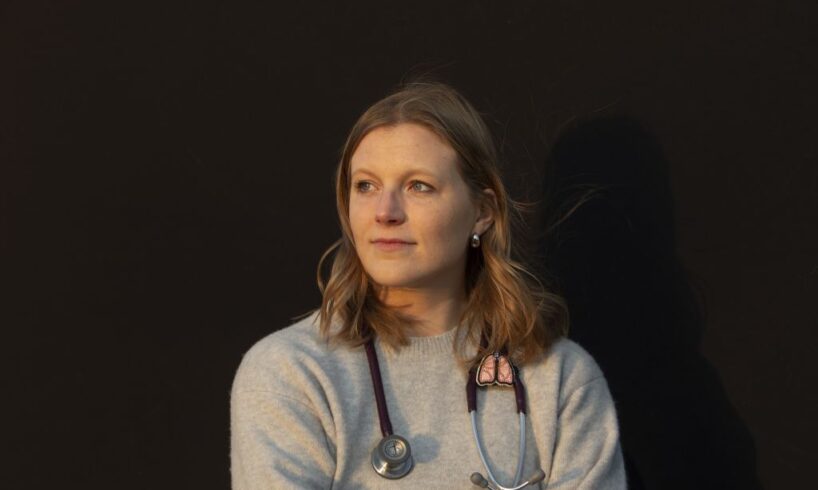
Julia Sawatzky says doctors who live where they practise have a “deeper understanding” of their community’s needs. But her worries about the health risks posed by the fossil fuel industry make her unsure about settling in northern Alberta. Photo: Amber Bracken / The Narwhal
She looked into health data collected by the province. The most current community health profile for the municipality of Wood Buffalo, where the Athabasca oilsands are located, shows emergency room visits for asthma are nearly double the rest of the province. Emergency room visits for chronic bronchitis and emphysema are four times higher in Wood Buffalo than the rest of Alberta. In Fort McMurray, emergency room visits for asthma are 40 per cent higher than the rest of the province and nearly twice the provincial average for chronic bronchitis and emphysema.
Sawatzky is concerned that fossil fuel extraction is playing a role in an increased risk of respiratory diseases. Asthma has long been linked to air pollution and a peer-reviewed Canadian study, published in early 2025, documented the increased risk of respiratory illnesses among Albertans living close to oil and gas activity.
“Oil and gas activities in Alberta are associated with negative impacts on human health,” the researchers wrote, adding, on average, their results indicated a nine to 21 per cent increase in the odds of cardiovascular and respiratory illness for people in closer proximity.
The study didn’t focus on the oilsands, but for Sawatzky, the area’s increased emergency room visits for asthma speak for themselves.
As she weighed the risks — and the unknowns — Sawatzky began to form a theory of why many of her colleagues chose not to put down roots in the region, and to reconsider living there herself.
Yet the idea of being a non-resident doctor makes her uncomfortable. Living where they work “can allow doctors to have a deeper understanding of the local health context: health determinants, health-care needs and broader community resources,” she said.
“The ability of doctors to move around and the fact that after I graduate residency, I’ll probably have a lot of choice, really underscores my privilege,” Sawatzky said. But she still wonders whether the four-and-a-half-hour drive from Edmonton might be a better choice for her if she decides to work in Fort McMurray after completing her training.
Sawatzky is not alone. In environmental hotspots across the country and around the world — where health outcomes can be affected by pollution or extreme weather — some highly sought-after and mobile doctors are quietly leaving to safeguard their quality of life. Across the country, people struggle to access family doctors and, according to the Canadian Institute for Health Information, only seven per cent of Canadian doctors work in rural areas, such as the oilsands region. The problem is driven by a multitude of complex factors, including doctors’ concerns about environmental risks, according to experts interviewed by The Narwhal.
Uche Ralph-Opara, the chief health officer at global health non-profit Project HOPE, co-authored a recent report examining how extreme weather, such as floods and wildfires, has disrupted care delivery. A physician herself, she is starting to see health workers weigh climate risk alongside compensation and infrastructure when deciding where to live and practise. “Across the different regions where we work, you know, we’re finding some doctors avoiding placements,” she said.
A tailings ponds near Fort McMurray, Alta., where emergency room visits for asthma, chronic bronchitis and emphysema are higher than in the rest of the province. Photo: Amber Bracken / The Narwhal
The connection between access to care and environmental factors is an emerging area of research. A 2021 study published in The Lancet surveying doctors in Australia’s Northern Territory, a region facing extreme heat, storms and water insecurity, found 34 per cent of respondents said climate change is either already causing, or likely to cause, them to consider leaving the area.
But it’s a subject that’s difficult to quantify in Canada, both because of a lack of data and because many of those closest to the issue are reluctant to speak out. The Canadian Association of Physicians for the Environment said some doctors are worried about professional repercussions after witnessing the treatment of medical whistleblowers, while others worry about jeopardizing future care for the patients they left behind by drawing attention to the environmental risks of serving these high-need communities.
The Narwhal reached out to the Canadian Association of Petroleum Producers, which represents companies that develop and produce oil and natural gas in Canada, to ask about concerns that its members’ operations pose health risks to nearby communities and may be contributing to the ability to recruit doctors. The association did not respond.
The Narwhal also asked Alberta’s Ministry of Health and Alberta Health Services to verify Sawatzky’s observations about respiratory illnesses and fly-in doctors in Fort McMurray multiple times over nearly six months and never received a response.
Doctors’ association says health risks of LNG are contributing to shortage
The issue is not isolated to the Alberta oilsands. In the past few years, at least seven doctors have left Dawson Creek, B.C., over concerns about the health impacts of the liquefied natural gas industry, according to the Canadian Association of Physicians for the Environment.
Their departure left the town without half of the doctors required to fully staff the hospital’s emergency department, the doctors’ association said in August 2024. Access to primary care in Dawson Creek lags behind the provincial average, with 61.5 per cent of residents attached to a family doctor or nurse practitioner, compared to 76 per cent elsewhere in B.C.
Stephen Ashwell left in 2014. The physician’s reasons were two-fold: one, his aging parents needed more help and two, the town he once loved had been transformed by the rise of the liquefied natural gas (LNG) industry.
The region is home to one of the country’s most substantial gas deposits. The industry has been a huge economic driver in the area, but it’s come at a cost, Ashwell said. “It was just kind of progressive degradation of the environment and the town the whole time I was there. It became a less attractive place to live.”
Ashwell came to work in the town in 1987, drawn in by the rural lifestyle. For 25 years he worked as a general practitioner, doing everything from obstetrics to emergency medicine. By the end of his tenure he was focused on oncology and palliative care.
During his tenure there, a lack of data meant he couldn’t say whether the cancer cases he saw were statistically unusual. But Ashwell said he wouldn’t be surprised to see cancer rates rise over time. “These things often take many years to unpick and to reveal themselves,” he said. “We know there are carcinogenic hydrocarbons being released. Eventually, that’s going to bite you.”
His biggest concern for his patients was prenatal exposure to low doses of toxins from the oil and gas industry. In the years since he left, his concerns have been bolstered by research.
In a 2018 pilot study led by the school of public health at the Université de Montréal, elevated levels of benzene metabolites were found in the urine of 29 pregnant women in British Columbia’s Peace River region. While noting the small sample size and the need for more thorough monitoring, the researchers reported a byproduct of benzene was 3.5 times higher in women in the area than the national average. That figure was six times higher in Indigenous women.
A 2022 study out of the University of Alberta showed that communities living near fracking operations have experienced higher rates of adverse birth outcomes. And in 2024, a team of doctors and researchers in B.C., Ontario, Quebec and the U.S. reviewed more than 50 studies — including two from Canada — on fracking and health, which also pointed to an increase in adverse birth outcomes, as well as respiratory diseases.
A flare from a liquefied natural gas facility in Kitimat, B.C. Doctors say the explosion of the industry in the province makes them worried about health risks for both their patients and themselves. Photo: Marty Clemens / The Narwhal
Ashwell relocated to Victoria. “I feel it’s safer from an environmental standpoint. I feel that I’m less likely to be exposed to environmental toxins here than in Dawson Creek,” he said.
Environmental health concerns aren’t the only reason Dawson Creek has a hard time keeping doctors, physician Ulrike Meyer said. She moved to the Peace Region in the 1980s and has seen other doctors come and go for decades. “It’s not an easy sell to attract somebody in the northeast or in rural practice, any rural community will tell you that,” she said.
Meyer’s colleagues are often foreign-trained doctors who must spend a certain number of years in underserved areas to get licensed in Canada. But many don’t stay, telling her larger centres offer better schools and job opportunities for their families. Often, they leave to join family living in other parts of the country.
The region’s natural beauty is one reason Meyer chose Dawson Creek as her home. She remembers buying a pair of sunglasses soon after arriving — having grown up in North Rhine-Westphalia in Germany, where thick industrial smog obscured the sunshine, pristine northeastern British Columbia felt dazzling in contrast. Over the past 33 years, she has worked as a rural family doctor while raising three children with her late husband, a farmer.
“I love this area, it’s home for me,” Meyer said.
Her appointments often involve taking environmental histories of her patients, asking if they work for the LNG industry or how close they live to compressor stations, which pressurize gas to move it along pipelines, or flare stacks, used to burn off excess flammable gas. Some of their homes are surrounded by industrial infrastructure.
Stories etched in her memory include the woman from a decade ago who had tingling in her lower legs and lived next to a compressor station and a body of wastewater she described as being on fire 24/7. A young industry firefighter with unexplainable neurological symptoms told her they mostly resolved when he left town. Another patient who worked his whole career in oil and gas, dealing with toxic substances, told her he believed work was the reason he was dying of cancer.
Her own stories add to those shared by colleagues, including the seven doctors who left in recent years, all of whom she knew. Meyer suspects some of the health issues she has seen in her practice have resulted from exposure to contaminants, but an absence of rigorous population-level studies makes this hard to prove.
While the town of Dawson Creek attracts people because of its surrounding natural beauty, the area is a centre for oil and gas activity, which physicians like Ulrike Meyer believe has had negative health impacts on residents. Seven doctors have left the town in recent years, leading to a shortage of emergency room staff and family practitioners. Photo: Amber Bracken / The Narwhal
Dawson Creek belongs to the Northern Health authority, which released a regional cancer report earlier this year. It found that while residents generally experienced stable or slightly increased rates of new cancers between 2011 and 2021, rates of lung cancer exceeded the province-wide rate. Northern Health also consistently had a higher rate of cancer-related deaths, specifically for kidney, colon, lung, prostate, head and neck and invasive bladder cancer.
While studies showing a direct link between fracking and specific health outcomes are lacking in Canada, studies from other countries have shown living near LNG and hydraulic fracturing operations is associated with increased risks of respiratory, skin, reproductive and possibly carcinogenic health effects.
The Narwhal reached out to the Canadian Association of Petroleum Producers to ask about B.C. Peace River region doctors’ worries that their patients’ illnesses were linked to the liquefied natural gas industry. The association did not respond.
“The very industry that’s leading to some of these health harms is also exacerbating a crisis in access to health care,” Melissa Lem said in an interview. A family physician and past president of the Canadian Association of Physicians for the Environment, Lem interviewed three of the doctors who left Dawson Creek. They cited diagnoses of rare tumours and deadly cancers in their own patients, colleagues, friends and family members, as well as the quality of their children’s education, as their primary reasons for leaving, she said.
Despite “their concerns about the health of their families,” none were willing to speak publicly, Lem said. Some told her they still work remotely with the community and don’t want to jeopardize those relationships.
Others told Lem they got pushback for voicing their concerns. It’s a worry John O’Connor can relate to.
In the early 2000s, the former northern Alberta physician began to call attention to what he considered above-average cancer rates and other health concerns in Fort McMurray and Fort Chipewyan, Alta., an oilsands region home to Athabasca Chipewyan First Nation, Mikisew Cree First Nation and Fort Chipewyan Métis. O’Connor believed high rates of respiratory illness, inflammatory bowel disease and autoimmune diseases across the region could be attributed to industrial pollution.
His advocacy was met with intense criticism, including complaints to the College of Physicians and Surgeons of Alberta, which investigated O’Connor for raising undue alarm. While he was eventually cleared of the allegations, the backlash was so intense that Lem said it sent a clear message to other doctors — speaking out about environmental health risks can come at a personal and professional cost.
“Nothing will change unless more physicians speak up about what they’re seeing,” said Lem.
Despite her deep relationship with the community, Meyer is contemplating leaving. “It’s hard because you know logically you should not live here, probably, or you might take a toll for your health,” she said. If she leaves, it will make the town’s care gap even more acute.
In Ontario’s Chemical Valley, doctor shortages and concerning health impacts have both lasted for years
In southwestern Ontario, the area of industrial activity spreading out from Sarnia is known as Chemical Valley, and has some of the worst air quality in the country. Concerted efforts over the past decade have improved the situation somewhat, but studies from the Ontario government and others have found increased risks of cancer, particularly leukemia, due to air pollutants such as benzene. A 2021 study by researchers at Children’s Hospital of Eastern Ontario also found children in the Lambton region, which includes Sarnia, were more likely to develop asthma than children in the nearby Ontario regions of London-Middlesex or Windsor.
Last year, Aamjiwnaang First Nation, which is located near petroleum and petrochemical plants in the Sarnia region, declared a state of emergency after a month of elevated benzene emissions caused headaches and nausea in the community. In February this year, the First Nation and the federal government signed on to a pilot project to address the impacts of industry — a move that came after the nation sounded the alarm for decades.
In July this year, Western University medical student Allison Pert completed a four-week rural medicine rotation focused on Indigenous health in the region. Two weeks were spent in the Sarnia area, including seeing patients at Aamjiwnaang First Nation alongside health practitioners.
“People seem well aware of the potential health risks associated with living in such close proximity to, you know, this expansive chemical industrial area,” she said. Patients told her anecdotes about adverse health effects — fertility and respiratory issues — that they attributed to pollution.
Like other parts of Ontario, the region struggles to fill family practice vacancies. INSPIRE-PHC, a network of primary care researchers and stakeholders in Ontario, found that more than 10,000 patients in Sarnia had no regular primary care provider in the city in 2022, up from 8,200 in 2020 and more than in similar-sized cities such as Belleville and Welland. Since December 2024, Sarnia’s Bluewater Health hospital has shut down urgent and emergency general surgery services three times due to a surgeon shortage.
Aamjiwnaang First Nation outside of Sarnia, Ont., is right beside an area known as Chemical Valley, where petroleum and petrochemical plants have long been allowed to emit high levels of benzene, a known carcinogen. Photo: Carlos Osorio / The Narwhal
The intensity of industry in the region dates back over a century, and concerns about health care access aren’t new either. In 2011, Tor Oiamo, an associate professor in the department of geography and environmental studies at Toronto Metropolitan University, led a study that showed people living in areas with high air pollution in Sarnia had less access to primary care than other residents.
“The results were pretty striking,” he said, noting that in general, economic marginalization is associated with lower health care access and utilization, and lower income neighbourhoods commonly experience higher levels of air pollution.
This confluence of factors can have serious outcomes. Air pollution is associated with an earlier chance of dying as well as stroke, heart disease, chronic obstructive pulmonary disease, lung cancer and pneumonia. A well-trained doctor can make this linkage and plan interventions, Oiamo said — that is, if a doctor is available.
Pert expects to graduate in 2029 and is already weighing the risks of where to practise.
“I’m someone who loves rural practice, and I’m passionate about Indigenous health, and I went into medicine really to remediate these exact needs that we’re talking about, but it is a dilemma,” she said. “If I choose to live in these communities, what am I sacrificing?”
Worries about the health risks of climate change could add to Canada’s doctor shortage pressures
Along with the risks of pollution, major weather events linked to climate change are impacting the global and Canadian health-care workforce. When a 2017 fire in 100 Mile House, B.C., destroyed the home of a couple of near-retirement doctors, they chose not to rebuild. The rural community temporarily lost oncology, obstetrics and anesthesia services.
Evidence from around the world shows extreme heat, wildfires and floods can drive doctors away, Ralph-Opara of Project HOPE said. A 2020 World Health Organization report on workforce planning advises governments to consider and address the effects of climate change on staffing, warning that populations with climate-related health issues are increasingly vulnerable to health-care shortages .
“When we talk about climate change, our focus is often around infrastructure and health impact, but we’re not talking enough about the human toll it’s taken on the people actually delivering care,” Ralph-Opara said, adding that climate stressors are exacerbating burnout, anxiety and mental health impacts for health providers.
While Canadian data exists on physician supply and some environmental health risks, no government agency appears to be formally considering connections. Health Canada said it has not investigated potential links, though it does have programs to support expanding access to family health services in rural and remote areas.
The Narwhal sent questions to the health ministries in Canada’s four largest provinces, British Columbia, Alberta, Ontario and Quebec. Alberta and Ontario did not respond. Neither British Columbia nor Quebec had specific plans to make sure environmentally risky areas are adequately staffed.
A new generation of doctors, like Julia Sawatzky, are weighing more than just financial compensation when determining where to settle and practise. Their own health and the risks posed by environmental contaminants are a deciding factor for some. Photo: Amber Bracken / The Narwhal
The British Columbia Ministry of Health sent an email statement saying it does not formally track if environmental factors are impacting recruitment, but does “recognize that climate change is reshaping health risks in B.C.” The department said it is training health workers on addressing how climate change might be affecting their mental health and improving occupational health and safety for workers affected by climate risks.
In Quebec, the Ministry of Health and Social Services said it hopes to have a plan to adapt its public health response to the changing climate by 2027. The plan will be informed by regional health assessments and the knowledge that climate change has a “disproportionate impact on disadvantaged subgroups of the population or those with fewer resources to adapt,” a media spokesperson said.
In Alberta, Fort McMurray still struggles to recruit, which the province is trying to address with financial incentives for doctors living in rural, remote and northern communities. But northern incentive programs in that province and others that have them, like Ontario, are designed to compensate health-care workers for moving to remote locations, not taking on environmental or climate risk.
Meanwhile, Pert, Sawatzky and a new generation of doctors are weighing more than pay cheques. They are taking into account their own health risks, too. And they know this comes at a cost to the community.
“A lot of community members and patients don’t have the option to decide not to live near places where the environment is being destroyed,” Sawatzky said.