(function(w,q){w[q]=w[q]||[];w[q].push([“_mgc.load”])})(window,”_mgq”);
My hometown has been hit again. Over 12–14 December, Russia directed about 300 various airborne weapons at Odesa Oblast—with over 130 Shahed drones launched just Sunday morning alone, according to regional military authorities.
The strikes targeted critical infrastructure across the southern coast. The sheer concentration of firepower overwhelmed the city’s air defenses. Four days later, this city of 1 million people remains without electricity, heating, or running water.
This is the longest continuous blackout Odesa has endured since Russia’s full-scale invasion began in February 2022. Previous attacks knocked out power for hours, sometimes a day.
Now, as winter darkness falls at 4 p.m. and temperatures drop toward freezing, an entire city is learning what it means to function without the infrastructure of modern life—and demonstrating why Russia’s strategy of breaking Ukrainian civilian morale through suffering has failed for nearly three years.
When the city goes dark
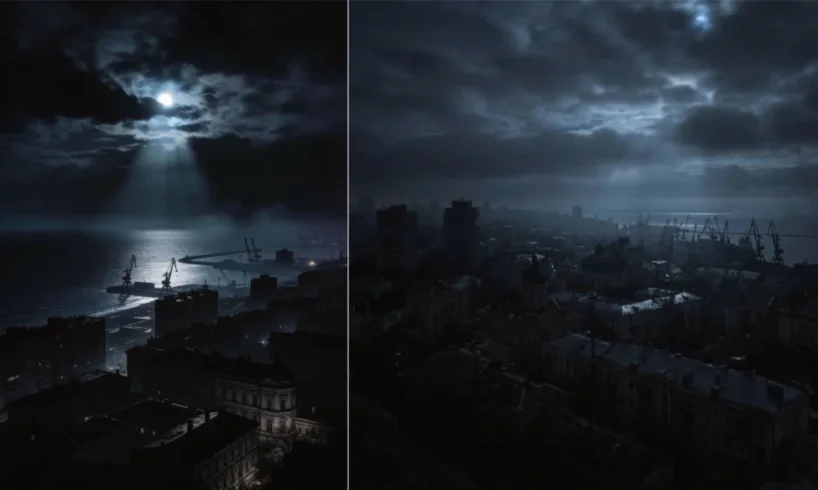
Blackouts are nothing new for wartime Odesa. After previous strikes, one or two districts might lose power while repair crews worked through the night. This is different. I took this photo from my apartment on Friday night. Across the city, neighbors saw the same thing—flames on the horizon, the only light breaking the darkness.
When the sun sets now, the entire city sinks into complete darkness. The only lights visible are the dim glows of shops and restaurants running on generators—and those close early, fuel being precious.
Potable water disappeared from supermarket shelves within hours of the attack. It’s only now, four days later, that bottles are gradually returning to meet demand.
The free public water distribution points—pumps drawing groundwater with the help of generators—have seen lines stretching for blocks, residents clutching every container they could find at home.
How 1 million people cope
Ukraine’s network of Resilience Centers—warming points where people can charge phones, power banks, and other devices—has become a lifeline. Odesa has 410 of these centers operating. Supermarkets across the city now offer free charging stations for small electronics, their generator-powered outlets surrounded by clusters of phones.
Odesa residents gather at a Resilience Center to charge devices and warm up. Composite photo: Author
Odesa residents charging electronic devices at Tavria V and ATB supermarkets during the city-wide blackout. Composite photo: Author
Cooking at home requires preparation: those who stockpiled gas cartridges and portable burners beforehand can manage. With refrigerators useless, many have turned balconies and window ledges into improvised cold storage, bags of food dangling outside apartments in the December chill.
Others simply order takeout or dine at restaurants—Odesa has no shortage of these for every budget, and the ones with generators remain packed. But some ill-prepared businesses were forced to shut down, like my favorite bakery on the corner.
Some residents have advantages. Newer apartment buildings often have stored water reserves, backup power for essential systems, and elevators that operate on emergency schedules. Those in older Soviet-era buildings or the historic downtown have fewer options. The disparity is stark but unremarked upon—everyone is improvising.
And helping each other. “People who got water and power back offer help to others,” one resident wrote. Yesterday someone proposed “rescuing food from refrigerators by gathering at the seaside and cooking it all to music.” Somehow, Odesa keeps its humor.
Emergency response and gradual repairs
Assistance has arrived from Ukraine’s Emergency Service units across multiple oblasts. Tank trucks delivering water are now stationed in every district. Other regions have donated generators to power boiler facilities, racing to restore heat before temperatures drop further.
Ukraine’s State Emergency Service distributes water to Odesa residents during the city-wide blackout. Composite photo: DSES Odesa
According to DTEK Odesa Electric Networks, as of 15 December power engineers had restored electricity to nearly all critical infrastructure in Odesa and the surrounding region, plus another 84,800 households.
Workers repair damaged electrical infrastructure in Odesa after Russian strikes on 13–14 December 2025. Composite photo: DTEK Odesa Electric Networks / Facebook
More connections are expected through the week, though full stabilization of the grid remains distant. Odesa will likely operate under strict electricity distribution schedules for weeks to come.
A city that refuses to stop
Odesa has always been known for its resilience and entrepreneurial spirit, and even four days into complete blackout, that reputation holds. Most supermarkets and shops remain open. Restaurants are serving customers. Public transport—everything except the electric trams—continues running.
The port, despite heavy strikes, withstood the attack; ships still ride at anchor in the harbor, and maritime trade, though reduced, continues.
Schools opened today on generator power, with lessons cut to 30 minutes to fit the shortened winter daylight. Teachers and students are adapting the way everyone else has—without complaint, because complaint changes nothing.
This is how a predominantly Russian-speaking city responds to Russia’s attempt to freeze it into submission. Odesa and its people have proved their resilience against adversity once again.
But the future of this city—like so many Ukrainian towns and villages—hinges on what comes next: the terms of eventual negotiations, the resolve of Western allies, and whether the democratic world can muster even a fraction of the resilience that Ukrainians display every day.
If it could, the negotiating terms would look quite different from what we’re seeing today. For now, Odesa waits for the lights to return—and keeps moving in the darkness.
Read also:
Russian drones strike Odesa’s power grid again, injuring seven civilians
Over 450 drones and 30 missiles hit Ukraine’s south in overnight attack on energy grid
(function(w,q){w[q]=w[q]||[];w[q].push([“_mgc.load”])})(window,”_mgq”);