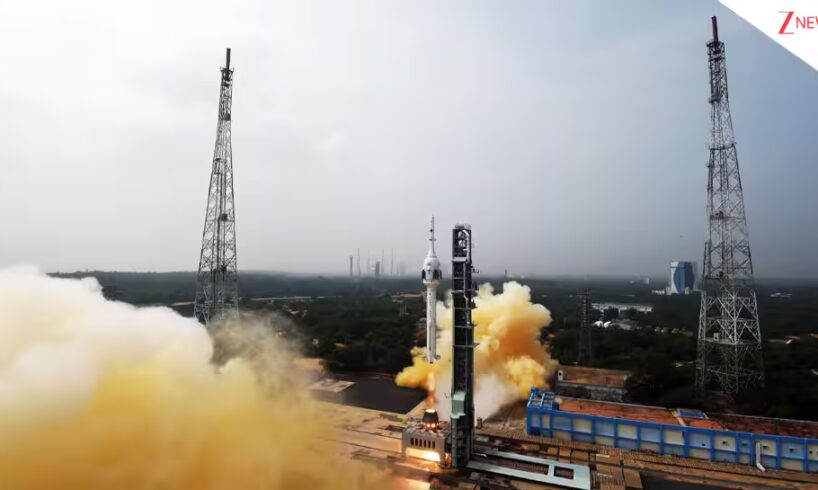
As India prepares to send its own astronauts into space under the Gaganyaan mission, one silent but crucial process stands above everything else — human-rating. Rockets like LVM-3 have already proven they can safely carry satellites, but carrying humans is a completely different challenge. When human lives are involved, even a small risk becomes unacceptable, and failure is no longer just a technical issue, but a human tragedy. This is why human-rating matters so deeply.
Human-rating means designing, testing and approving every space system to be safe enough for people. It covers the rocket, the crew capsule, and all systems that keep astronauts alive. It is about ensuring that risk stays within very strict limits when humans are on board. As Unnikrishnan Nair S., former VSSC Director and founding Director of the Human Space Flight Centre (HSFC), Bengaluru, explained to The Hindu, the goal is not to eliminate risk completely — which is impossible — but to keep it within clearly defined safety boundaries. According to NASA safety standards, the maximum acceptable risk of a major accident that could lead to loss of astronauts is just 0.2% during the most dangerous phases — launch and return.
To achieve this, engineers add multiple layers of safety. For example, instead of one flight computer, a human-rated rocket carries three or four computers, so if one fails, the others instantly take control. The rocket also has a powerful crew escape system, which can pull the crew capsule away in seconds if something goes wrong during launch. Inside the capsule, a reliable life-support system ensures clean air, correct pressure and a safe environment. Every part is tested again and again, checked in detail, and documented carefully — far more than what is done for rockets that carry only cargo.
Add Zee News as a Preferred Source
Human-rating is difficult mainly because reaching space is extremely violent and unforgiving. A rocket must break free from Earth’s gravity in just 8 to 10 minutes, accelerating to about 28,000 kmph. During this short time, it faces intense shaking, extreme heat, and huge physical stress, especially at the point where air pressure and speed together put maximum force on the rocket body. There is no room to slow down, turn back, or land safely.
This is very different from a passenger aircraft, which usually has two engines, flies smoothly at under 1,000 kmph, and has large safety margins. If one engine fails, the aircraft can continue flying on the other, and if needed, glide to a nearby airport. Because of this difference, even the most reliable rockets succeed only about 98–99.5% of the time, while commercial aircraft are far safer, with roughly one fatal accident in about 1–2 crore flights.
That is why only a handful of rockets in the world are certified to carry humans. Today, just three rockets regularly fly astronauts into Earth’s orbit — Russia’s Soyuz-2, China’s Long March-2F, and SpaceX’s Falcon-9. In the US, the Atlas V carried astronauts in a test mission in 2024 using Boeing’s Starliner, but it is still awaiting final approval for regular crew flights after technical reviews. NASA’s Space Launch System (SLS) is also certified, but so far has flown only one uncrewed mission, and is now preparing for its first human flight.
Different countries have different authorities for human-rating. In the United States, NASA gives the final approval for astronaut safety, even for private missions like Crew Dragon and Starliner. The FAA only ensures public safety on the ground, not astronaut safety. In China, the China Manned Space Agency (CMSA) certifies human space missions, while in Russia, Roscosmos approves the Soyuz system.
History shows how tough and unforgiving human spaceflight is. Soyuz has flown over 150 human missions since 1967, with an overall success rate of about 98%. After early tragedies in 1967 and 1971, safety was drastically improved. Since then, Soyuz has maintained a 100% crew survival record, and its escape system has saved lives multiple times. The US Space Shuttle flew 135 missions with two tragic losses, while SpaceX’s Falcon-9 with Crew Dragon has so far achieved a 100% success rate in 20 human missions, including private missions like Axiom-4, piloted by Indian astronaut Subhanshu Shukla. China’s Shenzhou programme has also shown strong safety, with all crews returning safely even after facing challenges like space debris damage.
The reason most rockets are not human-rated is simple — safety costs money and performance. Human-rating makes rockets heavier, more complex, and more expensive. Extra systems reduce payload capacity and increase launch costs. For cargo missions, the priority is maximum load at minimum cost, not human safety. Adding human systems would make such launches uneconomical.
For Gaganyaan, India has chosen the LVM-3, its most reliable rocket. ISRO has strengthened the rocket, added extra backups, improved engine reliability, and built a fast crew escape system. Once certified, it will be renamed HLVM-3. With seven consecutive successful flights, including Chandrayaan-3, and fully Indian engines like Vikas, C25 cryogenic engine, and S200 boosters, the rocket reflects India’s push for Atmanirbhar Bharat.
Human-rating may be invisible to the public, but it is the strongest shield protecting India’s astronauts. It turns ambition into responsibility — and dreams into disciplined reality.
(Girish Linganna is an award-winning science communicator and a Defence, Aerospace & Geopolitical Analyst. He is the Managing Director of ADD Engineering Components India Pvt. Ltd., a subsidiary of ADD Engineering GmbH, Germany.)