Russian forces are hunting Ukrainian uncrewed surface vessels at sea and from the air. Meanwhile, US and European actors are scrambling to get their hands on the technology, as evidenced by discussions in offices, at exhibitions and during trials.
The force behind this success are Ukrainian-made unmanned Magura boats – inconspicuous, fast, manoeuvrable and deadly to the enemy. In just two years, they have rewritten the rules of modern naval warfare.
The appearance of these vessels took the Russian Black Sea Fleet by surprise. Russia could hardly have imagined that Ukraine, with almost no ships of its own, could push its forces from Zmiinyi (Snake) Island and Odesa all the way to Novorossiysk. Even there, Russian warships are suffering relentless attacks.
Advertisement:
The success of each mission rests with engineers and military personnel who have honed their skills to a level that enables them to inflict the heaviest losses on the Russians. These experts have been assembled in “Group 13”, a specialised unit within the Defence Intelligence of Ukraine (DIU).
The special unit is led by an officer who goes by the alias “Thirteen”. Thirteen’s special forces unit has destroyed two dozen Russian assets at sea and in the air.
Thirteen, Commander of Group 13
Photo: Ukrainska Pravda
Recently, DIU showcased its modernised naval drones to Ukrainian and foreign journalists. Thirteen outlined the combat history and how tactics for deploying Magura drones have evolved over the past two years.
Ukrainska Pravda attended the briefing and highlighted the key points from the commander’s account.
The Magura family adapts to new tasks
These kamikaze marine drones were first used in the western Black Sea, where the Ukrainian special forces struck Russia’s reconnaissance ship, Ivan Khurs. Strikes on Russian warships have gradually pushed eastward since then.
In February 2024, Group 13 ambushed and sank the Russian missile boat Ivanovets as it patrolled the waters of Donuzlav, Crimea’s deepest lake.
In just 13 days, the special forces destroyed the large landing ship Tsezar Kunikov near Alupka. Thirteen recalls that the unit had a completely different target that night, but new intelligence revealed a Russian ship moving right into a flock of Magura drones. Operators quickly redirected the drones, and the Tsezar Kunikov came within range of the Ukrainian boats on its own.
A Magura V5 kamikaze sea drone
Photo Ukrainska Pravda
Advertisement:
Thirteen said that one of the most emotional operations of the war was the destruction of the corvette Sergei Kotov in the Kerch Strait in early March 2024. The Russian ship had been manoeuvring between civilian vessels in an attempt to evade pursuit. This proved futile, as five kamikaze boats first immobilised the corvette and then sank it.
Over its few years of use, the Magura V5 has undergone numerous improvements. Group 13’s commander said this model has been thoroughly tested and is virtually fail-safe for special forces operations.
Group 13 experts analyse each target in detail before missions. Modular design enables the unmanned boats to be rapidly adapted for any task.
The market price of a Magura V5 boat is around US$250,000. Thirteen emphasises, however, that his unit acquires them at a significantly lower cost.
A Magura V5 maritime kamikaze drone
Photo: Ukrainska Pravda
In 2024, Russian forces began using helicopters and warplanes to detect, track, and destroy maritime drones. This revolutionised the fight against the unmanned vessels at sea and disrupted Ukrainian missions.
Group 13 experts were then tasked not only with destroying ships but also with hunting down Russian aircraft.
To counter the aerial threat, the unit developed tactics using swarms of multi-purpose drones. Ukrainian engineers mounted a machine-gun turret on a catamaran-style hull, creating the Magura V6 to destroy helicopters. The hull design enhances stabilisation for the combat module and enables accurate short-burst fire.
An exhibition model of the Magura V6 unmanned drone equipped with a combat module
Photo: Ukrainska Pravda
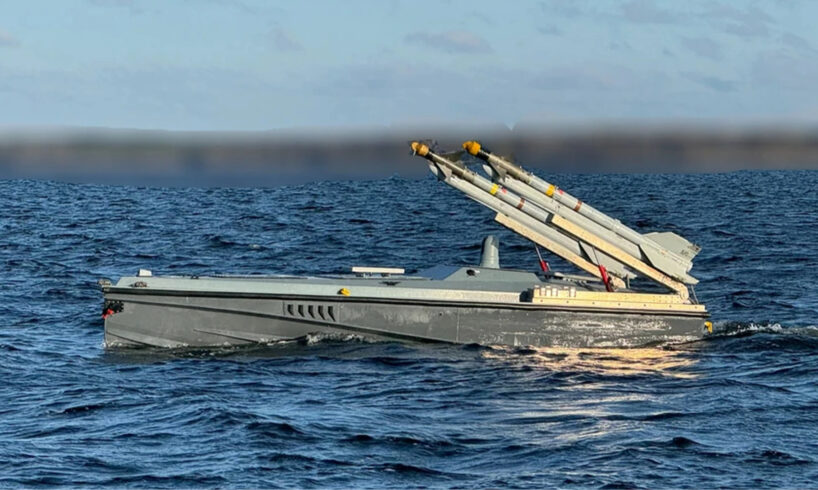
Shortly after, engineers began integrating air-to-air missiles, giving rise to a drone armed with R-73 missiles. On 31 December 2024, naval drones equipped with these missiles shot down two Mi-8 helicopters and damaged a third.
In May, the new Magura V7 drone, armed with AIM-9 Sidewinder air-to-air missiles, made its sea debut, shooting down two Russian Su-30 fighters.
“At first, helicopters posed a critical threat and made our work difficult”, said Thirteen. “But to counter them, boats armed with turrets and missiles were developed. After that, the enemy stopped using helicopters against us altogether, realising they had become easy targets for our missiles.
We set the conditions of engagement, forcing them to adapt and deploy aircraft instead. But those too proved unsuccessful.”
A Magura V7 marine drone armed with AIM-9 Sidewinder missiles
Photo: Ukrainska Pravda
Thirteen emphasises that today, Magura is a versatile platform, capable of more than just combat. For example, it can serve as the basis for boats designed to extinguish fires in ports or tackle burning ships in the roadstead.
How are the Russians responding?
The most effective way to detect uncrewed surface vessels is from the air. To achieve this, Russian forces are deploying nearly all their aviation platforms in Crimea. Transport planes, maritime aircraft and fighter jets are actively searching for drones, but pilots are now hesitant to fly close enough to engage them.
“Today, planes no longer approach our boats directly because they know there’s a serious risk of being shot down,” Thirteen said. “Sometimes they attempt strikes from a distance, but in most cases, bombs and missiles miss their targets. They often run out of ammunition and return to base empty-handed.”
As an alternative to manned aviation, Russian forces have begun deploying reconnaissance UAVs and first-person view drones. Thirteen describes this as an effective measure, but one that is not posing a critical threat to the Ukrainian military.
Chevron of Group 13
Photo: Ukrainska Pravda
Brothers-in-arms from “Prymary” (Phantoms), another DIU unit, contribute significantly to the success of Group 13’s missions. Although each unit plans its operations independently, Prymary’s systematic raids on Crimean airfields destroy Be-12 naval aircraft, An-26 transport planes and fighter jets, further limiting Russian attempts to track the deployment and numbers of uncrewed surface vessels.
In early December, Prymary destroyed a Russian Orion reconnaissance drone that had been patrolling the Black Sea.
The uncrewed vessels can also assist Prymary operatives in striking ground targets. At least two models of unmanned surface vessels (USVs) capable of carrying quadcopters and fixed-wing UAVs are documented in Sea Battle: The Age of Drones, a film by Ukrainian serviceman and journalist Artem Shevchenko.
Advertisement:
Radars can detect Magura, but only when it’s too late
Their small size and sleek design make Magura drones extremely hard to detect with ship or ground-based radars.
Thirteen emphasises that shipborne radar systems typically detect drones only a few kilometres away. From that moment on, the clock starts ticking for Russian sailors.
Ground-based radars also lack sufficient sensitivity, forcing Russian forces to rely on passive defence systems at their bases. Chief among these are boom barriers – floats fitted with chains and nets placed across bay entrances to block access. Drone operators, however, have learned to overcome such obstacles: special forces identify the weakest points in these barriers and jump over them at speed.
Sometimes, the Russians send barges and old ships out to sea as part of their passive defence systems. If the operator determines that a drone cannot pass through such a barrier, they command the first drone in the attacking group to detonate, thereby clearing a path for the others.
One of the most striking examples of bypassing physical barriers came during a Black Sea operation in temporarily-occupied Crimea, where DIU drones leapt over the buoy barrier in Vuzka Bay before targeting and destroying several Russian speedboats at the berths.
“The Russians use electronic warfare to protect their facilities, but we are developing countermeasures”, said Thirteen. “We analyse each facility to assess the threats and equip the drone for the specific task accordingly.”
Advertisement:
Thirteen at a console for controlling a Magura drone
Photo: Ukrainska Pravda
Asked by the journalists whether the Russians are using unmanned boats, Thirteen said they have carried out several successful operations. However, marine drones are not widespread among Russian forces, as it is far more difficult for them to find suitable targets.
Group 13 is already dealing with a similar challenge. With almost no Russian warships at sea, the main forces of the Black Sea Fleet have been confined to Novorossiysk or the Sea of Azov, areas that are difficult to reach. As a result, DIU is now focusing on other key Russian targets and limiting its fleet’s ability to venture far into the sea.
“During one of our recent attacks on Novorossiysk, the Russians shot up a bunch of their own buildings in an attempt to destroy our boats. For us, this shows that the loss of new ships in the Black Sea is incredibly critical for them”, said Thirteen.
Thirteen noted that a new stage of naval combat is imminent: clashes between unmanned boats equipped with different types of weapons. Ukrainian engineers and Group 13 operators are already gearing up for it.
Translation: Artem Yakymyshyn
Editing: Shoël Stadlen