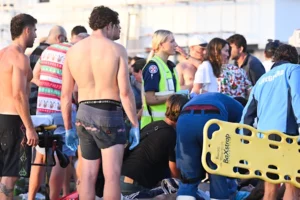
The attack on Sydney’s Bondi beach that killed at least 15 people brutally interrupted one of the first of 15,000 public lightings around the world of a menorah, a multi-branched candelabrum central to Judaism, to mark the start of the eight-day Hanukah festival. The annual global lightings are organised by the Chabad-Lubavitch movement, a branch of Orthodox Hassidic Judaism whose visibility as a vibrant, open and outgoing community appears to have made it a target for hate.
What is the Chabad-Lubavitch movement?
The website for the “Chabad of Bondi” simply states: “Where everyone feels at home”. It is a global organisation that aims to strengthen Jewish life by providing religious, educational, social and cultural services but it has roots in the 18th century in a Russian town called Lubavitch. The word “Chabad” is a Hebrew acronym for its three pillars: chochmah (wisdom), binah (comprehension) and da’at (knowledge). The philosophy of the movement is based on the teachings of its seven leaders, known as rebbes, on “Jewish mysticism”, a tradition that seeks a deeper understanding of God through meditation, textual study and contemplation. Its members were persecuted under the Soviet Union and the community was nearly entirely wiped out in the Holocaust. They rebuilt out of New York. Today the movement has about 6,000 “emissaries” across the world who represent it, and 3,500 “Chabad houses”, which act as synagogues and community centres. It is deeply traditional in some respects, with male followers tending to wear the black-and-white clothing of ultra-Orthodox Jews, and women generally covering their natural hair with scarves or wigs, but it is also known as non-judgmental and open to Jews of all backgrounds, with a focus on an individual’s inherent goodness, rather than their level of observance.
Why was a lighting of a menorah organised at Bondi beach?
Every year since the early 1970s, the Chabad has organised public lightings in city squares and parks in an attempt to encourage Jews to celebrate Hanukah, a relatively minor holiday in the Jewish calendar when on eight consecutive nightfalls, family and friends gather to light one additional candle in the menorah to commemorate the “miracle of light in the temple”. The story goes that when the Jews won a battle against the Greeks 2,000 years ago to practise their religion freely, an oil lamp that had one day’s worth of oil was ablaze for eight. At the annual modern-day lighting in Sydney, which is home to a large Jewish community, there is usually a petting zoo, face painting and box after box of free jelly doughnuts. About 2,500 donuts were distributed last year. Approximately 1,000 people had come to Bondi on Sunday for the celebrations.
Was this the first attack targeting the Chabad-Lubavitch?
There is a long and sad history of attacks on its members. In 1994, Lebanese-born Rashid Baz shot at a van of 15 Chabad-Lubavitch students who were travelling on the Brooklyn Bridge in New York City, killing one and injuring three others. In 2008, a Chabad house in Mumbai, India, was a focus of the terrorist attacks that struck 10 sites in the city’s tourist and business districts, including the Trident, Oberoi and Taj hotels. Rabbi Gavriel Holtzberg and his wife, Rivka, and four other people were killed after being taken hostage. And last November, an Israeli Chabad rabbi, Zvi Kogan, an emissary to Abu Dhabi, was abducted and killed. Three Uzbek nationals were subsequently sentenced to death for what an Abu Dhabi court called a “premeditated murder with terrorist intention”.
Did the attack on Bondi beach lead to lightings being cancelled?
An event in Melbourne was cancelled but others across the world continued, with some lightings “doubling in size” because of the Bondi beach shooting, Chabad’s leaders said. There were 25 public Hanukah celebrations in Manhattan alone. Rabbi Mendel Silberstein, of Chabad Lubavitch of Larchmont and Mamaroneck in New York City, said in a statement: “Chanukah teaches that we do not respond to darkness by retreating.”