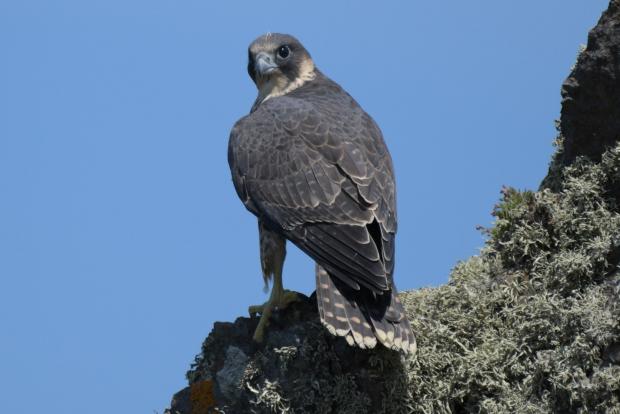
The first park-wide survey examining the number of peregrine falcons across its area revealed the number of breeding pairs has slumped by 56 per cent since 2002.
It leaves just 31 pairs in the entire park, with only six pairs left in its Highland area compared to 19 recorded in 1981 – a 68 per cent decrease.
Worryingly, less than half of the Park’s territorial pairs successfully fledged young in 2024.
The study points to various potential reasons: changing land use, decreased food supply, disease and, it adds, wildlife crime.
Ian Thomson, head of investigations at the RSPB Scotland, who has spent nearly two decades documenting raptor persecution, fears the prime threat lurks within the national park’s grouse moors.
Golden eagle nest in Cairngorms National Park (Image: Mark Hamblin)
“I’m not suggesting other factors like climate change and Avian influenza are not important,” he stresses, “but illegal killing is absolutely playing a part.
“We are talking about an area – particularly on the eastern side – where food supply for birds of prey is abundant.
“Peregrine falcon will eat grouse.
“Unfortunately, some land managers see them as a threat to stocks of game birds, and we know species such as golden eagles, hen harriers and peregrines receive pretty short shrift in some areas.”
He adds: “We only ever detect a fraction of persecution incidents anywhere.
“Those killing birds of prey make efforts to cover up the killing. They are not going to leave the body of a dead bird lying about for someone to stumble across.”
When Cairngorms National Park Authority posted details of the research on its Facebook page, followers’ comments highlighted the divisions between those who place the blame at the park’s grouse moors, and those who point to other factors.
Read more:
Some pointed out the Avian flu death of a peregrine falcon chick, one of two hatched to a pair in the urban setting of University of Glasgow, others suggested bird of prey protection laws meant too many predators and not enough prey.
According to RSPB’s Bird Crime 2023 report, spanning 15 years of research, Scotland accounted for 400 out of the UK’s total of 1529 bird crime incidents, with birds shot, trapped and illegally killed including golden eagles, hen harriers and white-tailed eagles.
It claims 75 per cent of UK incidents were connected to the gamebird shooting industry.
Scottish incidents included the discovery in April 2020 of a rare white-tailed sea eagle within the national park’s area in Donside, Aberdeenshire, which was found to have been poisoned.
The following March, a satellite tagged golden eagle found dead at Invercauld Estate was confirmed as having been poisoned.
A golden eagle was found dead beside a hare baited with poison on Invercauld Estate, in the heart of the Cairngorms, in March 2021 (Image: RSPB)
The estate’s CEO, Angus McNicol, CEO said: “The death of a golden eagle about five years ago occurred on a farm owned by the estate and let to a tenant.
“It was a very concerning incident which was entirely detrimental to the estate’s interests. The area concerned is part of a successful naturally regenerating Scots pine and birch woodland.
“In a survey on Invercauld Estate in 2019, in total 1,117 breeding pairs of red and amber listed – the most endangered – birds were identified, an increase of 16% on the results from the previous year.
“The figures included 33 pairs of raptors, covering six different species. This rich diversity of rare birdlife is very important to us and is a demonstration of successful upland management for both people and nature.”
Last August, an osprey was found with gunshot wounds in the Glen Doll area on the opening day of the grouse shooting season which led to it being put down.
Elsewhere, the search continues in Dumfries and Galloway for two golden eagles named Tarras and his mate, Wren, that went missing in late August in hills to the north of Langholm.
Their disappearance followed the 2023 illegal killing of golden eagle Merrick, shot dead while sleeping at a roost site in the Moorfoot Hills, and the more recent loss of a satellite-tagged hen harrier called Red.
Grant Moir, chief executive, Cairngorms National Park Authority (Image: Cairngorms National Park Authority)
Back in the Highlands, Grant Moir, chief executive of Cairngorm National Park Authority, says while it’s too difficult to point to any single factor behind the drop in peregrine numbers: “There’s no doubt that there’s still persecution that takes place.
“There was a peregrine found shot just outside the park boundary around 18 months ago. It still goes on,” he adds.
“But it can’t be the only factor. Avian flu has had in impact not just across the peregrines, and prey availability will also be a part.”
Far Ralia, Cairngorms National Park (Image: NQ)
According to Rewilding Britain, around 44 per cent of Cairngorms park territory comprises driven grouse moors.
He adds: “It’s not a non-controversial area. It’s not about saying ‘that type of land management, or this type’. You can run a grouse moor and still have peregrine falcons on your land.
“The key thing is that if they are declining, it shouldn’t be because of persecution. We should be able to stamp that out.
“That’s why we are looking at things like more tagging, nest cams, ringing – to try to stamp it out as much as we can.”
Ian at RSPB Scotland says while satellite tracking technology has revolutionised understanding on raptor crime, it offers only limited information.
Read more:
“It was never intended for crime detection, satellite tags were introduced to understand the movements of birds. But what it’s shown is where birds are dying or disappearing.
“That has proved to be a real eye opener which has started to put a scale on the level of persecution that we didn’t have before.
“I can sit at my desk and see where golden eagles and hen harriers spent last night where they are today.
Red, a young hen harrier fitted with a satellite tag, went missing in Dumfries and Galloway last year. (Image: RSPB)
“I can also see if a tag that is functioning perfectly suddenly disappears, which is when alarm bells start going off.
“We might not be seeing the bodies of birds, but we see very clear evidence in data and attempts made to cover up the evidence: we found a satellite tag wrapped in lead and thrown in a river, and another wrapped in foil and thrown in a loch.
“Others have been buried – clear attempts to cover up evidence of the crime.
“Technology is also changing for those who want to kill birds of prey,” he adds.
“Rather than doing it in the middle of the day, they can wait until 2am and go out with a thermal imaging and shoot a bird right out of a tree.
“If it’s not got a tag, then who is going to know?”
A spokesman for The Scottish Gamekeepers Association said: “Peregrine numbers in the countryside have been dipping for some time. It is clearly multifactorial and not restricted to the Cairngorms National Park.
“We are pleased to see reductions in wildlife crime overall in Scotland. Our policy on this issue is clear. If one of our members is convicted of a wildlife crime, they are removed from the organisation.
“Species conflicts do occur, whether foxes and hens, gulls and humans or raptors and prey species. What we advocate, to minimise or prevent problems, is a workable legal licensing system to resolve conflicts.
“That is where we need to get to. Indeed, better use of licensing mechanisms was a recommendation from Professor Werrity’s review of grouse shooting.
“That is important. What is a dangerous road is if people get to a position where they feel they have no legal options at all.
“Regrettably, it is more likely, in that type of scenario, that people make the wrong choices; choices that are costly for wildlife and themselves. No one wins from that.
“Legal solutions are the only way.”
And at Scottish Land & Estates, director Ross Ewing says that while concerning, the reported decline in the peregrine population within the Cairngorms National Park reflects a wider trend observed in the Scotland and UK-wide populations over the last three decades.
“Regional moorland groups operating in the national park have, for the last five years, undertaken annual transect surveys to better understand the population dynamics of a variety of raptors, including peregrines.
“Gamekeepers involved with these groups are committed to raptor conservation, evidenced by the increasing numbers of other species (including the golden eagle).
“The report points to a range of potential drivers for the reported decline, including avian influenza, interspecific competition with other species and prey availability. Land managers concur with these suggested drivers, along with the impact of harsh weather on breeding productivity and habitat change linked to increasing afforestation.
“Wildlife crime is also referenced but care should be taken when drawing inferences about raptor persecution related to grouse moor management.
“Scotland’s official wildlife crime report shows that between 2021-2023, there were 19 offences against peregrines recorded in Scotland.
“However, none of these incidents took place within the Cairngorms National Park, and the vast majority were linked to the illegal laundering of peregrines in the Lothians and Scottish Borders.”
Meanwhile, Ruth Tingay of campaign group Raptor Persecution UK, fears upland land management practices, particularly land managed for intensive driven grouse shooting remains “a serious issue affecting peregrines and many other raptor species in Scotland.”
“They are perceived as a threat to gamebird stocks – red grouse.
Cairngorms National Park (Image: NQ)
“Even though they’ve had legal protection (on paper at least) since 1954, these crimes continue.
“Those who kill raptors will go to great lengths to hide the evidence to avoid detection, so whatever cases are detected are typically considered to be the tip of the iceberg.”