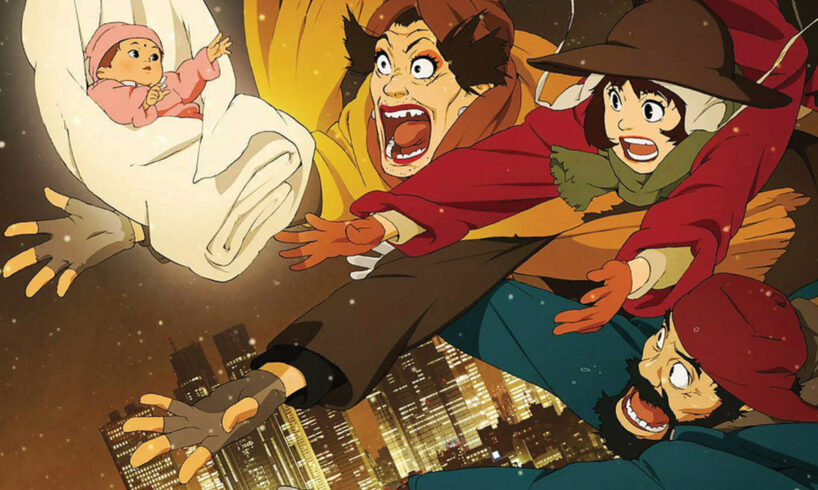
Released nearly a quarter of a century ago, Satoshi Kon’s tragicomedy adventure anime Tokyo Godfathers (2003) is as important and hard-hitting now as when it first came out — which, admittedly, is something of the director’s calling card. The movie tells the story of three homeless people who find an abandoned infant on December 24. While that sounds like the recipe for the most mushy, forced tearjerker ever, it is, in fact, one of the greatest Christmas movies ever. Here’s why:
ALL the Christmas Tropes
Understanding Christmas in Japan
Japan doesn’t really do Christmas. December 24 and 25 here is basically a couple’s holiday, a sort of Valentine’s Day 2: Cupid’s Revenge. The country does have a celebration that feels like Christmas, though: New Year. Called Oshogatsu, it’s when Japanese families get together, forgive old grudges, eat seasonal food and put up special decorations. It’s an all-around magical time, which explains why Tokyo Godfathers ends on New Year’s Day with the three protagonists — Gin, Hana and Miyuki — reuniting the abandoned baby with her parents (technically a spoiler but this is a movie where the journey is more important than the destination.)
And yet, for its undeniably Japanese character, the anime manages to cram seemingly every known Christmas movie trope into about 90 minutes of runtime. Tokyo Godfathers kicks off at Christmas Eve with a nativity scene and a Christian sermon, and before it ends, it hits you with Twelve Days of Christmas-worth of religious themes like miracles, rebirth and salvation through the grace of a purer being. It’s all handled very delicately, though, with no indisputably supernatural elements or evangelizing. The movie is ultimately secular.
But Christmas tropes don’t have to be spiritual, and Tokyo Godfathers has those as well, from musings on found families to mutual help, charity and amazing coincidences that feel otherworldly but could just as easily be written off as luck. Tokyo Godfathers admittedly doesn’t feature a career woman from the big city throwing it all away for a small-town lumberjack or something, but those are the beats of Christmas romance stories, so don’t expect to find them here.
The Die Hard of Christmas Anime (but Better)
Forget Die Hard. Tokyo Godfathers is THE action Christmas movie on account of it using Christmas as more than just a jolly background for people shooting each other. As previously discussed, Tokyo Godfathers is chock full of authentic Christmas moments, which is why it’s so surprising that it also manages to find space for legitimately heart-pumping action scenes. Though maybe that should be expected from a film inspired by John Ford’s 1948 western 3 Godfathers.
Without giving too much away (because here it would be ruining the journey), on their quest to find the infant’s parents, Gin, Hana and Miyuki get involved with gangsters, an assassination attempt, gunplay and puddles of blood. Ultimately, Tokyo Godfathers can’t be called an action movie per se, but its action sequences are powerful stand-out moments because they appear suddenly after scenes of silence, stillness or just people talking.
Going back to the Die Hard comparison, a pivotal scene in the movie even takes place on a rooftop and features characters swinging dangerously over the edge in what may have been a very sneaky tribute to the Bruce Willis movie. Probably not, but it’s worth mentioning that Tokyo Godfathers does also involve people who screwed up their marriages, which is another important detail of Die Hard. Again, though, the anime isn’t an action film, but it’ll definitely scratch an itch for fans of the genre all while bleeding red and green from the Christmas-infused story.
Echoes and the Invisibility of Tokyo’s Homeless
Throughout most of the film, Gin, Hana and Miyuki fade into the background of Tokyo life, occupying a kind of parallel space hidden behind the colorful billboards and neon signs. The plot, storyboarding and camerawork are works of art constantly centering the characters as people from another world who are only noticed when they enter the domain of “normal” people, like when they board a train and get scolded for their smell.
Many times, the homeless trio are barely treated as humans. There are decent characters in Tokyo Godfathers, but society as a whole does not come off smelling of roses in Kon’s Christmas movie. Ultimately, Gin, Hana and Miyuki are invisible because society does not look for them despite or perhaps because the trio is just like them, which the film explores through the use of echoes.
During Tokyo Godfathers, the name “Kiyoko” keeps repeating. It’s first given to the abandoned infant, inspired by the Japanese title of Silent Night, but then turns up again and again through various characters. Additionally, scenes of one character saying something off the cuff only for an unrelated person to later do it or multiple characters abandoning their families are found throughout the film. These symmetries link humanity as a whole, erasing the differences between the homeless trio and the people around them. They are us, and we are them, and the main difference between us is more dumb luck than most would be comfortable admitting.
In the end, Tokyo Godfathers celebrates the magic of the holidays while also entertaining action junkies, but it is not a movie for putting on in the background. To get across everything that it has to say, it demands your undivided attention, which it rewards with one of the greatest, most action-filled and profound Christmas movies ever.
Related Posts
Discover Tokyo, Every Week
Get the city’s best stories, under-the-radar spots and exclusive invites delivered straight to your inbox.
Updated On December 15, 2025