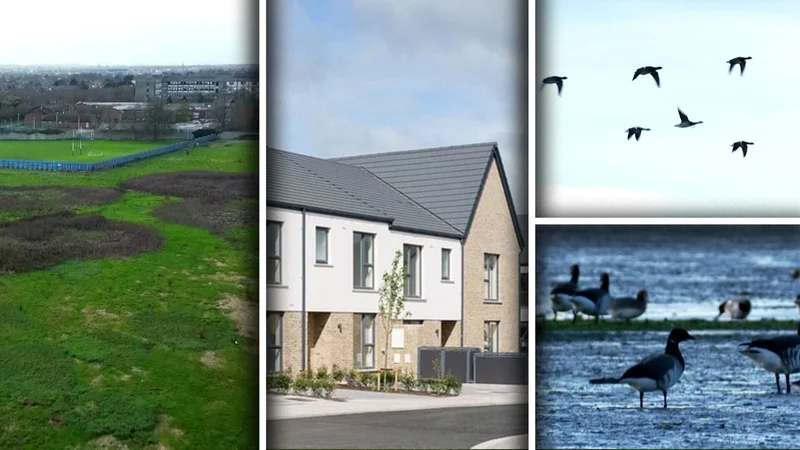
An unpublished report commissioned by Dublin City Council has identified hundreds of feeding sites used by light-bellied brent geese across the county.
The interim study, obtained by Prime Time, is intended to act as a planning framework to help local authorities permit housing development across Dublin, while meeting conservation commitments to the protected species.
To date, the construction of roughly 1,200 homes has been halted due to potential impacts on the birds’ feeding sites.
Under Irish and EU law, the State must protect the birds’ habitats. Enforcement of this conservation law has led to several planning rejections, leading to some claims that decision-makers are prioritising birds over people during a housing crisis.
The unpublished DCC survey identifies 442 feeding sites used by light-bellied brent geese across Dublin, with 265 locations found to be “consistently” used “during most winters.”
It also ranks the most important “50 land parcels” within Dublin for feeding, finding that 20 were located in Fingal, 19 in Dublin City, 11 in Dún Laoghaire–Rathdown, and none in South Dublin.
BirdWatch Ireland’s Helen Boland says Ireland plays a critical role in the species’ survival, with around 95% of the global population – approximately 30,000 birds – migrating here from the Canadian High Arctic between October and April.
What they eat here not only sustains them on their 4,000km journey back to Canada, she told Prime Time, but “fuels their entire breeding success in the Arctic.”
Helen Boland, BirdWatch Ireland
The purpose of the study is to give planners a way to prioritise the sites, so that when an application is made, they can approve sites of lesser importance and reject those that are important for the birds’ feeding needs.
However, only the interim phase of the research has concluded. Two more of years of data gathering in each of the four Dublin local authorities during winter months will be required to bring it to completion.
To date, only Dublin City Council has begun tendering for this next step.
The Irish Planning Institute’s Gavin Lawlor, who is also a director at the planning consultancy, Tom Philips and Associates, welcomed the new survey but is critical of the length of time it is taking to complete.
“It’s one of many symptoms that have led us to the housing crisis,” Mr Lawlor told Prime.
He said the need for a survey has been evident since 2017 when concerns were first raised about the adverse impact on brent geese in developing the St Paul’s College site in Raheny, North Dublin.
It was also evident, he says, in 2021 when the new Dublin City Development Plan was being drawn up and land was being rezoned for residential purposes in areas where the geese were potentially affected.
“It’s not about birds versus people. It’s about getting the correct balance between development and the environment,” he said.
“Brent Geese are a key protected species, but the frustration that’s happened is due to a lack of data, that people have taken the precautionary principle.”
Last month, after a decade-long battle, the plan to build 580 apartments and a 100-bed nursing home at St Paul’s College was defeated, primarily because of concerns that the site was an important inland feeding ground for the geese.
An Coimisúin Pleanála concluded that “adverse impacts” on the geese’s habitats “cannot not be ruled out” and therefore “the precautionary principle” was applied.
While St Paul’s College is the highest-profile case where there’s been a clash between the needs of geese and developers’ plans, there are many more according to Mr Lawlor.
“Anywhere with short grass within approximately five to six kilometres of Dublin Bay has a risk of being affected,” he said.
Gavin Lawlor, Irish Planning Institute
Ecological surveys are required to assess each site’s importance to the birds once they are observed feeding. But it can be difficult to reach hard scientific conclusions about any site’s importance in isolation, without a county-wide framework.
Under the EU Birds and Habitats Directives, where there’s a doubt about action causing harm to a protected species it must be avoided, so planning is refused.
A review by Prime Time found several recent housing and sports developments, where concerns about brent geese have proved decisive in planning decisions.
In July, the proposed development of 330 homes and 60 assisted living units at the former Cadbury’s pitch-and-put in Coolock in north Dublin was refused planning permission, because the applicant failed to show development “would not have significant effects on the geese beyond reasonable scientific doubt”.
According to Gavin Lawlor – whose company Tom Philips and Associates represented the developer, OTR Development Company – the dispute went on so long that “the grass grew, the birds didn’t like it, they moved away.”
“Now the site is still deemed to be unsuitable for development, unfortunately,” he said.
Also in July, after a long-running planning dispute, Templeogue-Synge Street GAA club was granted permission to rebuild its clubhouse, but only after earlier proposals for a larger development at Dolphin Park – 160 homes and an all-weather pitch – were dropped.
In August, Howth Football Club’s plans to develop an astro-pitch were also turned down by An Coimisúin Pleanála over doubt that it could adversely affect the light bellied geese.
A similar plan to develop an all-weather pitch and other facilities at Martin Savage Park in Ashtown, used by St Oliver Plunketts GAA club and Phoenix Football Club, in a rapidly expanding residential area, is also currently on hold after six years in the pipeline.
The plans were halted in early 2024, after the National Parks and Wildlife Service (NPWS) submitted its views on the case.
In a follow up letter, the Department of Housing described the park as being “ranked among the top 20 inland feeding site used by brent geese in the Dublin area.”
As a result, the Department called for a wider Dublin area survey “to consider the combination effects of other presently mooted developments” on brent geese.
That request ultimately led to the DCC’s unpublished interim report.
Brent Geese in Dublin
While much is known about the feeding habits of light-bellied brent geese, significant information gaps remain, which the new survey is intended to address.
For example, we know that they feed in the early parts of winter. After Strangford Lough in Co Down, the most important feeding areas in Ireland are around County Dublin, including protected habitats at North Bull Island, the River Tolka Estuary, Baldoyle Bay, Malahide Estuary and Rogerstown Estuary, all of which are designated Special Protection Areas (SPAs).
After an initial feeding period on the coast, the geese then move inland.
“As the winter progresses, they have a tendency then to move on to terrestrial grasslands, farmland and amenity grasslands,” according to Helen Boland.
This second phase of their winter feeding that has caused the clash with developers and sports clubs, as the grassland areas where they flock to feed are often sites for development or amenities.
Under EU law, inland sites found to be important for the geese’s feeding cycle are afforded the same level of protection as the designated coastal Special Protection Areas (SPAs).
While the brent geese population around Dublin remains stable, rising by 4% per year according to Bird Watch Ireland’s latest figures, the Irish Wetland Bird Survey prepared for the National Parks and Wildlife Service has warned that this trend could reverse if key feeding habitats are lost, Helen Boland said.
“What needs to be understood now is, what is the ‘tipping point’ beyond which these birds can’t sustain their population here in Ireland? We don’t know what that is,” Ms Boland said.
Although the DCC report remains unpublished and incomplete, the Minister for Heritage, Christopher O’Sullivan has already relied on it to make an important intervention in an ongoing planning consultation over Martin Savage Park.
In a reversal of the Department of Housing’s previous position, Mr O’Sullivan wrote to local Fine Gael TD Emer Currie in October, stating that “the planned works at the park may proceed” as the proposed development “will not have an adverse effect overall in relation to the population of Light Bellied Brent Geese in the wider Dublin area.”
Minister for Heritage, Christopher O’Sullivan
He states that ongoing work and the development of a “survey tool” in relation brent geese “gives NPWS scientific confidence that sustainable conservation population and area targets can be achieved… in the wider Dublin area.”
Local residents’ group The Glens Residents Association, which opposes the park’s development over the geese and flooding risks, has raised concern about the Minister’s intervention based on an unpublished study.
In a statement to Prime Time it said: “Many residents feel there is a strong political push to advance the project while key environmental and flood-risk studies remain incomplete.”
While the planning consultation is ongoing at Martin Savage Park, Birdwatch Ireland’s Helen Boland says “having a well-documented planning tool in place will help speed up the planning process” on all Dublin sites.
But there needs to be greater urgency in completing necessary surveys to make it effective, she said.
“This issue has been building for a long time. It is the responsibility of the local authorities to get moving, so that no more slow-downs are happening in the planning process.
“We don’t want wildlife or biodiversity being negatively affected, but also we want to be able to progress speedily with the necessary developments for people, for sports, for housing,” she said.
The full report from Oonagh Smyth and Tara Peterman will broadcast on the 16 December edition of Prime Time at 9.35pm on RTÉ One and RTÉ Player.