(function(w,q){w[q]=w[q]||[];w[q].push([“_mgc.load”])})(window,”_mgq”);
When Belarus released 123 political prisoners on 13 December—including Nobel Peace Prize laureate Ales Bialiatski—the price wasn’t measured in diplomatic concessions or policy changes. No, it was something much more tangible: potash, a potassium-rich mineral that makes crops grow.
The US agreed to lift sanctions on Belaruskali, Belarus’s state potash monopoly and largest taxpayer, in exchange for the prisoner release.
Lithuania’s Foreign Ministry immediately stated that the EU would not follow, citing Belarus’s “combined hybrid attack” and ongoing support for Russia’s war against Ukraine. But the deal reveals an uncomfortable truth about global agriculture: potassium is irreplaceable, and Belarus controls a huge share of the world’s supply.
Explore further
Lithuania exposes Belarusian false flag scheme to frame Vilnius for hybrid attacks
The irreplaceable nutrient
Potassium is one of three essential nutrients for plant growth, alongside nitrogen and phosphorus. Unlike nitrogen fertilizers, which can be synthesized from natural gas, potassium must be mined from underground salt deposits concentrated in very few places.
Belarus holds approximately 23% of global potash reserves and, before sanctions, produced roughly 20% of the world’s supply, according to US Geological Survey data. There is no synthetic alternative.
“No substitutes exist for potassium as an essential plant nutrient and as an essential nutritional requirement for animals and humans,” the USGS states.
This geological lottery made Belaruskali part of what the US Treasury called “Lukashenka’s Wallets”—companies providing funds to the regime through a patronage network of monopolies, tax breaks, and favorable contracts.
Treasury explicitly described Belaruskali as “a major source of tax revenue and foreign currency for the Lukashenka regime” when imposing sanctions in August 2021.
Why the US blinked—and the EU didn’t
The United States imports roughly 85% of its potash from Canada alone—an extreme dependency unmatched by any other major importer, according to US Census Bureau data cited by Argus. Before sanctions, Belarus supplied an average of 635,000 tons annually to the American market.
The Trump administration’s decision to lift sanctions comes just days after threatening severe tariffs on Canadian fertilizer.
Having Belarus as an alternative strengthens Washington’s negotiating position in the ongoing tariff dispute with Ottawa. Potash was added to the US critical minerals list in 2025, signaling a strategic push to diversify supply sources.
The EU faces different calculations. European sanctions remain in place, and Lithuania—which lost billions in transit fees when it banned Belarusian potash shipments through Klaipėda port in February 2022—explicitly rejected any softening.
“None of the reasons why the EU began imposing sanctions on Belarus has disappeared,” the Lithuanian Foreign Ministry said. Opposition leader Sviatlana Tsikhanouskaya described EU sanctions as “far more painful” for Minsk than US restrictions — suggesting Lukashenka’s real prize would be European relief, not American.
Catastrophic price spike
The war Belarus helped launch punished Ukrainian farmers with fertilizer costs that peaked at two to three times normal ratios relative to crop prices in 2024, according to UkrAgroConsult.
The traditional benchmark—one ton of nitrogen fertilizer costing no more than 2.5 tons of wheat—was shattered, with potash and other inputs following similar spikes. Many farmers couldn’t afford adequate fertilization.
Only two of Ukraine’s major chemical plants—Cherkasy Azot and RivneAzot—remained operational after Russia’s invasion.
Global potash prices spiked to $1,000 per ton in mid-2022 before falling to below $300 today. But the damage was done: reduced fertilizer application during wartime affects yields for seasons to come, at a moment when Ukraine’s grain exports are critical to global food security.
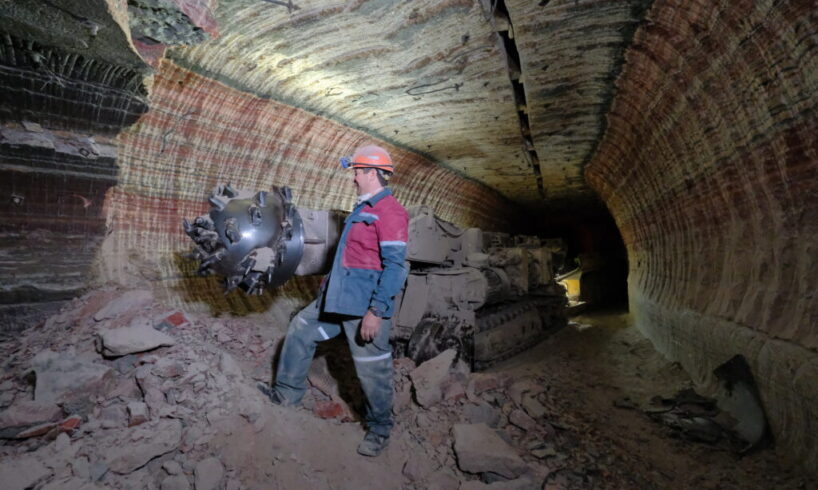
Deep underground, a mining machine extracts potash—an irreplaceable crop nutrient that gives Belarus outsized leverage in global markets and world politics. Photo: belaruskali.by
Sanctions bit, but Belarus adapted
Western sanctions initially devastated Belarusian potash exports. When Lithuania cut off Klaipėda, Belarus’s global market share collapsed from 20% to just 9%, according to the Centre for Eastern Studies in Warsaw.
But Belarus found workarounds.
Shipments were rerouted through Russian ports. Belaruskali engaged in aggressive dumping, offering prices up to 50% below market value. By 2025, Belarus was on track to export over 12 million tons—actually exceeding pre-sanction levels, Argus reported.
The recovery came at a cost: longer transit routes, higher fees to Russia (which treats Belarus as a competitor), and exclusion from the US and EU markets. US sanctions relief reopens the American market, making global trade significantly easier.
Meanwhile, Belarus continues supporting Russia’s war effort, hosting Russian troops, missiles, and tactical nuclear weapons. Over 1,100 political prisoners remain in Belarusian jails.
Read also
Nobel laureate, top opposition figures freed as Belarus trades prisoners for US sanctions relief
EU ambassadors agree on new sanctions package against Belarus
“Provocations will continue”: Expert says Belarus balloon attacks are joint Russia test of EU limits
(function(w,q){w[q]=w[q]||[];w[q].push([“_mgc.load”])})(window,”_mgq”);