(Photo: Hiwa Hussamadin/Rudaw)
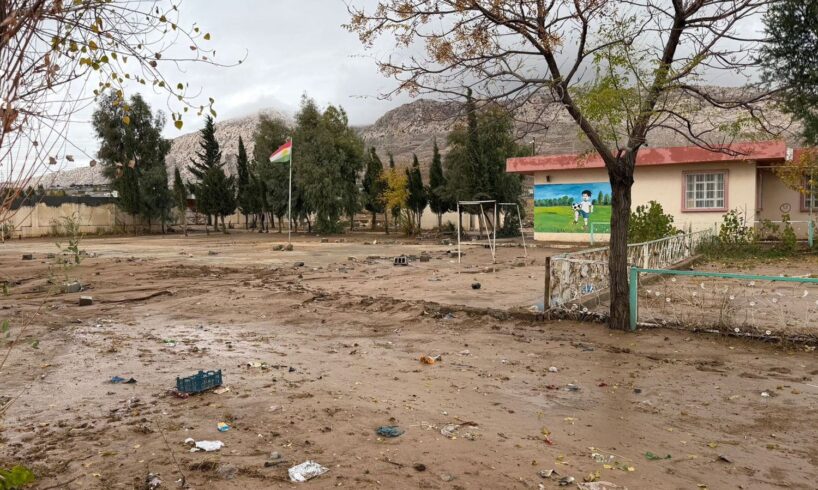
On December 9, torrential rain swept across parts of Iraqi Kurdistan. While the rainfall itself was a natural event, the disaster that followed was not. In the district of Chamchamal, flash floods led to tragic loss of life and widespread material damage, submerging neighborhoods and exposing the fragility of local infrastructure.
Beyond the mud and debris, the floodwaters washed away something more consequential: the remaining layers of social trust between citizens and the authorities meant to protect them. The Chamchamal catastrophe should not be read through a meteorological lens alone, but through a political and sociological question at the heart of governance: who owns the risk?
The irony of Chamchamal is stark. A town long known for chronic water shortages during summer found itself drowning in winter. Initial assessments indicate that the failure to clean drainage networks, the alteration of natural waterways and flood channels by greedy land speculators, and the disregard for urban expansion standards have left residential areas, especially low-lying neighborhoods, vulnerable to even moderate rainfall. Families were displaced, livelihoods disrupted, and losses accumulated in a district already struggling with economic stagnation and limited state investment.
This was not an isolated “act of God”. It was the predictable outcome of administrative failure. The question is not why the rain fell, but why its consequences were so uneven. Why does a district like Zakho benefit from modern flood defenses and urban planning, while Chamchamal remains exposed to the first serious storm?
A useful way to understand this crisis comes from sociological work on risk and trust. Drawing on the ideas of German sociologist Ulrich Beck, scholars argue that public trust erodes when no authority clearly “owns” risk. In modern societies, risks must be identified, acknowledged, and managed by institutions with both responsibility and capacity. When authorities deny risks or shift responsibility onto citizens, distrust becomes systemic rather than episodic.
In Chamchamal, risk was not owned by the authorities from the central government. It was externalized to ordinary people, who were left to confront danger individually and collectively once the systems meant to protect them failed.
To understand the public response to the floods, it is important to distinguish between two forms of social capital. The first is vertical trust: the confidence citizens place in institutions such as government agencies, emergency services, courts, and elected bodies to act predictably and responsibly in moments of crisis. The second is horizontal cohesion: the solidarity among citizens who help one another regardless of political or social divisions.
Thinkers such as Francis Fukuyama and Robert Putnam have long warned that horizontal cohesion cannot substitute for vertical trust. Strong community bonds are valuable, but when citizens increasingly rely on self-help and informal networks, it often signals the retreat of state responsibility rather than its success.
The scenes from Chamchamal reflected this imbalance clearly. Ordinary people rescued neighbors, cleared debris, and shared resources. These acts were humane and admirable. Yet they were also symptoms of institutional absence.
In the days following the floods, Kurdish media and social media platforms amplified images of citizens helping one another, framing the response as a celebration of “Kurdish resilience”. While well intentioned, this narrative is misleading. Praising solidarity in this context risks turning resilience into an excuse for governance failure. When citizens must rescue one another, it is not evidence of state strength; sometimes it is proof of state withdrawal.
Social cohesion should complement political accountability, not replace it. Weaponizing solidarity as a media narrative masks the erosion of vertical trust and normalizes the expectation that citizens will compensate for systemic neglect.
The Chamchamal disaster also exposes a deeper structural injustice. For years, the Kurdistan region has been constrained by Baghdad’s budgetary pressures and political disputes. Yet districts such as Chamchamal, Garmian, and Raparin face what can only be described as a double siege. They are marginalized by federal policies on one side and deprioritized within the Kurdistan Regional Government’s internal allocation of resources on the other, where infrastructure investment has favored certain urban centers over the periphery.
If there is a lesson to be drawn from Chamchamal, it is that social trust cannot be rebuilt through condolences or symbolic gestures. Trust is restored only when authorities visibly assume responsibility for foreseeable dangers. Owning the risk means acknowledging vulnerability, investing in prevention, and ensuring that the safety of a citizen in Chamchamal is valued as highly as that of a citizen in Erbil or Duhok.
From a policy perspective, this requires a shift from reactive crisis management to preventive governance. Local and regional authorities must conduct transparent risk assessments for flood-prone areas, allocate infrastructure budgets based on vulnerability rather than political proximity, and establish clear lines of accountability when failures occur. Emergency response must be institutionalized, not improvised, and media narratives should reinforce responsibility rather than romanticize abandonment.
The flood in Chamchamal will not be the last. Climate variability, urban expansion, and aging infrastructure make future crises inevitable. The real choice facing policymakers is whether these risks will continue to be borne by citizens alone or finally owned by the institutions entrusted with their protection. Without such a shift, Iraqi Kurdistan risks exhausting its most fragile and essential resource: the trust of its people.