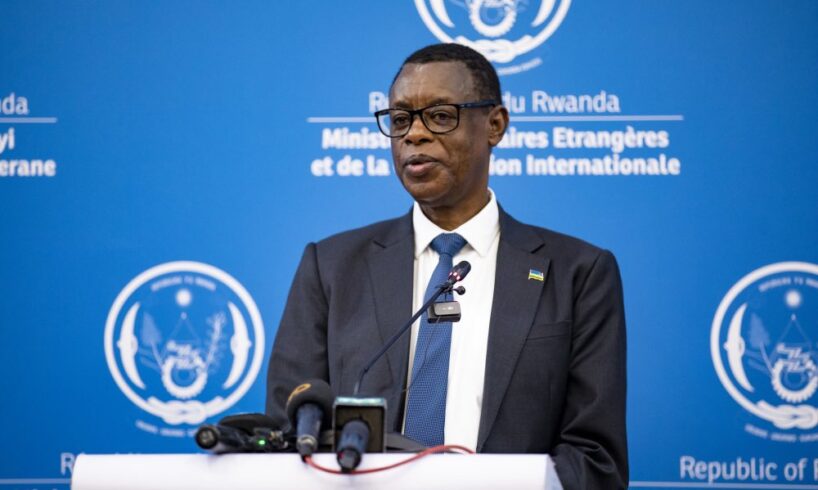
NAIROBI, Kenya, Dec 15— Rwanda’s Minister of Foreign Affairs and International Cooperation, Olivier Nduhungirehe, has criticized Western governments for what he described as selective condemnation of violence in eastern Democratic Republic of Congo, as renewed fighting sees rebel forces enter the last government-held city in the region.
In a statement, Nduhungirehe accused Western countries of ignoring what he termed repeated ceasefire violations by the Congolese armed forces (FARDC), particularly aerial bombardments in densely populated areas.
“The same pattern, over and over again,” Nduhungirehe said.
“You will never hear the West condemning these blatant violations of the ceasefire by the FARDC. These air strikes against densely populated areas, including Banyamulenge villages, have been going on for several months now, and the DRC government is even bragging about them.”
He claimed that international condemnation only emerges when the AFC/M23 rebels respond to what Rwanda describes as sustained aerial attacks.
“Western countries suddenly wake up only when the AFC/M23 retaliates,” he said.
The remarks come amid heightened international pressure on Kigali.
On December 13, US Secretary of State Marco Rubio warned that “Rwanda’s actions in eastern DRC are a clear violation of the Washington Accords signed by President Trump, and the United States will take action to ensure promises made to the President are kept.”
Meanwhile on the ground in eastern DR Congo, four days ago, residents said rebel forces have entered Uvira, triggering heavy artillery fire and gun battles that have forced thousands of civilians to flee across the border into Burundi.
Terrified residents described the situation as chaotic, with shops and schools closed and much of the population sheltering indoors.
The escalation came barely a week after a peace deal brokered by US President Donald Trump between DR Congo President Félix Tshisekedi and Rwandan President Paul Kagame, aimed at ending the long-running conflict in the mineral-rich region.
The M23 rebel group claimed it had “liberated” Uvira, while UN-backed Radio Okapi quoted residents as saying rebel fighters were visible on major streets.
However, South Kivu Governor Jean-Jacques Purusi told local media that Congolese army units and allied militias remained in control of the city, located just 27 kilometres from Burundi’s capital, Bujumbura, across Lake Tanganyika.
Burundi has since closed its border with DR Congo, according to a Burundian military source cited by AFP.
A local human rights official warned of a “risk of a massacre” if remaining government forces attempted to mount stiff resistance. “It’s chaotic, nobody’s in charge. Uvira is done for,” a Burundian officer told AFP.
Burundi, which has several thousand troops deployed in eastern DR Congo in support of the Congolese government, has also voiced strong frustration.
Foreign Minister Edouard Bizimana described the M23 advance as “a slap in the face” to Washington’s peace efforts, calling failure to implement the agreement “a humiliation for everyone, and first and foremost for President Trump.”
He claimed to have seen “several trucks full of soldiers” arriving as reinforcements from Rwanda.
On Tuesday, the United States, the European Union and eight European countries accused Rwanda of backing the rebel offensive and called for an immediate halt to the fighting.
In a joint statement, they expressed “profound concern” over the violence, warning of its “destabilising potential for the whole region,” and urged the Rwanda Defence Force to halt operations and withdraw from eastern DR Congo.
Rwanda has denied any involvement in the fighting.
In a statement on X, the Rwandan foreign ministry said responsibility for ceasefire violations “cannot be placed on Rwanda,” accusing the Congolese and Burundian armies of systematically bombing villages near Rwanda’s border.
UN experts, however, have said Rwanda’s army is in “de facto control of M23 operations,” an assertion Kigali disputes.
The United Nations says about 200,000 people have been displaced since the latest fighting began earlier this month. At least 74 people, mostly civilians, have been killed, and 83 others wounded.
Burundian officials reported more than 8,000 arrivals daily over the past two days, with some 30,000 refugees crossing the border in a single week.
The latest offensive comes nearly a year after M23 seized Goma and Bukavu, the other major cities in eastern DR Congo.
The group is not a signatory to the US-brokered peace deal and is engaged in separate talks with the Congolese government under Qatari mediation.
In a national address, President Tshisekedi accused Rwanda of “deliberate violations” of the peace accord, describing the conflict as a proxy war over a strategically vital region rich in critical minerals. Rwanda, for its part, says Congolese and Burundian bombardments near its border have forced more than 1,000 civilians to flee into Rwandan territory.
Eastern DR Congo has endured more than three decades of instability since the 1994 genocide against the Tutsi in Rwanda with repeated peace agreements collapsing as armed groups compete with the central government for power and control of the region’s vast natural resources.