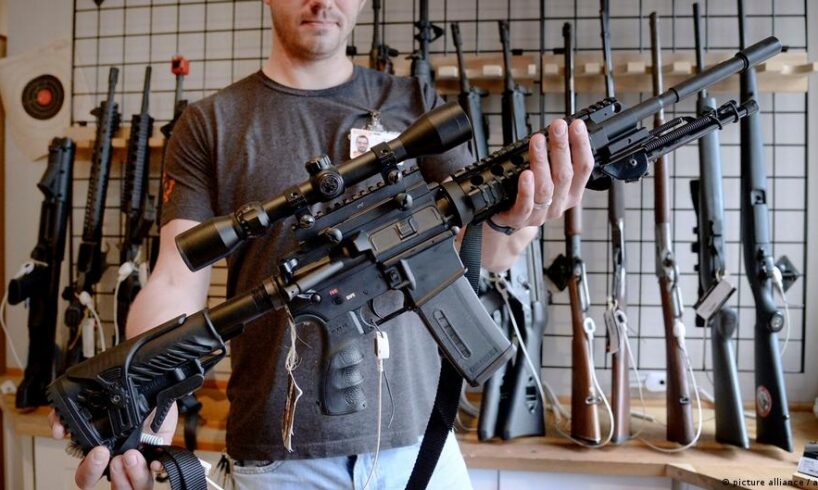
Australia is poised to overhaul its gun laws in the wake of the terror attack on Jewish festivalgoers at Bondi Beach in Sydney.
Australian Prime Minister Anthony Albanese on Monday tabled changes to national laws at a meeting of the National Cabinet, a roundtable of the nation’s federal, state and territory leaders.
They includes bringing into effect a national firearms register, which is anticipated would allow information sharing on gun owners across state borders.
Increased sharing of intelligence to inform which people can be granted a firearms license, how many guns can be owned, curbing the types of permitted firearms and being an Australian citizen are among the new laws that the nation’s parliaments are being asked to implement.
It is a rapid response to the tragedy, which has seen 16 people confirmed dead in what has been Australia’s biggest mass shooting event since 1996.
The reason for Australia’s tough approach on civilian gun ownership harks back to its 1996 mass shooting event and bipartisan political support.
Australia’s Prime Minister Anthony Albanese has begun a process to further restrict his nation’s gun laws.Image: Flavio Brancaleone/REUTERS
Who owns a gun?
There are few, recent, comprehensive global datasets on gun ownership. In 2018, the Small Arms Survey found the nations with the highest ratio of guns to people were the United States (120 guns for every 100 people), Yemen (52 guns per 100 people), New Caledonia (42 per 100), Serbia (39 per 100) and Montenegro (also 39).
Australia had 14 guns per 100 people.
Today, there are estimated to be more than one billion guns owned by civilians around the world. Views on gun ownership also differ widely,
Australians favor barriers to gun ownership
Australians have no constitutional right to own firearms and its residents largely support onerous barriers to acquire guns.
It overhauled its gun ownership laws in the wake of what remains its deadliest mass shooting. In 1996, 35 people were killed by 25-year-old Martin Bryant in Port Arthur, Tasmania.
In response, a national gun buyback scheme reduced the number of guns in Australia. Gun regulation policies are largely supported in a bipartisan fashion by Australia’s major political parties.
Gun regulations are currently managed by the nation’s eight states and territories. While these differ from state to state, there are consistent principles. For example, a person must justify the reason for purchasing a gun, and cannot merely argue self-defense. Automatic and semiautomatic firearms are also banned.
Australians also have a negative attitude towards guns and gun ownership, though firearm numbers have risen in the 30 years since Port Arthur.
The Australia Institute think tank published findings earlier this year showing 65% of people wanted stronger gun laws, and 7 in 10 believed laws should make gun access more difficult.
It also found that license holders owned four guns on average, with just two people in Sydney, where the Bondi attack took place, owning over 300 guns each.
Australia is now believed to have more than four million guns in the country, around 500,000 more than the 2017 estimates in the Small Arms Survey. That increase has been attributed to existing gun owners acquiring more firearms.
Bondi Beach shooting ‘terrorism’ say Australian police
To view this video please enable JavaScript, and consider upgrading to a web browser that supports HTML5 video
The United States has a constitutional right to firearms
Australia’s stance on gun ownership comes in contrast to the US, which has a constitutionally enshrined right to bear arms.
Gun deaths between the two countries also contrast. Australia has 0.88 per 100,000 people, while the US has above 10 in every 100,000.
Like Australia, the US has a mix of federal and state laws regulate how Americans can acquire weapons. Gun control is a much-debated subject, with powerful lobby groups that advocate against control measures, and legal interpretations limiting efforts to restrict or further regulate ownership.
Research by the Pew Research Center in 2024 found most gun owners own a firearm for personal protection, and that 40% of households have a gun. Around half of non-owners could see themselves acquiring a weapon.
According to the Rockefeller Institute of Government, US, reported 109 mass shootings from 2000 to 2022.
Germany requires a license, and personal insurance
In Germany, there are three licenses a person may obtain to buy, own or use firearms.
A Waffenbesitzkarte — a weapons possession card — enables the purchase and ownership of a firearm, but not the loading or use. This means even gun collectors must have a license to acquire weapons for display purposes.
There are two licenses that enable the active carry of a firearm.
The Waffenschein — a firearms license — allows the holder to carry a loaded firearm. A Jagdschein is a hunting license, permitting holders to use their weapons only for game hunting.
Low caliber weapons like flare guns or starter’s pistols, also require a Kleiner Waffenschein, literally a small firearms license. Gun ownership is also restricted to adults, who have demonstrated “specialized knowledge” and need to own a weapon, carry liability insurance to the tune of €1 million and prove “reliability under weapons law”. These laws, and other requirements, also apply to non-citizens.
Australia mourns after Bondi Beach terror attack
To view this video please enable JavaScript, and consider upgrading to a web browser that supports HTML5 video
Europe and beyond
There is a mix of gun ownership laws around Europe. The EU sets minimum standards for acquiring, possessing and selling firearms within member states, but individual states can set their own rules.
EU member states are also required to maintain licensing requirements.
Though these are diverse, mass shootings have, in recent years, prompted nations like Austria, Czechia and Serbia to open discussions on gun rules.
According to the Rockefeller Institute there were 26 mass shootings across the European Union from 2000 to 2022.
Edited by Andreas Illmer