The federal government has added to short-term spending but decreased it overall, while Treasury has upgraded its inflation forecast for the next two years, the mid-year budget update reveals.
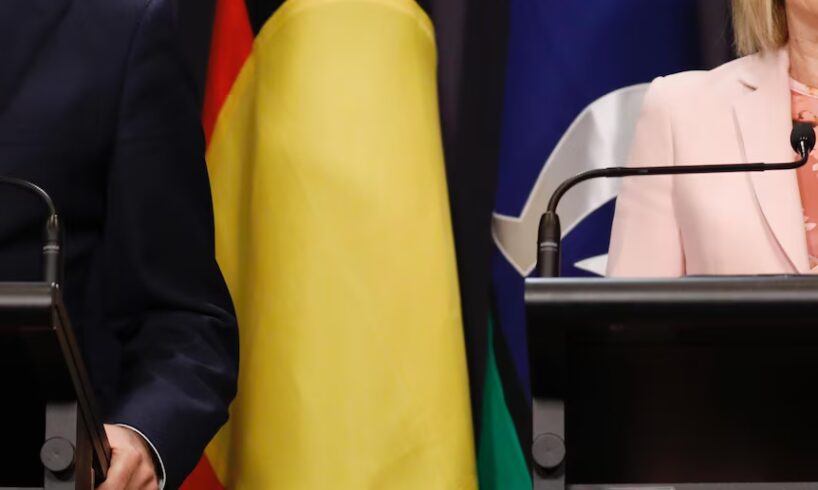
In Canberra on Wednesday Treasurer Jim Chalmers and Finance Minister Katy Gallagher delivered the first comprehensive update to the nation’s finances since the 2025 election.
The budget papers show the government’s own decisions improved the bottom line by $2.2 billion over four years, despite the fact that the watering down of its super tax plans has wiped $3.8 billion off revenue.
Most of these savings come in the later years of the budget forecast period. Overall, the government’s decisions will increase spending by $1.8 billion this financial year, compared to Treasury’s pre-election update (PEFO)
The largest savings come from the public service, where $6.8 billion will be saved over four years by further reducing reliance on consultants, as promised during the election, and by cutting down on travel and non-staffing expenses.
Once again, the budget has also been aided by a higher tax take, with $41.3 billion more expected in receipts over the next four years.
This has been propelled by higher-than-expected inflation, which results in more income tax, and by a boom in private investment. Inflation has also pushed up government payments, which are $35.1 billion higher overall.
The budget bottom line is better in each year, with an underlying cash deficit of $36.8 billion in the current financial year compared to $42.2 billion estimated at PEFO. Much of the change in this year is driven by the higher tax take.
Budget papers predict higher inflation over the next two years compared to the last update. Treasury suggests some of the uptick in inflation is temporary, but says increases in prices for services and new homes will be “more persistent”.
Growth forecasts for China and the US have been revised down, as has the estimate of Australia’s real economic output in this financial year.
“The main task … has been to make room for pressure on spending, to make room for our election commitments in a way that we could still ensure that this progress continues in strengthening the budget,” Mr Chalmers told reporters in Canberra.
“There are difficult decisions in this update, and there’ll be more to come. And that is the reality of managing a budget like ours at a time of very substantial fiscal constraints, and a lot of global and domestic uncertainty.”
New spending includes housing and rollover of social programs
Much of this short-term increase in spending is to cover election commitments and subsequent policy announcements.
New funding has also been allocated to roll over programs that were due to “terminate” because they were only funded for a limited period of time. They include several health programs, domestic violence programs, and Closing the Gap initiatives.
A handful of new decisions includes a $1.1 billion outlay for mental health, including new youth specialist centres and upgrades to existing Medicare and Headspace services, plus $233 million for science agency CSIRO.
The update also includes $10 billion over eight years for the government’s election promise to support the construction of 100,000 new homes reserved for first home buyers.
This money is placed in a fund, which means it does not count towards the usual measure of the budget bottom line.
It will comprise $2 billion in grants and $8 billion in loans, delivered in tandem with states and territories on vacant or public land, with construction to start in the next financial year.
Budget papers also reveal that 21,000 first home buyers have taken advantage of the expanded 5 per cent deposit scheme since it came online in October, in what appears to be an acceleration of interest in the scheme.
Earlier government figures showed fewer than 6,000 people used the scheme in October.
The government has also had to substantially expand its liability for the social and affordable homes it is funding under the Housing Australia Future Fund, stretching the Commonwealth’s commitment from $26 billion to $44 billion.
$1.8 billion will be saved by changing the rules around “deeming”, the process that estimates how much pensioners and other welfare recipients earn from their investments.
The less generous deeming method, which was announced in August, will achieve the saving by reducing the payments of some recipients through the means-testing system.
The government will also raise $720 million over four years by increasing international student visa charges to $2,000, an election promise.
Tobacco excise continues to fall
While tax increased overall, the tobacco excise continued its tumble over successive budgets, despite a higher uptake of smoking. The excise will collect 23 per cent less this financial year than was expected at the last update, and 29 per cent less next year.
Expected revenue from the petroleum resources and rent tax (PRRT) has also decreased by 23 per cent this year and by 17 per cent next year.