KUALA LUMPUR – Malaysian Prime Minister Anwar Ibrahim is facing pressure over whether to fulfil an election campaign pledge to recognise the Unified Examination Certificate (UEC) for entrance to Malaysian public universities and service, in yet another racially charged challenge to his administration.
Debate over the exam, equivalent to the A levels and offered at independent Chinese-medium high schools in Malaysia, has been reignited after the Democratic Progressive Party (DAP) recently renewed calls for it to be recognised, in a bid to shore up support from the ethnic Chinese minority.
This comes after the DAP, which supplies the most MPs to Datuk Seri Anwar’s multi-coalition ruling alliance, was trounced
at the November Sabah state elections, losing all the seats it had contested.
On Dec 7, DAP deputy chairman Nga Kor Ming said the party would meet Mr Anwar to seek recognition for the exam, just days after the party had said it “would work closely with the Prime Minister to accelerate the reform agenda over the next six months”.
Top party sources had told The Straits Times that some leaders during an emergency leadership meeting on Dec 1 called for DAP to consider leaving the unity government if no progress was made after the six-month period, or at least resign from Cabinet.
Recognition of the exam has long been an issue for the ethnic Chinese community in Malaysia, but many among the Malay-Muslim majority believe this to be unnecessary, unpatriotic and unconstitutional.
For Mr Anwar, there is a need to strike a balance between Chinese voters – who have overwhelmingly backed the premier’s Pakatan Harapan (PH) coalition for decades – and Malays, who have largely voted for the opposition Perikatan Nasional (PN).
The UEC was created by the United Chinese School Committees’ Association of Malaysia (Dong Zong) to provide a streamlined assessment after Chinese independent schools opted out of the national curriculum in 1961.
Today, it is accepted by universities including those in the US, Britain and Singapore but not by federally run public universities or civil service in Malaysia.
The Taiwanese-based qualification introduced in Malaysia in 1975 is offered by just 63 schools, with some 10,000 students taking the exam annually, compared with about half a million children who opt for other pathways.
At the 2018 General Election, UEC recognition was not only an election vow for the then opposition PH, but the ruling Barisan Nasional (BN) coalition also pledged to recognise the UEC if it formed government and received a strong mandate from the Chinese community.
A task force was set up in 2018 to look into the issue after PH came to power by ending BN’s six decades of uninterrupted rule, but the administration was toppled before the committee could table its report.
However, historian Eddin Khoo, who led the UEC task force back then, told The Straits Times that his recommendation, after talking to nearly 100 stakeholders, is “not to recognise (it), but to make allowances or exemptions for UEC to be used as entry requirements”, with prerequisite Sijil Pelajaran Malaysia (the O levels equivalent) credits for Malay and general knowledge.
He lamented that, based on the committee’s engagements, “it was clear that politicians and interest groups were less focused on finding a solution and compromise than they were in capitalising on what has become a permanent crisis”.
“They turned it into a racial or language issue, when in fact, it should be looked at as an education policy. In time, because more Malays are enrolling in Mandarin-medium schools – they make up about 15 per cent of students in these Chinese independent high schools – the desire to accept UEC will eventually be less about race, but about the material and demographic reality of the marketplace,” he said.
In 2023, Education Minister Fadhlina Sidek said the Anwar administration had no plans to recognise the UEC for university entrance, citing the National Education Policy and the Education Act 1996.
The DAP is making fresh efforts to push for UEC recognition as it is viewed as the most identifiable Chinese-interest issue where PH has failed to deliver.
Mr Anwar has said he is open to proposals but insisted that “the Malay language must be elevated as the language of knowledge that is mastered by all Malaysians”.
“If any race or party wants to put forward (proposals), there is no problem. But as citizens who follow the principles of the Constitution, it should start with emphasising the primacy of mastering the Malay language,” he told reporters on Dec 12.
DAP politician Charles Santiago, a former Klang MP, is among several figures to have hit out at the premier for “continued hedging” over the issue, which signified “a deeper failure of leadership”.
The issue has quickly sparked backlash from Malay nationalists, who viewed Mr Nga’s comments on Dec 7 as an attempt to pressure the Premier. They have long warned of efforts to undermine their special rights and privileges, including the primacy of their language as the lingua franca of Malaysia.
On Dec 11, Umno youth chief Akmal Saleh made a thinly veiled accusation against Mr Nga of “pretending not to know” that the UEC does not fulfil long-standing principles of the national education policy of using Malay as the main medium and standardised curriculum and exams.
Others from Umno and Malay interest groups also claimed recognising UEC ran contrary to Article 152 of the Federal Constitution, which states that Malay must be the main language for all official purposes.
However, the same article adds that “no person shall be prohibited or prevented from using (otherwise than for official purposes), or from teaching or learning, any other language; and nothing in this clause shall prejudice the right of the federal government or of any state government to preserve and sustain the use and study of the language of any other community in the federation”.
Others argue that foreign qualifications such as A levels and International Baccalaureate, which are not taught in Malay, are already accepted in federally run universities and the public service.
Furthermore, the likes of Sarawak, Sabah, Selangor and Penang – the latter two governed by Mr Anwar’s PH – have been accepting UEC as far back as 2015 for applications to universities, jobs and educational financing offered by these state governments, although often with additional requirements to prove competency in Malay and English.
On Dec 9, DAP secretary-general Anthony Loke revealed on a podcast that the government would introduce a new language policy within six months aimed at “upgrading” the standard of Malay, English and Chinese and will include recognition of the UEC.
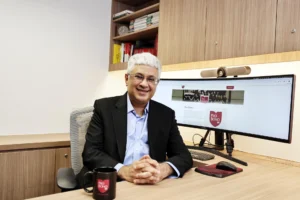
On Dec 9, DAP secretary-general Anthony Loke revealed that the government would introduce a new language policy within six months.
PHOTO: BERNAMA
But sources told ST that the racially charged row had by then pushed back an understanding within the administration that it would make an announcement ahead of Chinese New Year in February, on how the UEC can be accepted for admission into public universities.
In the same podcast, Mr Loke waved away calls from the DAP’s grassroots members for the party to leave the Anwar administration, given the failure to fulfil election promises such as recognising the UEC.
“If DAP cuts ties (with Anwar) today, will that solve everything? Will we suddenly see everything implemented? That’s why I said we must give at least six months to try. After six months, whatever decision we make, we’ve already informed the Prime Minister that we will not withdraw our support for him, at least until the next general election,” he said.
Sign up for our weekly
Asian Insider Malaysia Edition
newsletter to make sense of the big stories in Malaysia.