Open this photo in gallery:
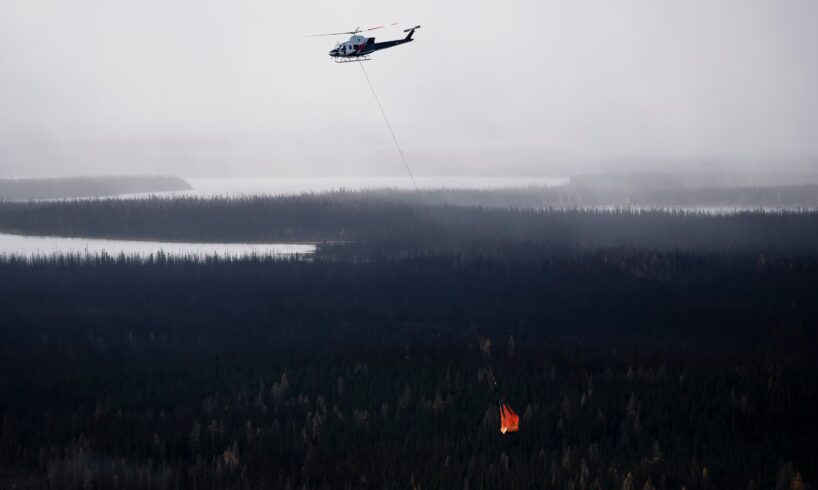
A helicopter moves equipment fuel between work sites near the Ring of Fire mineral deposit in the James Bay lowlands of northern Ontario, Oct. 24.Christopher Katsarov/The Canadian Press
Prime Minister Mark Carney and Ontario Premier Doug Ford will finalize a deal on Thursday to cut red tape for mines and other major projects − with a side agreement that could allow preliminary work to begin next year on a road to the remote Ring of Fire area.
A draft of the overall deal, unveiled last month, is similar to agreements with Manitoba, Prince Edward Island and British Columbia, which signed its accord in 2019. The arrangements allow Ottawa to defer to provincial processes for environmental assessments and Indigenous consultations for major projects that fall under the purview of its Impact Assessment Act, with an eye to reducing duplication.
Ottawa and Ontario will also formally unveil a Nov. 24 letter sent to the Ontario government by the head of the federal Impact Assessment Agency of Canada (IAAC) that says it could wrap up its reviews of segments of the proposed Ring of Fire road by June, 2026, and allow some preliminary work to start, three years earlier than Queen’s Park had expected.
Northern Ontario chiefs step up demands for consultation in resource projects
A provincial government source confirmed that the deals would be formally announced at an event in Ottawa on Thursday. The Globe and Mail is not naming the source, as they were not authorized to speak about the event publicly. Audrey Champoux, a spokeswoman for the Prime Minister’s Office, declined to comment on the deal on Wednesday.
Despite the agreements, mining in the Ring of Fire − an expanse of muskeg about 500 kilometres north of Thunder Bay − remains many years away. A completed environmental assessment for the final segment of the road into the Ring of Fire is still expected to take another three years, and construction could take a decade or more. Ontario has repeatedly asked Ottawa to help with the cost, which could be close to $2-billion.
Mr. Ford has made a push to extract critical minerals from the Ring of Fire a central theme for years. Recently, his government has pitched the Ring of Fire as an economic imperative in the face of U.S. tariffs.
Ontario promises faster mine approvals to counter Donald Trump’s economic threats
But the plans have faced vocal opposition from some First Nations and environmental groups, lengthy environmental assessments and a federal regional impact assessment on the overall potential effects of mining in the area, which Mr. Ford has demanded be scrapped.
Even with the deals to be announced Thursday, Mr. Ford would not rule out using the new powers his government has granted itself in legislation known as Bill 5. The law, similar to Mr. Carney’s legislation for fast-tracking infrastructure known as Bill C-5, sparked condemnation from First Nations when it was passed earlier this year.
Ontario’s law allows the province to designate temporary “special economic zones,” where it could suspend any provincial or municipal law to speed up a project. The Premier had previously suggested he would designate the Ring of Fire as such a zone “as soon as possible.” He said Wednesday such a zone could still be needed in the region.
“Absolutely, because it moves things along a lot quicker. And we have to cut out red tape and regulations,” he said at an unrelated announcement in Toronto.
Two small First Nations near the Ring of Fire − Marten Falls and Webequie − have signed co-operation agreements with Ontario and support the project. They have led the years-long environmental assessments for segments of the road themselves. Mr. Ford said Wednesday he hoped development in the region would help young people in these communities.
Opinion: A pipeline is just the beginning: More threats coming for Indigenous rights
Marten Falls Chief Bruce Achneepineskum said he hoped the latest deal between Ontario and Ottawa would reduce duplication between his own First Nation’s environmental assessments and the federal regional impact assessment, which includes 15 local First Nations, some of which oppose mining in the Ring of Fire.
“For us, it just meant sometimes, a rehashing of the same old studies that we are already doing,” Mr. Achneepineskum said in an interview. “I think that’s what Ontario and the feds are agreeing on.”
But he also said he supports that federal regional assessment, which he said could take another three years, adding that the other First Nations have a right to make their voices heard.
The letter on the Ring of Fire from IAAC, signed by president Terence Hubbard, says this federal regional review will continue but will not affect timelines for the road projects or “create any obligations on Ontario.”
Alvin Fiddler, grand chief of the Nishnawbe Aski Nation, an umbrella group of 49 Northern Ontario Indigenous communities, said it’s disappointing that an agreement was made between Ontario and Canada “regarding our lands, and we had very little input into the process.”
Marten Falls and Webequie are members of the Nishnawbe Aski Nation, which also includes First Nations that oppose the Ring of Fire push. Mr. Fiddler, a critic of Mr. Ford’s Bill 5, said he respects the autonomy of Webequie and Marten Falls but that the Nishnawbe Aski Nation wants to have its say as well.
“We’re not opposed to streamlining any process, as long as it does not diminish any environmental protections that are there now, or that it does not diminish our rights,” he said.
With a report from Pippa Norman