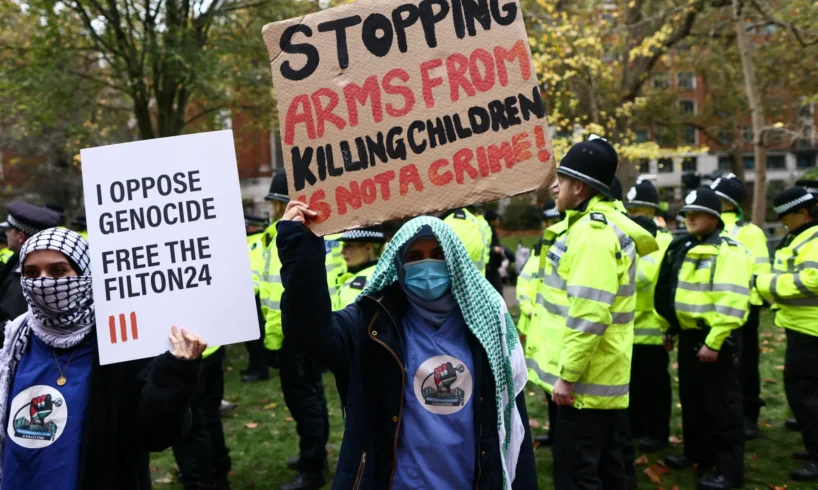
London, United Kingdom – Six remand prisoners affiliated with the proscribed protest group Palestine Action who are on hunger strike are not receiving adequate healthcare and face an immediate risk of death, hundreds of British healthcare professionals have warned.
On Thursday, more than 800 doctors, nurses, therapists and carers wrote to Justice Secretary David Lammy to warn that “without resolution, there is the real and increasingly likely potential that young British citizens will die in prison, having never even been convicted of an offence”.
Recommended Stories
list of 4 itemsend of list
The prisoners, aged between 20 and 31, are: Qesser Zuhrah; Amu Gib; Heba Muraisi; Teuta Hoxha and Kamran Ahmed. Lewie Chiaramello is on a partial strike, refusing food every other day as he is diabetic.
“Put simply, the hunger strikers are dying,” James Smith, an emergency physician and university lecturer, told a news conference in London on Thursday, speaking alongside family members of some of the hunger strikers, politicians supporting them, their lawyer and activists.
“They are all now at a critical stage.”
The group are being held across five prisons over their alleged involvement in break-ins at the UK subsidiary of the Israeli defence firm Elbit Systems in Bristol and a Royal Air Force (RAF) base in Oxfordshire. They deny the charges against them, such as burglary and violent disorder.
Palestine Action, which was banned in July as a terror group, a label that applies to groups such as ISIL (ISIS), believes the UK government is complicit in Israeli war crimes.
The demands of the pro-Palestine hunger strikers include immediate bail, the right to a fair trial and the de-proscription of Palestine Action. They are also calling for all Elbit sites to be closed.
James Smith, an emergency doctor with 11 years of experience, fears one or more of the Palestine Action-linked hunger strikers will soon die in prison [Reuters]
Zuhrah and Gib have been refusing food for almost seven weeks.
“After three weeks, the body has exhausted fat stores and organ tissue in order to generate enough energy simply to maintain bodily functions,” explained Smith, who has been in contact with the hunger strikers.
He said that prolonged starvation leads to heart muscles breaking down, kidney filtration problems, and muscle weakness that affects breathing and heart failures, which can “suddenly cause death”.
In their letter, the healthcare professionals said twice daily assessments, daily blood tests and 24-hour medical cover were needed.
“If any of the above requirements are not met, then it follows that the hunger strikers require care unavailable in the prison. As such, they should be managed in a hospital setting, particularly in the event that complications arise.”
Pressure has been piling for weeks on Lammy, who has refused to meet with the lawyers to address their concerns over the activists’ welfare.
Teuta Hoxha, who is on the 40th day of her strike, suffers from low blood pressure, headaches, chest tightness and shortness of breath.
Her 17-year-old sister, Rahma, said Teuta feels “weak” and nauseous, and is preparing to die.
“Lammy needs to urgently meet with the lawyers, to save my sister’s life,” she said.
‘This is a very deadly period’
When they are hospitalised, the prisoners are unable to call their loved ones, as they do from jail.
Hoxha said her sister recently discharged herself from hospital against medical advice in order to tell her family about her condition. Ella Mousdale, a relative of Zuhrah’s, said she had done the same.
Zuhrah, 20, has suffered with chest pains, exhaustion, and a consistently high pulse of 100bpm “despite doing next to no physical activity”, her lawyers said. She has told loved ones that she regularly collapses in prison.
“She’s very slow. She’s hunched over. Physically, she’s just had body pains all over and just is extremely weak, so she can’t hug me back any more,” Mousdale told Al Jazeera after visiting her on Sunday.
“It’s difficult for her to stay awake. It’s difficult for her to talk for long periods of time.”
Zuhrah stopped communicating with the family on Wednesday, so they assumed she had been transferred to hospital, with Mousdale saying they no longer knew if she was alive.
“This is a very deadly period,” she said.
Protesters, including medics, gathered outside of HMP Bronzefield in Surrey, where Zuhrah is detained on charges relating to the incident in Bristol.
The left-wing MP Zarah Sultana joined the demonstration on Wednesday, demanding that prison officials transfer Zuhrah to hospital. An ambulance arrived several hours later, footage shared on social media showed, but it was unclear if Zuhrah had been hospitalised.
Sultana confirmed in a post on X on Thursday night that Zuhrah was “safe and is continuing her hunger strike”.
A Ministry of Justice spokesperson told Al Jazeera that a member of prison staff had been injured in scuffles between protesters and the police, but they were unable to confirm the circumstances or gravity of their injury.
The spokesperson described the protest as “completely unacceptable”, citing security risks, adding that the Prison Service has assured ministers “that all cases of prisoner food refusal are being managed in accordance with the relevant policy, and with appropriate medical assessment and support – consistent with prisoner rights”.
A spokesperson of Sodexo, the company that manages HMP Bronzefield, said, prisoners refusing food receive “regular medical assessment and support from clinicians, as well as being offered mental health support”.
Ahmed, who has refused food for 39 days, is “losing half a kilogram [one pound] every day”, his sister Shahmina Alam said, adding that his ketone levels are “steeply rising” again. He now weighs 61.5kg (135.5 pounds), having entered prison at 74kg (163 pounds).
“I call upon Lammy to please have this meeting,” she said. “[Ahmed’s] heart is slowing down … What are [they] waiting for, for it to stop?”
More than 20,000 people have signed a petition by the campaign group Avaaz calling on the justice secretary to intervene, while more than 50 MPs have joined Jeremy Corbyn, the left-wing independent politician, in urging Lammy meet the hunger strikers’ lawyers.
John McDonnell, Labour MP, told Al Jazeera, “There’s a real anxiety now about what the hell is going on. Why aren’t we intervening as a government? Why aren’t we sorting this out? There’s an increasing worry that we’re in a situation now which is highly risky.”
So far, Lammy has not responded to the request for a meeting “for reasons he has not explained and which are not clear to us”, said Daniel Lemberger Cooper, the solicitor for the hunger strikers, as he described their attempts to engage with the government as an effort to prevent the prisoners’ deaths rather than discuss criminal proceedings.
Some will have spent more than two years in prison before their trial takes place.
The former Guantanamo detainee Mansroor Adayfi, who was held in the notorious camp for more than 14 years without charge, joined the hunger strike in solidarity on Wednesday.
“Hunger strikes are not a protest of choice – they are a last resort. The British government wants these men and women to disappear quietly,” said Adayfi.
“This hunger strike is not about food, it’s about dignity and justice. It’s about remand being used as punishment. A system that believes that silence will protect it.”