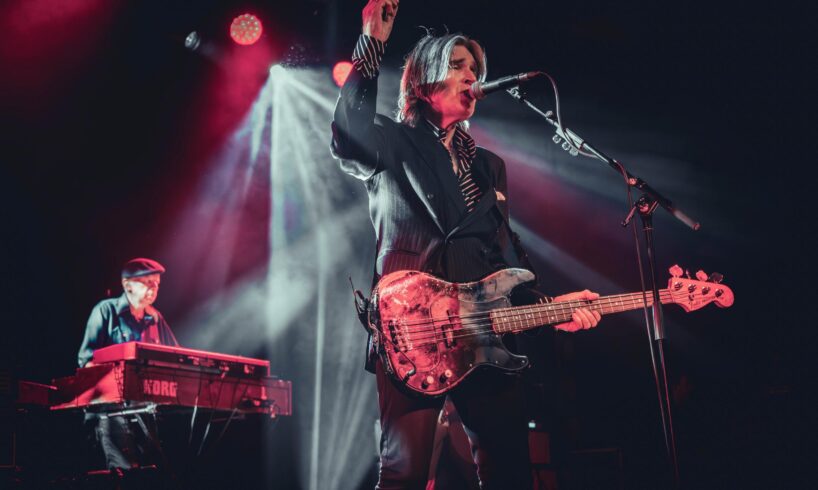
Members of Franz Ferdinand, Glasvegas, Idlewild, Admiral Fallow, Lau, The Bluebells and Frightened Rabbit have criticised the dropping of long-running shows presented by Iain Anderson, Billy Sloan, Natasha Raskin Sharp and Roddy Hart this month.
Singers Justin Currie, Jacob Alon, Karine Polwart, Eddi Reader, James Yorkston, Kathryn Joseph, Hamish Hawk, Callum Easter, Rachel Sermanni, Darren McGarvey, Iona Fyfe, C Duncan, James Yorkston, Blue Rose Code and Pictish Trail are all urging a rethink amid growing fears about the long-term impact of the shake-up.
The open letter – which raises concerns about the loss of “career igniting” opportunities – has also been backed by crime writers Val McDermid and Ian Rankin, who have both performed in their own bands, and the Edinburgh Makar and author Michael Pedersen, who has organised arts events in the city for the last 15 years.
The open letter calls for a reprieve for the “trusted voices” of Radio Scotland’s late-night schedule and declares: “We do not want to lose them.”
Singer-songwriter Karine Polwart has criticised Radio Scotland’s late-night revamp. (Image: MIHAELA BODLOVIC)
It also suggests that the future generations of new talent will find it much harder to get a vital “first chance” of exposure unless specialist Radio Scotland programmes are protected in the late-night slot.
The open letter has emerged a month after The Herald revealed plans to drop several shows to make way for a new “easy listening” programme, Up Late.
Singer-songwriter Kathryn Joseph has backed an open letter urging Radio Scotland to rethink changes to its late-night schedule. (Image: free)
Commercial radio DJ Lynne Hoggan is being brought in to present Up Late which is intended to have “broad mainstream appeal,” from 10pm till 12 midnight, Monday-Thursday, while comic and actress Ashley Storrie will be keeping her current Friday night slot for a weekend edition of Up Late.
It has since been announced that Hart, who has been a regular Radio Scotland presenter for the last 13 years, will be taking over the weekend slots currently filled by Sloan and Anderson for a new show on Saturday and Sunday evenings.
Singer-songwriter Jacob Alon has criticised the cancellation of several specialist music shows on BBC Radio Scotland. (Image: Newsquest)
BBC Radio Scotland has insisted that specialist music will still be a “cornerstone” of its programming.
The broadcaster has pointed to other shows which will be continuing, including Another Country, Travelling Folk, Take the Floor, Piping Sounds and Classical Now.
However the open letter warns of “grave concern” over the prospect of “deeply passionate music-lovers” being replaced with shows dominated by “generic playlisted pop music”.
It has suggested that Radio Scotland is the only station in Scotland with “anything that comes close to that level of career-igniting clout”.
The new open letter, which has been coordinated by the musician Stephen McAll, who records and performs under the name Constant Follower and has been one of the strongest critics on social media of the Radio Scotland revamp.
It is being sent to senior BBC executives in London and Glasgow, Scottish Culture secretary Angus Robertson, UK Culture Secretary Lisa Nandy MP, UK Culture Minister and Edinburgh MP Ian Murray, Scottish Douglas Alexander MP and broadcast regulator Ofcom.
Other backers include the Scottish Music Industry Association, organisers of the Scottish Album of the Year Awards, which has raised concerns that Scotland’s creative identity could be “diluted through homogenised programming” by Radio Scotland.
The group, which has more than 6000 members, published its own open letter last month warning that the changes would create a “a significant gap” in Radio Scotland’s coverage of Scottish culture coverage if they went ahead.
The BBC has said that Up Late will focus on feature a curated blend of well-known classics from the 1970s to the present day, and will have a “strong Scottish influence”.
The new open letter suggests the “curated” late-night shows on Radio Scotland were vital in providing space “where exciting new music can be discovered and new artists introduced to Scottish listeners.”
It states: “A playlist doesn’t give you an enthusiastic and globally respected quote you can use on tour posters, press releases or the sleeve of your debut EP.
“Neither does a playlist go to small gigs by unknown bands, or offer encouragement and advice to young, upcoming artists.
“Nor does it get quietly excited about a new demo that nobody has heard, or pick up the low-level talk in the scene that says, ‘you might want to hear this’.
“No, it’s the deeply passionate music-lovers, who have spent their working lives inside the Scottish audio landscape, who do these things.
“People who have lived with a lifetime of records, bands and live sessions and can recognise something that needs to be heard.
“People who, from the hundreds of thousands of tracks released every day, find and quietly back an artist or a song they believe in before it disappears into the noise.
“People who connect the dots across the musical spectrum for listeners with stories and context, and introduce us to our new favourite records by artists old and new. People who gave the Scottish artists who came before us their first chance, and who will give the Scottish artists after us their first chance.”
The open letter calls into question how the decisions taken on the late-night music programmes fit in with Radio Scotland’s remit.
It adds: “If, like us, BBC Radio Scotland wants our country to have a vibrant, evolving music culture that continues to punch above its weight on the global stage, we need spaces where new artists can be introduced to people who are actually listening, spaces that are guided by presenters and producers who know the Scottish musical landscape intimately and who understand and champion the incredible creativity our emerging musicians have to offer.
“For our own careers, those early discovery moments have already happened. This letter is about the artists who are just now writing their first songs or making their first recordings, wondering if anyone will ever hear them. We do not want the gate to be closing on them just as they reach it.”
Polwart said: “What’s the point of a national publicly funded broadcaster in Scotland if it retreats from its own stated commitment to support home-grown talent, make space for diverse Scottish storytelling and take creative risks?
“In a music industry already stacked against independent artists, why privilege what’s already mainstream across multiple commercial stations? How exactly does this support Scottish music and culture?”
Yorkston said: “Sometimes things have a value beyond listening figures or fear of confusing someone.
“I mean, I like easy going evening friendly pop music as much as the next aging Fifer, but there are already plenty of places to hear it.
“I do think the Scottish music scene has a value and it should be celebrated and supported, if not by our national radio station, then by who?”
McGarvey said: “Public funding is meant to protect the BBC from the excesses of commercialism, not bankroll a poor imitation of it.
“With this move, BBC Scotland may hope for broader appeal, but it comes at the cost of credibility and cultural depth. It is a terrible decision, and they can hardly pretend otherwise.”
Fyfe said: “I’d like to see the BBC reconsider this damaging act of cultural vandalism with a comprehensive audience-led consultation.
“The licence fee payers have made their voices loud and clear. The artists have made their adoration for the programming loud and clear. It’s in the BBC’s interests to conduct a thorough consultation.”
McAll said: “My career, like almost every artist who has put their name to this letter, began with those first plays on late-night radio.
“I want BBC Radio Scotland to pause the changes and consult with the music community on how It best to programme our national station’s late-night spots.
“The BBC should be nurturing the music scene that gives Scotland such an important voice on the world stage, not snuffing it out with mindless commercial-radio-style playlisting.”
Caroline Sewell, regional organiser at the Musicians Union, said: “These platforms are vital for independent artists in Scotland where opportunities remain all too few and far between for most. Streaming algorithms and social media cannot replace the credibility, reach, and cultural importance of public service broadcasting.
“Music is not just entertainment – it is an essential and intrinsic part of Scotland’s identity. It deserves to be heard, supported, and celebrated – not diluted into an unrecognisable mainstream version of itself.”
A spokesman for BBC Radio Scotland said: “It’s not unusual for radio stations to undergo changes, particularly in an increasingly competitive audio market and, whilst we understand some audiences may be disappointed, it is important that BBC Radio Scotland continues to listen to audience feedback and evolve its offer.
“We recently announced the details of our new weekend programmes as part of the schedule changes – Roddy Hart’s Mix Tape which will continue our long-held tradition of championing and discovering new music and artists in Scotland and beyond.
“BBC Radio Scotland remains proud to showcase the full breadth of Scotland’s musical talent, from established performers to the next generation of artists, across its schedule. Specialist music remains a cornerstone of BBC Radio Scotland’s music policy. Half of our total music hours are specialist.
“Roddy Hart’s Mix Tape will join an impressive range of specialist music titles which include Another Country, BBC Introducing in Scotland, Travelling Folk, Take the Floor, Vic Galloway, The Quay Sessions, Piping Sounds, Your Requests, and Classical Now.
“These programmes sit alongside BBC Scotland’s commitment to emerging artists including Young Traditional Musician of the Year, Young Scottish Jazz Musician of the Year, Young Scottish Classical Musician of the Year and BBC Introducing Scottish Act of the Year. We remain deeply committed to celebrating it all in our schedule.”