Noam: We’re here today with Rabbi Benji Levy. Rabbi Benji Levy, thank you so much for joining us.
Rabbi Benji: Thank you so much for having me.
Noam: Rabbi Dr. Benji Levy is an extraordinary educator, innovator, and leader. Benji is currently the CEO of Share, mainstreaming holistic, soulful, and intentional living. And he co-leads Israel Impact Partners, working with leading funders to accelerate the growth of nonprofits, amongst many, many, many other things. He’s a published author, holds a PhD in philosophy, and previously served as CEO of Mosaic United and Dean of Moriah College in Sydney. Benji lives in Jerusalem with his wife Renana and their four children. And Benji, we are so thrilled to have you with us today.
Rabbi Benji: It’s a big honor to be here with both of you and I wish you could be in different times. Hopefully we’ll have other conversations in the future.
Mijal: Yeah, definitely.
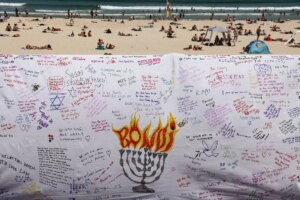
Noam: And right now we are coming to you because like I mentioned, your upbringing, everything is in Sydney. When you and I spent time together, it was actually on Bondi Beach. Three years ago, your house, there where you grew up, I remember actually having ice cream with your father-in-law, Ben and Jerry’s, right on the boardwalk there. And I stayed at the Adina Hotel with my wife, Raizie. And on a very personal note, that’s where we found out that she was pregnant with our fourth there. You’re now in Jerusalem, like I mentioned, but could you just tell us, what was it like growing up in Bondi? What’s the community like?
Rabbi Benjy: I always say that growing up in Sydney was just a dream. Really the most warm, beautiful, phenomenal community. Used to wake up in the morning. It’s like, gives me shivers even thinking about it. Get up early, be at Bondi Beach at sunrise. We used to go surfing. After that, we’d have a hearty breakfast and go off to Queens Park where I went to school, Moriah College. And we literally greeted the morning with the sun, surfing waves, with such a wonderful community, you know, Jews and non-Jews alike, everyone so connected. I used to play rugby a lot, so with a lot of the broader community as well. And really just feeling the sense of belonging, feeling a sense of being part of what we call in Australia, the lucky country. There’s really a sense of, you know, the saying, no worries, mate. You know, people just let things go. People just move forward. People are connected. People are very chilled. People are very relaxed. It’s almost like time is slower there.
The Jewish community specifically is one of the strongest Jewish communities in the world. Australia has, outside of Germany and Israel, the highest per capita rate of Holocaust survivors that went there. And I think because they were just trying to move far away from, you know, what they were thinking about, what they were experiencing, what they went through. And Australia is literally like on the other side of the world.
It’s got one of the highest rates per capita of Aliyah, of people moving to Israel. It’s got one of the highest rates per capita of tzedakah, of donations to Israel. It’s got a very high penetration of Jewish children going to Jewish schools. You know, when I was growing up there, over 50% of Jewish children went to Jewish schools. And these schools are not government funded. They are private schools and they’re extremely expensive. There was a high rate of people going to Jewish youth movements, very high level of synagogue attendance. And every element of the community from, they’ve got CSG, Community Security Group, a Hatzalah, a CHS, which is another form of medical support. It’s really a little organization within an organization. It’s a community within a community. And the infrastructure is phenomenal. The people are amazing. And it was really a dream come true.
Mijal: Benji, when did your family come to Australia?
Rabbi Benji: So my family personally, you know, left Lithuania and went to South Africa. And then in response to apartheid, really, my family didn’t stay in South Africa and moved to Australia. So different stages. My parents were basically in the 1980s, they moved to Australia. And then I was born in Sydney, and all my siblings were born in Sydney and my first three children were born in Sydney. I met my wife in Sydney. So everything really, my entire upbringing comes from that place.
Mijal: And I think you mentioned earlier that most of your family is still there.
Rabbi Benji: Yeah, so both of my sisters and brother-in-laws and nieces and nephews, in fact, I was there last week to meet my newest nephew. My parents both live there. My granny is still there. She’s, you know, well into her nineties and going strong. All my aunties, all my uncles. Every single Friday night when I grew up, we used to spend at a different auntie or uncle’s house. So my cousins are all there. And when I was there last week, I was also officiating at the wedding of one of my cousins, who I actually was the dean for her when she was at Moriah College at the school later in my life. And she married another student in that same year group. So everything is completely connected and interrelated. I have one cousin in Tel Aviv and a brother in Tel Aviv, and the rest of my family are all in Sydney, Australia.
Noam: Benji, when I was in Bondi a few years ago, it’s such a special place, the Australian Jewish community. My team, work with all the different Jewish schools there. The teachers from Kesar Torah to Emmanuel, from to Moriah, like these, and for people that don’t know these schools, there are different sorts of type of religious backgrounds, different type of political backgrounds. But there’s something powerful about the Jewish community in Sydney and in Melbourne and in Perth and in other areas in Australia, that you, like you mentioned, that over 50% or around 50% go to Jewish day schools.
When I was in Bondi Beach, a couple things stood out to me. One is exactly what you just described. I remember waking up at 5:30 a.m., 6 a.m., and seeing everyone out there on the beach. and then on Shabbat day, my wife and I took this walk of the, think it’s called like the Bondi Walk, what’s it called? The Bondi Walk.
Rabbi Benji: Bondi to Bronti. I recommended it to you guys.
Noam: Yes, you did. And it was a most remarkable, majestic walk. On Sunday, I remember buying the book of Bondi. And in my living room, there’s two books. I have something of Jerusalem and Bondi and The Beautiful Beaches of Bondi, I think it’s called. And now I can never, none of us could ever see Bondi in the same sort of way.
I want to go, Mijal, to you just for a second before we talk a little bit about Bondi. I think you were in Argentina in 1994 when the attack took place, killing dozens, I think 85 people killed.
Mijal: 85.
Noam: 85 people killed. I want to know what your reaction was to this moment, considering you were also there in Argentina in 1994.
Mijal: Yeah, I mean, I was a kid when it happened. I still have some fuzzy memories of it. Mostly I remember just my dad. He was one of the rabbis identifying bodies. So just remember him coming home and it being very serious. And one of my best friends in nursery school, kindergarten, her father was killed. And I remember that as well. I think maybe I’ll just say, growing up in Argentina and growing through the AMIA attack and all those things, it just makes you think about antisemitism differently, I think, than a lot of American Jews who grew up in America expecting a certain level of safety.
I remember a few years ago when we started talking about antisemitism more seriously in America before Tree of Life, that I said, well, this is actually really resonant in terms of what many smaller Jewish communities around the world have faced and are facing. So there’s something there about it.
And also, I lived in Argentina. I lived in Uruguay. The communities outside of America, sorry, I know I’m generalizing a lot, but they can be a little bit more tight knit because they’re smaller. So you know each other really well. There’s very few degrees of separation. It’s not like the New York Jewish community that is so huge.
So yeah, was just hearing about the horrible attack in Australia and other places just brings it back.
Noam: And Benji, would you say that that description of what Mijal was saying about the tight-knit nature of the communities outside of the U.S. major major cities like New York, L.A. Did you feel that tight-knit sort of community? Because I know that this in, this Australia, was a Chabad in Sydney, there was a Chabad group that put this together, but it wasn’t just for Chabad, it was for thousands of other people.
Rabbi Benji: There’s absolutely no question. Everything is done as a group and together. And while you may be a member of one synagogue, you frequent every other synagogue. And while you may be at one school, you frequent the other schools. I’m just thinking, you know, we had a program called Mikolot, which was a public speaking competition. From the first year, every single school in Sydney was invited before we then invited all the Melbourne and Perth schools and then went broader.
I was just came right now from speaking an hour ago to a Keser Torah group and unfortunately one of the children in that group had to fly back to Australia to her father’s funeral. And my wife runs Keshev, which is an organization for mental health and there’s a lot of Australian groups currently in Israel and she organized a mental health worker for all the different schools because they all work together and then they wanted some spiritual guidance. So I went there tonight, and last week I was speaking to the Israel Study Tour, which is the Moriah group. Previously when I was running the Israel study tour, it was Moriah and Masada together, which is one school on the eastern suburbs, one on the northern suburbs. There’s a real sense of community and they really put the unity in community, not just in a cliche way, in a very practical, visceral way in everything that we do.
Mijal: How big is the Jewish community in Sydney?
Rabbi Benji: In Sydney, it’s around 45,000 Jewish people. In Melbourne, it’s around 55,000. There’s only around 110,000 to 120,000 Jews in Australia. So those are by far the two biggest Jewish populations in Australia.
Mijal: I’m curious to hear a little bit more. So many of the headlines that I saw on the social media posts, and also just hearing from friends of mine who live in Australia, many of them said, you know, we are horrified, but we are not shocked. This was a long time coming. We saw certain signs. And I’m curious if you can just describe a little bit why we’re seeing this reaction right now.
Rabbi Benji: Look, it’s the million dollar question. It’s very complex. It’s very early to really diagnose, but it’s entirely true what you’re hearing. The Sydney that I described when I grew up is the same Sydney in terms of what you see, but demographically it’s transformed. Politically it’s transformed. The whole world has got flatter, so to speak, and even with Sydney. So as I grew up going to Bondi Beach, I have these memories of certain people from certain suburbs coming that we were more scared to walk on the boardwalk when they were around because they would come in and it was called “roll” in Australia. They’d like try mug you basically.
And it was almost like, know, they’re in their area. We’re in our area. And when they come here, so we, you know, deal with it with like accordingly. And I don’t think that’s a healthy way for a society to emerge that there’s these like two different suburbs that have such differences. And we actually saw in this little suburb, it’s almost like a city within a city, that there’s certain things that just go unchecked in a much deeper way. So certain hate speech, certain hatred, certain preaching. And again, not to generalize because every community has everything, but there was a larger concentration in some of these communities and it really went unchecked. And that community grew dramatically and it never went checked.
And I actually think that part of it is because of Australia’s no worries mate approach that you know live and let live and let’s just let but as these things grew more and more and the security group in Australia works very closely with ASIO, which is basically the intelligence organization of Australian security broader and with the local police and all these things and invest a lot of time and Israel has also brought a lot of intelligence and helped and there’s a lot of sharing there.
And, you know, as a dean of a school, you know, for six years at Moriah College, we would get this information and we’d have to increase our security. And the result was that the government would invest in higher walls and more security guards and greater protection on the outside, but not treating the cause. The symptoms were protected, but not the cause. And this got worse and worse. And that voter base got bigger and bigger. And this has sort of happened very, very slowly.
But on October 7, everything exploded, not just in Australia, but around the world. And days after, I’m sure you guys remember, one of the most impactful things was people screaming, eff the Jews, and globalize the intifada, literally on the Opera House. And there was a march across Harbor Bridge, and there was someone literally on a horse going across Bondi Beach with a Palestinian flag, which represented more than just Palestinian autonomy. It was a big statement to specifically do it in Bondi Beach.
Just so you understand from an Australian perspective, if you walk your dog on Bondi Beach, there is no greater crime, right? They are so particular and careful. And this individual was able to ride a horse across it without a helmet. If you ride a horse without a helmet, or if you bike ride without a helmet, these are the most particularly important things. And like they were just trying to live and let live.
And unfortunately, we’ve learned time and time again throughout Jewish history and throughout history in general, and I’m talking to two phenomenal students and teachers of history that when you leave these things unchecked, it never ends there. It gets worse and worse and worse. And unfortunately, people are warning, something bad is going to happen. Something worse is going to happen. And you know what? Bad things did happen. They literally torched, firebombed synagogues in Melbourne, restaurants in Sydney. There was graffiti defacing all different places.
When I woke up a week and a half ago on Shabbat morning in Sydney, Australia, the police on Bondi Beach were actually going over a graffiti area that said, death to Israel. And when I walked to synagogue, two streets away, on three different houses along the way, there was these different things. So it was just rising more and more and they were just trying to cover up the graffiti and cover up the mess and cover up these things. And they found that there was actually state sponsored terrorism. They actually found a direct connection to Iran sponsoring some of these things.
So it’s not just a bunch of vigilantes. There was a very, very systematic and organized approach from very organized terror cells and very organized ways and trying to radicalize and grow. And this, as we know, we see bad things in Paris and in London. It’s not just a Sydney problem. But because they let it just fester, it exploded in this absolutely terrible and devastating way. And this needs to be a wake-up call, not for the Jewish people, for the Australian government, for the Sydney community, and really quite frankly for the world. Because this cannot happen not on our beachfronts, not anywhere in civilized society.
Noam: Yeah, you’re going through those examples, I started writing down all of the different examples and I’m probably not going to cover it. But you just mentioned October 9th, eff the Jews outside the Opera House. 2024, activists leaking the contact details of hundreds of Australian Jewish creatives and academics who were harassed and intimidated. May 25th, 2024, Mount Scopus Memorial College vandalized with the words, Jew die. October 20th, 2024, Louis’s Continental Kitchen in Sydney set alight in an arson attack. December 6, 2024, an arson terrorist attack took place at the Adas Israel Synagogue in Melbourne, which destroyed property and Jewish books. January 17, 2025, the former home of a Jewish communal leader in Sydney was splashed with red paint. Several cars outside were set on fire. An antisemitic graffiti was scrawled across one burned out vehicle. February 12, 2025, two nurses, remember this, were suspended after a video on TikTok. Remember that? Showed them saying they would refuse to treat Israeli patients. Right? That was horrible. And the child care center in Sydney was vandalized with antisemitic graffiti and the like.
So when we hear this, Jewish people around the world and probably Jewish people in Australia, when I’m texting all of it, I won’t say the names of the people that I’ve been in touch with, they had the exact reaction that Mijal said. this, almost like this anger is what I’ve been hearing of like, we’ve been asking people to pay closer attention to this. Please, please pay closer attention to this.
And so you’re saying, Benji, that that is the reaction that you’re hearing consistently as well.
Rabbi Benji: Unquestionably people have been pushing harder and harder. There’s been a government change recently and they’ve been trying to placate certain parties and certain groups of voters. And we feel like we’ve just been left by the wayside. And we feel that this could have been preventable if we really stood up and listened earlier.
Mijal: is that the Jewish community is asking for more public support by politicians and public figures to speak up against antisemitism and anti-Zionism, especially when it goes into antisemitism, which I believe is most of the time? Or was this also just a greater wanting to have security support or both?
Rabbi Benji: I think it’s, I think at its core, it’s about education. Like the Jewish people have always believed in. I think that they wanted to create better understanding, not have any radicalization. Like I gave you the examples of like a dog walking on the beach or someone going without a helmet. If you were to see COVID in Australia, you, it’s like when, when the government wants to take something seriously, when they want to have zero tolerance, they can do it to the nth degree. You should have seen like curfews at evening for parties. I mean, such, you know, certain things that they deem as super important. If they would want to cut down on this, if they’d want to clamp down on this, there is no question. I remember when there’s been drug raids in some of these same suburbs that these people were radicalized in.
So I think the main thing that we want is an education, is understanding, is a zero tolerance for absolute racism, for hate speech, for criminal activity, the bare minimum, but applied across the Jewish community as well as any community. And we really believe that could have prevented something like this.
Mijal: It sounds like, if there’s a government and a society that takes certain things very seriously. So you see here like a very significant gap and double standard.
Benji: There was a permissive society. They were permissive in too many different ways. And there’s certain things that we have to have zero tolerance on, which is hard for a free society. We really want to live and let live. But there needs to be limits, because otherwise it can end like it just did.
Noam: So let’s go to what just happened the way it ended the way it just did. 15 people.
Mijal: We’re recording this just like a day and a half.
Noam: Yeah, this happened on December 14th. This is December 15th when we’re recording this on Hanukkah. You know, I just think of how when the 7th of October, when Hamas attacked the Jewish people, the Jewish state, and they defiled the holiday of Simchat Torah, I now think of these terrorists defiling the holiday of Hanukkah and taking away our holidays.
They’re our holidays. They’re our holidays where we celebrate our identity, where we celebrate our story, when we celebrate our relationship to the divine, when we celebrate our relationship to each other, where we bring so much lightness to dispel the darkness. And so maybe what you’re hearing in my voice is like a sort of anger that like, how dare you take that from us? But I want to know from you, Benji, what are stories that you’re hearing from on the day of December 14th? Are there stories that that you feel like so many of us around the world just don’t know about? What stories can you share with us about the day about December 14th.
Rabbi Benji: I think there’ll be history books written about that day. You know, there’s elements that reminded us of October 7, where there’s people running confused there in a time of celebration, as you say on a Jewish festival, and there’s music going on and they’re celebrating and there’s bullets flying and they don’t know what to do. That is what happened here.
My parents live the closest house to Bondi Beach. Outside their house, I was meeting my brother in Tel Aviv that morning. And my brother’s like, had to get off my scooter, he was coming to meet. My father was speaking to him and we’re sitting there together. And my father just screaming, where is the help, where is the help? My mother runs into the house, gets a medical kit. There’s someone lying on the floor outside our house. One of the community security members took them out of the area, but not very far, literally to out of their house, and they’re treating a gun wound. Unfortunately, half of his arm was blown off and they’re putting on a tourniquet and trying to do that.
And you’ve got this really difficult experiences on the ground in Sydney where people are completely confused. There was actually two simultaneous parties going on for Hanukkah. One in a place called Dover Heights, which is about a five minute drive and one on Bondi Beach. And there was confusion if there could be something there as well.
And I’m not sure if everyone realizes, but there were thousands of people in both places. And at the same time, they cut everything down. So they’ve got these two Hanukkah festivals happening simultaneously. My sister told me she’s on the floor telling her children, the Hanukkiah is not working. So we’re to play hide and seek right now. You know, thank God my sister’s a clinical psychologist. So she understood the language to describe in this kind of situation. But Australia is so far from these types of experiences. People are so confused. There’s just mayhem going on.
And then you’ve got, know, Ahmed al Ahmed, which I’m sure you guys saw, who’s obviously not Jewish, who snuck up behind a car on one of the gunmen and jumped on him, wrestled him, took his gun away from him, right? And was shot himself. As we speak, actually in the hospital. I spoke to someone today that went to go and visit him, right?
You had incredible citizens that just stood up in the most beautiful way, immediately after coffee shops just giving out free coffee, immediately after florists giving out flowers to go put for free to pay tribute, people taking people into their homes, people jumping on the back of cars. Even though this was a Hanukkah party, make no mistake, this was an attack on Western civilization. Bondi is an iconic beach for all Australians. This was in a public area. So we’re talking about every type of person there. There’s Jews and non-Jews that were killed, even though it was targeted directly at Jews. They’re all there together and there’s stories of people jumping on the back of people’s cars, driving people, running to try and tell people to get free.
And just on the flip side, know, unfortunately our experience has been that when you’re in Australia, God forbid, you check in on someone in Israel. I said before that I spoke, you know, to different groups over the last few days of students that are here. One of the teachers that were here had a call from their daughter and their daughter had been shot in the leg. She was there and the mother didn’t understand what was going on. She told me after she was speaking to her teacher next to her, what’s going on? What do you mean, you were shot? You’re in Australia, we’re in Israel. Like there’s no even conception of this. It’s so confusing.
And even saying that is terrible to say. And then unfortunately she also lost her nephew who actually died. And they’re sitting here in Israel. Israel has become the safe haven. It’s the craziest concept. And they’re sitting there on Bondi Beach.
So there’s stories of bravery. There’s stories of tragedy and they litter all over. could go on and on. But the carnage, the effect that’s happening, and we know this, unfortunately, from Israel and other places, not just physically, but the emotional damage, the PTSD, what the communities are going to have to grieve and go through from this. And just to understand immediately after, this has become a phenomenal memorial. All day, every day, we’re talking about hundreds of thousands of people have already been there to lay wreaths, to sing, to come together as a community. And as terrible as it is, I still see a bit of the true Sydney that I grew up in coming back out now as they come back together in spite of that terrible day.
Noam: It’s a very positive take right now, Benji, because, you know, and it’s live right now. like this happened yesterday. But one of the premier educators in Australia, she texted me saying, “we are heartbroken at the loss of life, the terrible injuries, the violence against our Jewish community and this line, the loss of our benign and beloved Australia.”
The loss of it. how do you feel about that? I view Australia in that same way when I was there. It felt benign and beloved Australia in a certain way. But you feel you see this positivity right now with the you feel like people coming out right now in a positive sort of way? Because I’m feeling, I’m in South Florida. Mijal’s in New York. You’re in Jerusalem. I’m I’m at this like stage of where I’m still, I feel that pain, not that you don’t feel that anger, that anger, and like how could this be allowed, how could anyone allow this to happen?
Rabbi Benji: Look, I think that on the one hand, yes, Sydney just lost its innocence, so to speak, and there’s many different occasions, but this is the most dramatic. This was the greatest shooting, I think, that’s happened in Sydney, Australia. This is the greatest attack on the Jewish people since October 7. This is massive. This is unquestionably terrible. And as I said at the beginning, this is a turning point.
Now, Chief Rabbi Israel Meir Lau famously said, like they asked him, why do you always focus on the cup as being half full? And he said, you can’t drink from the empty half. I genuinely believe as an eternal optimist, as part of a people whose anthem is Hatikva, is the hope that despite all the terribleness, there is a glimmer of hope here. Now, I’m not saying for one second that innocence has not been taken from us, right? And that happens in all our lives in different ways, in different places where we lose that moment. But that doesn’t mean that moving forward we cannot be hopeful.
And I am seeing two things. Number one, a genuine sign of hope from the regular Australian. The people that were the silent majority, the people that weren’t speaking up, people that were saying live and let live, realized there’s a limit to that statement. No worries, mate, until you lose your mate. And that mateship and that sense is really being felt here across the community.
So from those people, and I think that there is no bigger wake up call for the politicians. Will they decide to act differently? I don’t know. Do I genuinely hope they will? Yes. Do I think that it’s possible? Yes. Because if you can’t wake up from this, then I think, unfortunately, we can say goodbye to Sydney, Australia. But I do believe they can wake up from this.
Mijal: I want to add something very cynical, if it’s OK, just because I have been seeing so many responses from across the board. And again, this is like the cynical dark part of me that was thinking if there was anything that was remotely Israel related as part of God forbid an attack on Jews, we wouldn’t have seen this response.
Noam: What do you mean?
Mijal: I was thinking that I saw condemnation of this from across the board, not just from Australia, but politicians everywhere. everybody has been condemning this. And part of me, I am grateful for it. I hate how grateful I am because I’m like nebuch us Jews, that we’re like so grateful for sympathy for our dead. But another part of me was thinking if this was in a synagogue or there was like an Israeli flag in the background, or if this was at that concert in Amsterdam that was hosted yesterday where an IDF singer, whatever, somebody from their choir sang, we wouldn’t have seen this amount of condemnation. There was something about this particular terror attack enacted by a father and son connected to ISIS that I think is just, can be so clearly unrelated to Israel and Zionism that in a sense, sorry to sound, tell me if I’m being too dark or too cynical, but it’s almost like an easy test for politicians to pass.
Noam: Right, you’re saying it’s like there’s a permission to condemn right now.
Mijal: Yes, yes, yes. I’ve seen it everywhere. I’ve seen it like from many leaders from across the board, from the right and the left, who wouldn’t always condemn. And again, I’m both grateful and I’m also just watching it. And I want to insist that we Jews deserve dignity, respect and safety, whether we’re celebrating Hanukkah at the beach or whether we are celebrating Israel inside our synagogues.
Rabbi Benji: I would say two things to that. First of all, there are some that haven’t condemned enough. If you look, for example, at Qatar, their statement, they don’t mention Hanukkah or Jews or anything that is specific to that, just the general statement. And there was a very senior politician in Australia who rectified later, but the first statement was very similar in that sense. They didn’t specify it.
Mijal: All lives matter.
Rabbi Benji: Yes, but very quickly woke up and understood. So that’s the first point. And the second point is I think the people are realizing that globalize the Intifada doesn’t mean localize the Intifada in a synagogue. It means globalize the Intifada, which means there are no barriers. There are no boundaries. Wherever you are, we’re going to hunt you down. And this isn’t going to be confined to the Jews.
As Rabbi Sacks always says, know, what starts with the Jews never ends with the Jews. This was in Bondi Beach, the most iconic beach in one of those beautiful cities, in one of the most incredible countries in the entire universe. And therefore, doesn’t matter where you are, no one was safe at that moment at Bondi Beach. And therefore, I think what people are realizing is that if it was localized in the synagogue previously or at a Jewish school or at a Jewish restaurant or at a Jewish person’s home, it was never ever going to be confined to that place. It is always going to be broadened. And I think they showed their cards here. And I think if we don’t read that play, then we are making the mistake and I’m not saying us as Jews or us sitting here in this podcast, but saying us as thinking human beings in the 21st century.
Mijal: Of course, I agree with you and I pray that this tragedy is part of the wake-up call for what’s needed. I’m curious, do you have a sense that this is going to include… You mentioned before that the Australian Jewish community is very high rates of people moving to Israel, which by the way, I’ll just note as somebody who grew up in South America, that we always spoke about that in an ambivalent way because on the one hand, we were like Zionists, wanted to strengthen Aliyah, on the other hand, it often depleted the youth and the talents in a given community, where a lot of the idealistic people just ended up moving to Israel. But I’m curious if you think this is going to just increase Aliyah from Australia to Israel.
Rabbi Benji: So first of all, that problem also exists in Sydney, Australia and many small communities. A lot of the best and brightest are still in Sydney, Australia, and a lot of the best and brightest have moved to Israel. And it leaves behind less passionate idealists about that.
There’s four main responses I’m seeing to this.
The first is like, gam ze yaavor. Like we’ve got through this, we’re going to get through this as well. It’s going to pass.
Noam: This too shall pass.
Rabbi Benji: The second response is, that the government needs to get tighter on this.
A third response is we need to fight darkness with light and we need to do more positive things and more education in Australia.
And the fourth very real response is exactly what you’re saying. A lot of people thinking much more seriously about moving here. I can tell you a lot of friends that can afford it over the last five years I’d say and even more over the last two years have been buying homes in Israel, have been thinking more seriously, have been making more plans in that direction. Aliyah has increased. Two weeks ago, I spoke to the minister of Aliyah. He went to Australia to do a special program for doctors that want to come to Israel. And there was an incredible show up of support and people that are interested. So there’s definitely a much higher interest in it. There’s always going to be people that stay there, however. And I think also time will tell. I think that the government and the community are going to define how quickly people get on a plane or don’t.
Mijal: I know it’s not the same at all, but just with our incoming mayor in New York City, many Jews are having similar conversations. And I know those four responses that you mentioned, I see similar echoes of that in New York.
Although many are not moving to Israel. I mean, some are, but many are also going to join Noam in Florida. We’re seeing that kind of a, we’ll see a migration trend.
Noam: We’ll see if in New York City thing all talk or not. I want to see, Benji, I want to have a theological conversation with you very quickly. I had a student text me, I taught them 12 years ago or something, and they said, hey, there was a lecture that you gave us that stayed with me more than ever. It was the class on theodicy, when bad things happen to good people, and how you deal with that sort of question. I guess it’s the type of question that we all ask at different points in our lives.
So this was just last week that I sent him my source sheet on this. And I guess this is so often that these sorts of things happen that it’s relevant. But people like the Lubavitcher Rebbe of blessed memory, people like Rabbi Soloveitchik, people like Rabbi Sacks and many others, Rabbi Howard Kushner, have spoken about that when something terrible happens that you switch your “lamah,” lamed-mem-hey, which means why, and you start asking, “Limah,” for what? And that’s one standard classic theological reaction to when tragedy strikes.
I want to know you as Rabbi Benji Levy, how do you deal when you mentioned this student that you were just with just hours ago, whose father was killed, and going to their funeral, how do you help people deal with this theological challenge right now?
Rabbi Benji: I think that it’s very difficult to divorce the theological from the emotional and the traumatic. I think that first and foremost, I told them, however you’re reacting is okay, validating their emotions and allowing them to understand. I shared with them that when my daughter had a liver transplant, that I was very frustrated with God. But the fact that I was frustrated with God when I thought my daughter might die actually showed me that there’s a relationship to be had. I wouldn’t be frustrated with someone that I didn’t believe had an answer or wasn’t involved in any way, shape or form. So I think understanding that is a very important framing and letting them go through that emotion.
I think that there’s different stages to give different answers and different approaches. In fact, I don’t think the term answer is appropriate. I think approach is a much more appropriate answer.
I really believe in this lamah concept that you explained, you know, the Zohar actually talks about Chochmah, which means wisdom, as being made up of two words, koach, the strength of, ma, what. The why question is a paralyzing question. We don’t know the answer in this lifetime. But the strength of what is saying, what can I do about this? Because I can’t answer the why.
Now, even after I shared this, one of the students actually, you tonight said to me, but do you think we’ll ever know, will we ever know why God took such good people? Why did they take the father of my friend? That’s literally what she said.
And I said to her, I do believe one day we’ll learn something, but not in this world, not in this lifetime. You know, the Lubavitch rabbi gives the analogy. This was a Chabad group of students that I was speaking to of being behind, you know, one way glass, like an investigation and seeing someone that’s, you know, got a mask on and he’s cutting someone and it looks terrible. What’s going on. And you go around the other side and you realize they’ve got a mask because they’re preventing germs from going on a patient they’re treating and they’re removing a tumor. And this is actually a surgeon.
And we don’t know exactly why or what, but we do know that we’ve got a limited perspective. I told them that God is infinite and our brains are finite. It’s like trying to measure my height in kilograms or my weight in centimeters. It’s a different measuring system.
And while that’s a very disappointing answer. You when I was becoming more religious, I was so disappointed by that because I like to know the reason for anything. At the same time, you reach a level of maturity when you realize it’s actually a humbling answer. It’s actually an empowering answer because you’re able on a theological level to separate between two things. What can I do and what can’t I do?
Victor Frankl says between stimulus and response, there’s a period of time. That’s what you own in your response. So you need to be able to say, can I do something about this? If the answer is no, then to be able to say there’s a creator, God makes his own accounts, I can be frustrated about that, but I’m not going to know in this world and let go of that is very powerful because if you try control that which you cannot control, it will control you. And that applies to little things and big things in our life. And then it leaves us with, well, what can I control? And then we can only focus on that.
And I really genuinely believe, as frustrating as an answer that is, because it would be so much easier to say, well, this soul was put in the world for this reason. When not prophets, we don’t have divine providence. There could be all different mystical reasons that are happening, but the most mystical text, the Zohar, says, koach ma, the strength of what? And I think that’s a practical thing we can do in our own lives.
And I think that as we process, this is the second day, not just of Hanukkah, but the second day of Shiva. They’re not just lighting Hanukkah candles, but yahrzeit candles. Even that phrase is so difficult to say.
But we’re actually reeling. My family, my friends are going to funerals. I spoke to the person that runs the chevra kadisha now, an incredible guy that moved from South Africa. They’re inundated. They’ve never had to deal with these types of things. We have to go into a mode of healing, of helping.
And by the way, if it’s one community you want to be with, right now it’s the Sydney Jewish community. They’ve raised hundreds of thousands of dollars, not just for the families, but for the heroes that helped. There are lists of meals that have been organized till the end of the year. Everyone is just reaching out to help.
And it’s not just in the Sydney Jewish community. If I showed you my WhatsApp, my email, my phone, from all around, the top politicians in Israel to regular people and everything in between, and not just in Israel, but around the world, friends in America, everyone wants to help. And if you ask me, that shows the strength of what? Because we go into action to be there for one another while we may be paralyzed by the why.
If we can really lean into the what, hopefully we can channel the theology to be a practical action of positivity.
Noam: Benji, I just want to end with one last thing, we have to wrap-up right now. Incredibly inspiring. What is what are some places and things that people could do are there, links that you could share with us, that we could put in the show notes, there things that we could do because we want to be all of us, all of us, Jewish, non-Jewish, want to be part of the the core of ma figuring out the what we could what we could all be doing right now.
Like you said, we’ll be asking why forever. It’s paralyzing. We’ll do it and I’ll do it even if it is paralyzing. I will want to try to understand the why, but ultimately the what is what we have control of. Are there things that you could direct us to? Are there links that you could share with us?
Rabbi Benji: The short answer is yes. I can speak to the community. There’s a lot of different things. Some of them have been so inundated that we want to make sure it’s an effective use of resources and help. I’d like to just, to share one idea to frame that, a very short idea. There’s a famous dispute about the menorah, about the Hanukkah, which we’re in Hanukkah now, as to, you know, is it about the Hanukkah or the hadlaka, the lighting of the candles or the placing of the candles?
And there’s practical ramifications, but the way we decide the halakha, the Jewish law, is, it’s about the lighting. Which means that if you place it in the right place and you light it right, even if later, if you give it the right amount of, you know, oil or wick, and you put it in a place that shouldn’t go out, even if later wind blows it out, you’ve still fulfilled your obligation because you focus on the lighting you put in the right place. I think that’s the action that needs to happen now.
I think there shouldn’t be a person in this world. I say a person intentionally, not necessarily a Jew, a person that is listening to this conversation that is not moved in some way by these incredible lives that gave so much. We’re talking about a 10-year-old child, Matilda. We’re talking about a Holocaust survivor. We’re talking about rabbis with their congregants. We’re talking about such incredible human beings. And if you’re moved at all, turn it into action. It could be donating to some of these causes. It could be learning in their honor. It could be lighting the Hanukkah candle tonight. It could be hugging your child a little bit tighter.
If you can think of a practical thing that you can do this Hanukkah, this week, in their honor, as their family members are lighting the yahrzeit candle, then that is channeling the koach ma, the strength of what, into a practical way. We will share things in the notes of this episode. But please think of a way, even outside of that, if you can give to that, phenomenal, but find someone else that you can light their candle so that the light continues in this place of terrible darkness.
Mijal: Beautiful. Thank you for sharing and sending just from all of us our prayers for those who are in need of healing. And all of us are also praying for condolences and comfort to the families of those who have been murdered. And God willing, we should have, as we say, b’sorot tovot, better news. And we should continue to bring light to this Hanukkah inspired by the light that so many have brought.
Rabbi Benji: There’s only one word to say to that, a huge AMEN.
Noam: Amen.
Rabbi Benji: Thank you.
Noam: Thank you. Thank you, Benji.
Mijal: Yeah, thank you so much.