CDT presents a monthly series of censored content that has been added to our “404 Deleted Content Archive.” Each month, we publish a summary of content blocked or deleted (often yielding the message “404: content not found”) from Chinese platforms such as WeChat, Weibo, Douyin (TikTok’s counterpart in the Chinese market), Xiaohongshu (RedNote), Bilibili, Zhihu, Douban, and others. Although this content archived by CDT Chinese editors represents only a small fraction of the online content that disappears each day from the Chinese internet, it provides valuable insight into which topics are considered “sensitive” over time by the Party-state, cyberspace authorities, and platform censors. Our fully searchable Chinese-language “404 Deleted Content Archive,” currently contains 2,320 deleted articles, essays, and other pieces of content. The entry for each deleted item includes the author/social media account name, the original publishing platform, the subject matter, the date of deletion, and more information.
Below is Part Two of CDT’s summary of deleted content from November 2025. (Part One includes 16 deleted posts; Part Two includes 14 deleted posts.) Between November 1-30, CDT Chinese added 30 new articles, mostly from WeChat, to the archive. Topics targeted for deletion in November included: the catastrophic highrise fire at Hong Kong’s Wang Fuk Court; criticism of Tencent for censoring investigative reporting from reputed Shanghai media outlet The Paper; Sanae Takaichi’s controversial comments on Taiwan and their effects on Sino-Japanese relations and Chinese tourism to Japan; the plight of migrant workers returning to the countryside due to sluggish job prospects in cities; and ongoing attempts by officials in Miangyang, Sichuan province to control public opinion about a serious phosphate pollution problem there. (Note that the dates in this summary refer to when an article was published on the CDT website, not when it was deleted from Chinese social-media platforms.)
“An Analysis of the Wording of Statements from Officials, Lawyers, and the Factory in Question,” WeChat account The Situation’s Complicated
November 17, 2025
This article from an environmentally focused WeChat account dissects the wording of recent statements made by a local environmental bureau, a factory representative, and an intermediary lawyer regarding a pollution scandal in Mianyang, Sichuan province. The use of the term “no abnormal data found,” notes the author, doesn’t mean that there is no pollution, just that the pollution didn’t exceed a certain threshold within the testing period. And the phosphate factory’s claim that it “proactively” installed new equipment seems misleading, given that it was a necessary, regulator-mandated upgrade. The piece examines how certain “PR tactics”—such as accusing critics of harboring “ulterior motives” or invoking “historical and geographical reasons” for the pollution—are being used to evade responsibility and mitigate public anger.
“Japanese Official Bows Head in Meeting With Chinese Counterpart; Hu Xijin is Thrilled, but the Comments Section Is More Clear-Headed,” by Xu Peng, WeChat account Huanxisha Du Fu
November 18, 2025
An article criticizing former Global Times editor Hu Xijin and other nationalist pundits for crowing over a photo of a Japanese official bowing his head during talks with his Chinese counterpart. While Hu took it as a sign of Japanese obeisance, a diplomatic victory for China amid recent Sino-Japanese tensions, more sensible observers pointed out that the Japanese envoy’s posture simply reflected Japanese etiquette and professional courtesy. The article includes screenshots of some comments below Hu’s post accusing him of being ignorant, out of touch, and engaged in wishful thinking.
“While Yu Minhong Enjoys the Sunshine in Antarctica, His Employees Toil in Darkness,” WeChat account Mu Qi Says
November 18, 2025
A short piece about a tone-deaf email sent to employees by Yu Minhong, founder and president of New Oriental Education & Technology Group, during Yu’s recent cruise to Antarctica. Yu congratulated his staff on New Oriental’s 32nd anniversary, while waxing poetic about the natural beauty of Antarctica and its continuous polar sunshine. Contrasting Yu’s lavish trip with the grueling working hours and anxiety-inducing KPIs that his ordinary employees must contend with, the author argues that Yu’s inspirational rhetoric about the value of hard work is hypocritical and elitist.
“What Measures Can Be Taken to Prevent a Large-Scale Influx of Returned Migrant Workers From Rural Stagnation?” by Xiang Dongliang, WeChat account Constructive Opinions
November 18, 2025
Blogger Xiang Dongliang discusses local government concerns about the influx of unemployed migrant workers returning to their rural hometowns, and examines what policy measures might help prevent these returnees from “stagnating” in their careers or falling back into poverty in the countryside. Xiang writes that many of the solutions being discussed—such as creating rural public service jobs or improving vocational training—often prove impractical due to local budget constraints, unpredictable labor markets, and weak overall economic growth. He also predicts that administrative “assessment and supervision” will likely become the primary tool for enforcement, shifting the burden onto underfunded local governments.
“If I Meet Your Gaze, I Lose: The Qing Dynasty’s ‘Scowling Diplomacy,’” by Xiaoyuan Benyuan, WeChat account Xiao Yuan Reads Ming Dynasty History
November 20, 2025
An historical analysis of the Qing Dynasty’s peculiar approach to foreign policy, dubbed “scowling diplomacy,” which prioritized symbolic acts of disdain over substantive negotiation. The author writes that Qing officials often avoided eye contact, kept their hands hidden, and maintained solemn expressions, believing that maintaining a superior posture would demonstrate the Celestial Empire’s dignity and superiority. This led the Qing to make profound strategic blunders, such as the missed opportunity to understand British power during the 1793 Macartney Mission, the first British diplomatic mission to China. By remaining blind to global power shifts, the Qing Court sowed the seeds of its later military and political failures.
“LOL, That Guangming Daily Commentary” by Song Zhibiao, WeChat account 旧闻评论 (Jiùwén Pínglùn, “Commentary on Old News”)
November 23, 2025
Commentator and former journalist Song Zhibiao discusses the backlash to a front-page op-ed published by state-media outlet Guangming Daily, titled “Giving My Heart and Soul to Our Beloved Motherland.” Penned by Guangming Daily Deputy Editor-in-Chief Chen Pingao, the opinion piece excoriated Japanese PM Sanae Takaichi “and her ilk” for making saber-rattling remarks about defending Taiwan in the event of a Chinese invasion. To support his argument, Chen quoted some “patriotic” comments from Chinese social media, including this one, purportedly from an assembly-line lathe operator: “In order to fight back against Sanae Takashi’s provocation, I asked my team leader for permission to work five extra shifts every month, starting this month, without pay.” This quote in particular prompted a backlash in the op-ed’s comments section, with many netizens pointing out that the social media comment was likely sarcastic, and that Chen carelessly misinterpreted it. Following the humiliating backlash, the lathe operator’s quote was deleted from versions of the op-ed reposted on Phoenix.com and NetEase.com, remained visible for a time on the Guangming Daily website, and now appears to have been deleted from Guangming Daily’s version, as well.
“Some People Feel That Not Advocating/Hoping for War Is Unpatriotic,” WeChat account DasSchreibenAnDerWand (“The Writing on the Wall”)
November 23, 2025
The author, a Chinese student studying law overseas, responds to critics who felt that their previous article—which called those who advocate war “evil”—was unpatriotic. Pacificism is not equivalent to a lack of patriotism, writes the author, and true patriotism must value the well-being of a nation’s citizens, rather than advocating for aggressive conflicts that would inevitably drain resources and lower living standards. The article’s strongest criticism is reserved for overseas Chinese nationalists who, ensconced safely abroad and insulated from the economic and human toll of war, cheer for China to go to war with Taiwan or Japan.
“How Far Has Weibo Gone Downhill? ‘What’s On Weibo’ Is Changing Its Name,” Weibo account 评论尸 (Pínglùn Shī, “Comment Corpse”)
November 24, 2025
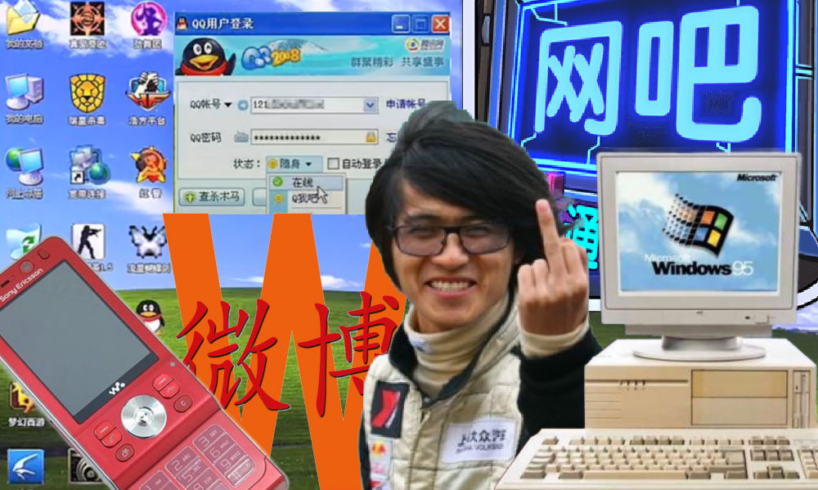
A brief article that poses the question, “How far has Weibo gone downhill?” Most of the article is a Chinese version of a statement from “What’s on Weibo” founder Manya Koetse, explaining that the website—which has tracked Weibo trends since 2013—will be changing its name to “Eye on Digital China,” in recognition of the diversification of the Chinese internet ecosystem, the rise of AI, and the popularity of platforms such as WeChat, Douyin, Kuaishou, and Xiaohongshu.
A collage of images emblematic of an earlier era in the Chinese internet (source: Eye on Digital China)
“Hong Kong’s Tai Po Fire May Have Revealed the Greatest Danger for High-Rise Housing,” by Xu Peng, WeChat account History Rhymes
November 26, 2025
One of many censored articles in November about the catastrophic fire that engulfed the Wang Fuk Court housing complex in the Tai Po district of Hong Kong, resulting in 160 deaths and nearly 80 injuries. The focus of the article is speculation that narrow spaces between the buildings and the presence of bamboo scaffolding covered in cheap netting may have contributed to the disaster by allowing the fire to spread more quickly. The author writes that the Wang Fuk tragedy serves as a stark warning about the long-term safety risks of high-density, aging “vertical communities” in Hong Kong, mainland China, and elsewhere.
“Why Did Hong Kong Burn Like This?” WeChat account 码头青年 (Mǎtou Qīngnián, Port Youth)
November 27, 2025
An article expressing profound shock and sadness that such a severe urban disaster as the Wang Fuk fire could occur in Hong Kong, a city once renowned for its order and efficiency. The author mentions various facets of the disaster: the victims were predominantly elderly residents unable to evacuate quickly; the 40-year-old complex was undergoing renovations at the time; highly flammable nylon netting and bamboo scaffolding used during renovation may have contributed to the blaze spreadinh so quickly. The author also suggests that inadequate regulatory oversight may have played a role, and links this to a broader systemic decline in Hong Kong’s governance and regulatory enforcement over the past decade.
“Hong Kong’s Biggest Conflagration is a ‘Reckoning’ 40 Years in the Making,” by Shou Ye, WeChat account 兽楼处 (Shòu lóu chù, “Beast office”)
November 28, 2025
Framing the Wang Fuk fire as a type of “reckoning” for Hong Kong’s hyper-dense public housing model, this article suggests that the complex’s “flexible cross-shaped” design with eight housing units per floor amplified the fire’s spread. The tragedy was exacerbated, says the author, by a long-delayed exterior renovation project using highly flammable materials to save costs. The author also argues that the failure to upgrade to safer metal scaffolding was due to political resistance by the powerful bamboo scaffolding workers’ union. (The role of bamboo scaffolding in the fire is, however, intensely disputed.)
“Comparing the Hong Kong Fire to the 2010 Shanghai Jiaozhou Road Fire: Excessive Subcontracting, Misappropriation of Funds, Compensation Schemes, and Housing Price Aftereffects,” by Uncle Da, WeChat account Uncle Da’s Theory of Evolution
November 28, 2025
WeChat blogger Uncle Da discusses some of the parallels between the Hong Kong Wang Fuk fire and the 2010 Shanghai Jiaozhou Road fire, claiming that both were preventable high-rise disasters plagued by poor project management and the use of outdated, flammable construction materials. The author writes that the Shanghai fire involved extensive subcontracting that pushed risk onto low-level workers, while the Hong Kong fire involved alleged misappropriation of renovation funds. The piece concludes by noting that even 15 years later, many victims of the Shanghai fire are still awaiting financial compensation.
“Cut Off Mid-Song! Will Everything Be Cancelled Now?” by Japanese Drama Room-Kun, WeChat account Japanese Drama and Music Room
November 28, 2025
A long, photo-illustrated article about a wave of cancellations of Japanese concerts and cultural events across China, including those from major artists like J-pop icon Ayumi Hamasaki (who performed to an empty stadium after authorities shut down her show). The abrupt shutdowns, sometimes occurring mid-performance or just hours before showtime, were attributed to “force majeure” following Sino-Japanese diplomatic tensions sparked by Japanese Prime Minister Sanae Takaichi’s comments on Taiwan. The author notes that the suspension of film approvals and live performances signals a significant freeze in Sino-Japanese cultural exchange, and likens this to the nearly decade-long restrictions that China placed on South Korean entertainment following the THAAD missile defense dispute.
“The Low-to-Middle Income Residents of the Hong Kong Housing Complex That Caught Fire,” by Jin Jing, Chen Jingxuan, and Liu Sicong; WeChat account True Story Project
November 30, 2025
A longform investigative report focused on the economic struggles of Wang Fuk’s low- and middle-income residents, many of whom invested their life savings to purchase units in the housing complex decades ago. After shelling out an average of HK$160,000-180,000 ($20,500-23,000 U.S. dollars) per household for much needed exterior repairs, many of the residents spent months living in cramped, darkened, stuffy homes. Then came the fire, the terrible loss of life, the loss of their homes and belongings, and the move to resettlement housing. The article underscores how numerous systemic failures, ranging from flawed design to regulatory negligence, have disproportionately victimized some of Hong Kong’s most vulnerable residents.