EU leaders are deciding on Russian assets for a loan for Ukraine at a summit in Brussels. Ukraine’s 3rd Army Corps and defense intelligence level the frontline, take out a Russian regiment in a joint operation in the Lyman direction. Russia’s ability to continue the war depends on Ukraine allies’ pressure, Zelenskyi says.
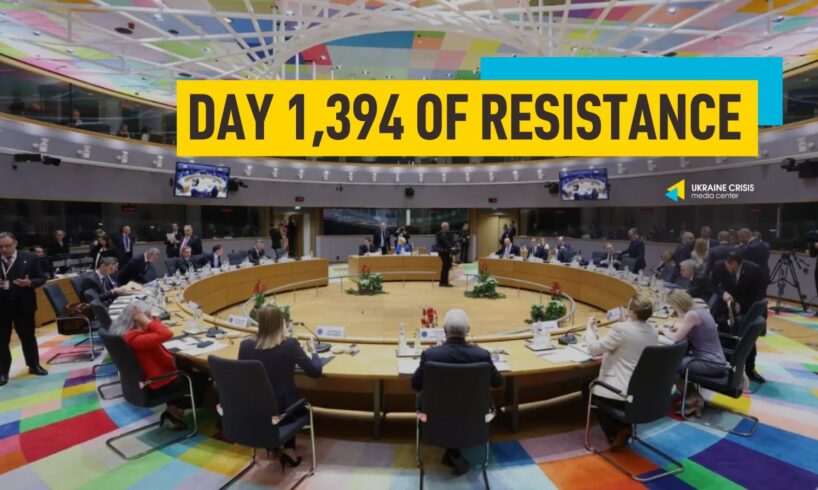
EU leaders deciding on Russian assets for loan for Ukraine at summit in Brussels
EU leaders meeting at a summit in Brussels on Thursday and Friday will decide on unlocking a EUR 210 billion reparations loan to Ukraine, financed by Russian sovereign assets frozen within the EU.
Most resistance comes from Belgium that holds most of the Russian assets immobilized in Europe. Belgium is demanding “independent” and “autonomous” guarantees from EU countries in return for its support for a loan to Ukraine.
Belgium said Thursday that it wants ironclad guarantees that it will be protected from retaliation — legal, financial or otherwise — and that’s become a major stumbling block. Another key demand from Belgium is that all EU countries end their bilateral investment treaties with Russia to ensure Belgium isn’t left alone to deal with retaliation from Moscow.
According to media reports, the U.S. has put pressure on European leaders and their governments to decide against seizing the assets.
Ukrainian President Volodymyr Zelenskyi attended the Brussels meeting in person.
In comments to The New Voice of Ukraine, the EU’s foreign policy chief, Kaja Kallas said EU leaders will try to agree over a reparations loan to Ukraine, which they consider to be a “plan A” solution. They are not working on “plan B.” Kallas restated what EU Council President António Costa earlier said: he has vowed to keep leaders negotiating until an agreement on Ukraine’s financing in 2026 and 2027 is reached.
A reparations loan would seek to support Ukraine through the production and purchase of weapons both in Ukraine and the EU as well as financial assistance to the country. Over the next two years, the EU wants to lend Ukraine EUR 90 billion.
Head of the Ukraine mission to the EU, Vsevolod Chentsov, described the country’s expectations of this week’s summit. Ukraine expects the EU to reconfirm its willingness to provide political, financial, economic, humanitarian and military support, he told Interfax Ukraine on Wednesday. He also said support for the country’s energy system was crucial.
The EU is expected to commend Ukraine for its progress on the accession path and completion of its homework to open the clusters.
Ukraine also expects support to strengthen air defenses that protect its cities, investment into its defense industry and increased cooperation between Ukraine’s and EU’s defense sectors, Chentsov said.
The EU is also expected to further pile pressure on Russia through sanctions, forcing it to engage in talks, he added.
The EU froze Russian assets in 2022 soon after the full-scale invasion. The decision was reconfirmed every six months until last week, when the EU used emergency powers to indefinitely freeze the assets in the bloc, averting the risk of losing control of the funds if any EU country vetoed the renewal of sanctions.
Last year, the U.S. gave USD 20 billion to Ukraine, funded by the profits of seized Russian assets.
Roughly EUR 300 billion worth of the Russian central bank’s assets is immobilized around the world. Of that, nearly EUR 210 billion sits in the European Union. The bloc plans a 140 billion euro loan for Ukraine backed by frozen Russian assets.
The Bank of Russia filed a lawsuit in Moscow seeking 18.2 trillion rubles (USD 229 billion) from Euroclear, Russian state-run media reported Monday. Euroclear, an international fund depository based in Belgium, holds most of the Russian assets immobilized in the European Union.
According to The New Voice of Ukraine, Belgium holds EUR 180 billion worth of the EU-based frozen assets (or 62.2 per cent), Japan – EUR 28.1 billion (9.7 per cent), the UK – EUR 26.6 billion (9.2 per cent), France – EUR 19.6 billion (6 per cent), Canada – EUR 15.1 billion (5.2 per cent), Luxembourg – EUR 10 billion (3.5 per cent), Switzerland – EUR 6.2 billion (2.1 per cent), the U.S. – EUR 4.3 billion (1.5 per cent) and Germany – EUR 210 million (0.07 per cent).
Ukraine’s 3rd Army Corps, defense intelligence level frontline, take out Russian regiment in joint operation in Lyman direction
The 3rd Army Corps and Main Intelligence Department of Ukraine’s Defense Ministry are conducting joint assault operations in the Lyman direction, the 3rd Army Corps said on Telegram Thursday.
The military has leveled the frontline and improved tactical positions in the area. Ukrainian troops took out a number of Russian soldiers comparable in size to a regiment and took prisoner “a significant number” of fighters.
The Ukrainian operations deny the Russians a possibility of maneuver and lay ground for further actions in this section, the unit said.
“Together with the Main Intelligence Department we’ve achieved an operational-tactical result in the Lyman direction. We continue shouldering each other since the times of the liberation of Moshchun and helicopters’ breakthrough to Mariupol,” said Commander of the 3rd Army Corps, Brigadier General Andriy Biletskyi.
Commander of the Artan unit of Ukraine’s defense intelligence, Lieutenant Colonel Viktor Torkotyuk, said the successful operation was an achievement of the frontline troops and commanders “who find solutions to any task.”
Russian forces are trying to employ their new offensive template [recreating their Pokrovsk successes] in the Siversk and Slovyansk-Lyman directions to set conditions for an advance on Ukraine’s Fortress Belt from the northeast and east, the Institute for the Study of War said in late November.
Russian Chief of the General Staff Army General Valery Gerasimov claimed on December 1 that Russian forces entered Lyman. Ukraine’s 3rd Army Corps said Russia’s claimed breakthrough into Lyman was not true.
Russia’s ability to continue war depends on Ukraine allies’ pressure, Zelenskyi says
Russian leader Vladimir Putin’s aggressive rhetoric is not new, while the allies’ pressure will define Russia’s ability to continue the war, Ukrainian President Volodymyr Zelenskyi told reporters ahead of his visit to Brussels on Thursday.
“The signals Putin is sending are not new for us. I’ve always said he does not want to end the war. Will he be able to continue it? The answer depends on our partners and their pressure first of all through sanctions and also by diplomacy,” Zelenskyi said, as cited by Ukraine’s public broadcaster Suspilne.
He added that the Russian economy cannot fully sustain the war as it did before if the sanctions are efficient.
Zelenskyi also said that the U.S. says both publicly and behind the closed doors that Putin is ready to end the war. Ukraine supports diplomatic efforts, but the talks are not easy.
“We do not agree over all points of a future agreement. There are disagreements over territories, financing, frozen assets and some other issues,” he said.
If Putin hampers peace efforts, which are at their most intense point, the U.S. should increase pressure on Russia, Zelenskyi added.
Speaking at an annual meeting with the defense ministry on Wednesday, Putin said the aims of what Moscow calls its “special military operation” would be met “unconditionally”. “If they do not want a substantive discussion,” he said, “then Russia will liberate its historical lands on the battlefield.”
He blamed former U.S. President Joe Biden for “consciously” unleashing the war in Ukraine and said that the “European little pigs” immediately backed the Americans.
“Today, we again heard signals from Moscow that they are preparing to make next year a year of war. And these signals are not only for us. It is crucial that our partners see them, and not only see them but also respond – especially partners in the United States, who often say that Russia wants to end the war,” Zelenskyi said in his nightly address on Wednesday. “This Russian mindset must be recognized — and acted upon. And when they are in this very mindset, they will also undermine diplomacy — seeking, through various diplomatic language and pressure over specific points in documents — to merely mask their desire to destroy Ukraine and Ukrainians, and the desire to legitimize Russia’s theft of our land,” he added.