A Canadian military counter-intelligence operative, who stands accused of passing sensitive information to Ukraine, was involved in an investigation into allegations that a leading Canadian defence journalist was a longtime Russian asset.
Two sources with knowledge of the case tell CBC News that Master Warrant Officer Matthew Robar was tasked to look into claims that Postmedia journalist David Pugliese had been recruited by the KGB in the early 1980s.
The sensational allegations were made in public before the House of Commons committee on public safety on Oct. 24, 2024, by former Conservative cabinet minister Chris Alexander, who produced a dossier of records purportedly from old KGB archives in Kyiv.
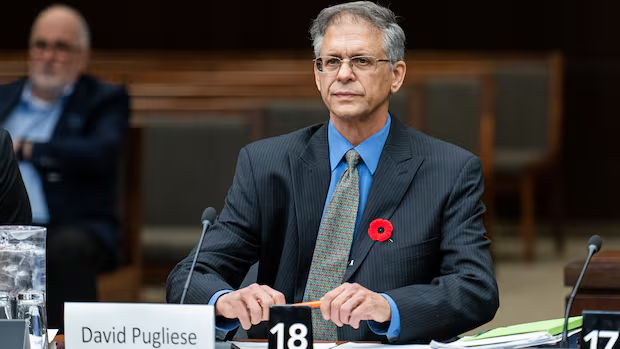
Pugliese, a tenacious journalist with the Ottawa Citizen who has exposed wrongdoing and mismanagement at the Department of National Defence for years, has vehemently denied the allegations, including in his own appearance before the Commons committee last year.
Robar faces eight charges under the National Defence Act and the Security of Information Act. He is accused of having unauthorized contact with a “foreign entity,” according to court records.
CBC News has confirmed through confidential sources that the individual was a representative of Ukraine’s defence intelligence agency.
As part of his investigation into the Pugliese dossier, Robar was introduced to an individual by another Canadian official. That set into motion the relationship which ultimately led to the charges laid against the veteran counter-intelligence officer on Dec. 10.
The seven-page dossier on Pugliese’s alleged Russian intelligence ties mysteriously surfaced in Eastern Europe in 2023 and Ukraine intelligence’s directorate (DIU) was handed a copy, according to two confidential sources, who asked not to be named because of the sensitivity of the investigation.
The Ukrainians’ overall intelligence agency, in turn, turned the dossier over to Canadian intelligence and “offered assistance” in investigating, the sources added.
‘Hallmarks’ of Russian disinformation
However, the suspicion — inside and outside — of the intelligence communities in both countries is that the documents are part of an elaborate Russian information operations campaign designed to discredit a number of Canadians, sow confusion in the political and institutional ranks of Canada’s Defence Department and drive a wedge between Canada and Ukraine.
“It has all the hallmarks of a Russian intelligence information operation, of which, you know, they are very experienced,” said national security expert Wesley Wark. “Not to say that they’re geniuses at it, but they have, what is it, 100-plus years of experience at doing these kinds of operations.”
A spokesperson for the Ukrainian Embassy in Canada would not comment on the Robar case, nor the allegations contained in the Pugliese dossier.
“With respect for the important work of the mass media, we would like to note that the Embassy of Ukraine in Canada does not comment on allegations or information attributed to anonymous or unidentified sources,” said Marianna Kulava, who added the embassy has not been contacted by Canadian authorities.
A member of the Canadian Armed Forces guards the Frederick Gate entrance in Petawawa, Ont., Tuesday, June 20, 2023. Master Warrant Officer Matthew Robar was released from custody at the base on conditions Monday. (Spencer Colby/The Canadian Press)
“We highly value our close partnership and friendship with Canada, and we are profoundly grateful for all the strong and principled support Canada and Canadians continue to generously provide to Ukraine.”
Unclassified court records, filed as part of the national security case against Robar, showed that he was warned to break off contact with the foreign intelligence representative, whom sources say he’d initially sought out as part of the Pugliese investigation.
The allegations levelled by military prosecution state that Robar was denied permission to work with the individual, who had been trying to solicit funds for a separate project, which the court records don’t identify.
The military prosecution also alleges that during the course of his dealings with the foreign intelligence representative, Robar revealed the identity of another Canadian intelligence officer who was engaged in covert activity. He is also believed to have shared the Canadian intelligence assessment that had been done on the person he was dealing with.
It was also alleged that Robar attempted to establish a direct relationship with the country’s defence intelligence agency and even discussed possibly going to work for them.
None of the allegations have been proven in court.
Pugliese says he wasn’t contacted by Robar
It’s unclear how much of the alleged activity related to the investigation into the Pugliese dossier.
Nothing in seven pages that Alexander tabled with the House of Commons following his testimony proves that Pugliese carried out any assignments for the KGB, the predecessor of the FSB, Russia’s modern-day intelligence service — or that he was even aware of the apparent Soviet interest in him.
In an interview with CBC News, Pugliese said he was never contacted by Robar — or the Defence Department — about the allegations against him or the investigation that had been launched into the dossier.
Military court records allege a foreign country was interested in obtaining allied funding and support for a project pursued by Master Warrant Officer Matthew Robar. Sources tell CBC News that country was Ukraine. (Sean Kilpatrick/The Canadian Press)
“I didn’t know there was an investigation of any kind,” said Pugliese, who added he wondered why military counter-intelligence would be involved and not the Canadian Security Intelligence Service (CSIS).
“I think the proper thing to do would have been to contact me and ask questions of me on what I thought of this so-called dossier.”
All of the documents in question predate the collapse of the Soviet Union in 1991.
“One of the first things is — everyone calls them documents,” Pugliese said. “What they are, are photostats and we don’t know where they’ve come from. So, everyone’s received them anonymously, and they’ve floated around for I don’t know how long. That should be setting off warning bells, whether this is an FSB operation or whether this is, I don’t know, forgeries.”
Researcher questions dossier’s typeface
The dossier, Pugliese said, contains a number of blatant errors, including where he was living at the time the Soviets were supposedly interested in him and falsely painted him as a left-wing student activist.
Giuseppe Bianchin, an independent researcher, looked into the documents Alexander presented at committee and argues — after consulting with a number of experts — that the dossier is a forgery.
“These pages alleging David Pugliese’s recruitment by the KGB are beyond reasonable doubt modern forgeries, crafted with deliberate intent to deceive,” Bianchin wrote in a report.
Bianchin said he consulted Erik van Blokland, a typeface expert and designer, regarding the documents that appeared to have been produced by a typewriter.
Van Blokland argued that the documents couldn’t have been produced on a typewriter and pointed to repeating specks of dust in certain characters which would be impossible to replicate on a mechanical typewriter. Furthermore he suggested that the repeated presence of the specks of dust are characteristic of Trixie Cyrillic, a typeface van Blokland invented in the early 1990s — years after the documents were purported to be created.
CBC News reached out to both van Blokland and one other expert named in the report, both of whom confirmed their analysis as presented by Bianchin was accurate.
Bianchin was asked what motivated him to spend time and energy trying to clear the name of a Canadian journalist whom he says he doesn’t know. Bianchin, a Michigan resident, told CBC News in recent weeks that he took a personal interest in the case while taking an online journalism course.
His report further muddies waters around the case.
CBC News has spent months trying to independently verify the authenticity of both the dossier involving Pugliese and the counter-dossier report. Those efforts have been so far inconclusive.
Pugliese and Postmedia are being sued over his reporting on alleged mismanagement inside a pair of charities set up to help Ukraine, Mriya Aid and Mriya Report. Both have Canadian connections.
Pugliese said he’s only been doing his job— trying to hold the government accountable. And if the dossier is an attempt to sow confusion, he says it has done so in spades.
“It certainly has set people in government and elsewhere chasing their tails, as everyone tries to, you know, claim that, or prove, that I’m some kind of deep-cover Russian by which, as I’ve repeatedly stated, is not only false, it’s just absolutely ridiculous,” Pugliese said.