The New South Wales government will move to limit protest rights and ban the display of hate symbols as it continues to reform state laws in the wake of the Bondi terror attack.
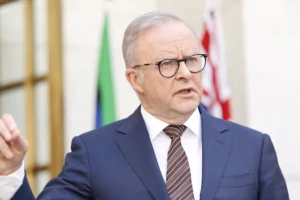
The premier, Chris Minns, said a ban on the phrase “globalise the intifada” would also follow tighter gun laws and new powers to ban protests for three months, after he linked pro-Palestine rallies to the shooting that killed 15 people.
Here’s how state laws are set to change.
What is the NSW government proposing?
Minns on Saturday announced the state will move to ban the display of hateful symbols, matching national laws, and give police new powers.
It would be illegal in NSW to publicly display flags and other symbols of listed terrorist organisations, including Islamic State, al-Qaeda, Hamas, Hezbollah, al-Shabaab, Boko Haram and others from “around the world”, according to the NSW attorney general, Michael Daley.
Federal laws already prohibit such displays, but Daley said the new state law would be simpler. Those responsible would face up to two years’ prison, similar to an existing state ban on Nazi symbols.
The state will also allow police to require a person they believe is committing any offence at a public assembly to remove their face covering.
Existing laws only give police that power that when the person is suspected of a serious indictable offence. Minns denied reforms would violate the rights of women wearing face coverings for religious reasons.
“Police [will] be in a position to identify who is responsible for offensive conduct, hateful slogans or racist behaviour,” Minns said.
The government will also move to limit gun owners to holding four firearms and create a power to effectively ban protests for three months after a terrorism event, in reforms announced earlier this week.
What about hate speech?
The government wants to expand its hate speech laws to include the phrase “globalise the intifada” and other phrases.
“I will insist that ‘globalise the intifada’ is included in that list of hateful, violent rhetoric in New South Wales,” Minns said.
Intifada literally means uprising or resistance, and is the term used by Palestinians for uprisings against Israel. The first intifada ran from 1987 to 1993, the second from 2000 to around 2005.
Former Guardian correspondent Ewen MacAskill previously wrote the “enduring image of the first [intifada] is of Palestinian youths throwing rocks at Israeli soldiers”.
“The second was a full-scale confrontation, with Israel attacking Palestinian cities and towns with artillery, tanks, helicopters and jets while Palestinians fought back with rifles and explosives … [and] terrorised Israel by sending suicide bombers across its border… More than 3,000 Palestinians and more than 1,000 Israelis were killed.”
For Palestinians and their supporters it can mean resistance against oppression, but many Jewish groups and leaders see it as a call to violence against people of their faith.
Two people were arrested after allegedly shouting slogans calling for “intifada” during a protest by pro-Palestinian demonstrators in London on Wednesday, amid a new crackdown by the Met and Greater Manchester police in the UK. The group behind the protests said uttering the word “intifada” was not a call for violence and condemned police for the “political repression of protest for Palestinian rights”.
To ensure the expansion of hate speech laws survives legal challenges in NSW, the government will send laws to a parliamentary committee. Minns said the government will look to ban the phrase in the new year after the committee reports back.
Asked whether the phrase “from the river to the sea” would be banned, he said he would not prejudge the parliamentary committee’s investigation.
Minns also flagged NSW would take further action against preachers and community figures who promote hatred or violence, following a federal government crackdown announced this week.
More law reform will follow in 2026 if people find loopholes in the proposed changes, Daley said.
“We will not stop. This process will never end,” Daley said.
“We can’t force people to live together in harmony … [and] for those very small few who decide that they won’t do that, what is left at our disposal is strong legislation backed up by the best police force in the world.”
What does this mean for protests?
While specific bans on protests and the phrase “globalise the intifada” are yet to be legislated, Minns said residents who engage in either could face legal trouble.
Chanting “globalise the intifada” may already be in breach of existing hate speech laws in the state, according to advice provided to government, Minns said.
“You’re running a very risky racket if you’re thinking of using that phrase before the bill goes through,” he said.
Minns also warned police would not tolerate breaches of the law, including at any unauthorised protests planned for this week.
“If there’s an unauthorised protest and they attempt to go on the street, take over the streets, then they’ll met with the full force of the law,” he said.
Police have warned any large-scale public gatherings will face a significant policing response.
Could reforms be stopped by parliament or legal challenges?
All of the flagged reforms are yet to pass the state parliament, which will sit on Monday and Tuesday.
Daley said he had briefed the opposition on previously announced protest and gun reforms and would continue to discuss the changes with the crossbench. Face covering and hate symbol reforms will also be put to parliament in December.
Minns said he believes the protest-limiting reforms are constitutional and the government is prepared for any legal challenge. He said his cabinet unanimously believes the reforms are essential, including Penny Sharpe and Jihad Dib, who marched across the Sydney Harbour Bridge in August to protest against the killing in Gaza.