If you missed Part I, you can read it here.
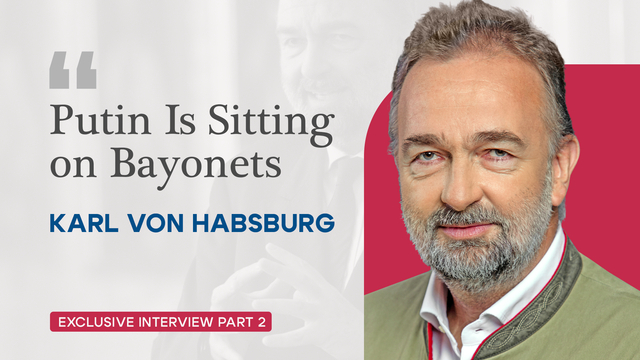
Karl von Habsburg – grandson of the last Austrian emperor Charles I and current head of the House of Habsburg – is a politician, public figure, and journalist. He continues his discussion with Kyiv Post on Ukraine’s path to EU and NATO integration, the necessity of full victory, and Europe’s role in countering Russia’s aggression.
JOIN US ON TELEGRAM
Follow our coverage of the war on the @Kyivpost_official.
Kyiv Post (KP): In an ABC News interview, President Volodymyr Zelensky said Ukraine’s victory means state survival, as Russian President Vladimir Putin wants to occupy the entire country. How do you define victory for Ukraine?
Karl von Habsburg (KvH): Survival is the first step. I agree with him, but that cannot be the ultimate step. The ultimate step has to be Ukraine’s territorial integrity and sovereignty.
It has to include the question of reparations being paid – not only for the destruction of industry and infrastructure but also for refugees. We’re talking about huge amounts here, because we’re talking about 5 million refugees and internally displaced persons who have been away from home for years.
So, Russia has to pay a price. If it takes 50 years, then it takes 50 years. If it takes 100 years, then 100 years. It took Germany a hundred years to pay back reparations for the First World War.
And one more thing that I think should be stated is regime change in Russia. We have to put this as a goal of the war, which I truly believe in.
Other Topics of Interest
ISW Russian Offensive Campaign Assessment, December 21, 2025
Latest from the Institute for the Study of War.
If the first two points work – or even if the first point alone works, the territorial integrity and sovereignty of Ukraine –regime change will follow in Russia, because politically it cannot be sustained otherwise.
I think it was Otto von Bismarck who said: “You can do anything you like with bayonets except sit on them.” That is exactly what Putin is currently doing – sitting on bayonets – and that just doesn’t work in the long term.
KP: Zelensky and other Ukrainian officials have repeatedly said that China could pressure Russia into a peace deal with Ukraine. Do you think that’s possible?
KvH: Peace negotiations must have a clear starting point somewhere. First of all, they have to happen with the participation of Ukraine, because Ukraine is the victim. Any peace negotiation without Ukraine at the table is, for me, basically invalid. All these absolutely ridiculous summits in Anchorage and things like that are completely valueless exercises.
The role of China is very difficult to assess. I think China can have a great influence on Russia because it’s providing Russia with a lot of material.
China sometimes acts very pragmatically. If China was really threatened by sanctions, I assume it would stop its support for Russia, because its own economic situation is more important than supporting Russia.
I think the idea of making it very clear to China that any support for Russia will have consequences would be a very good thing to do – but that would have to happen in unison between Europe and the US.
Apart from that, China is very economically minded, and providing Russia with material that it needs is part of that economic thinking.
Karl von Habsburg at a Symposium celebrating the 150th anniversary of Chernivtsi National University. Photo: Julia Struck/Kyiv Post.
KP: As a reserve captain in the Austrian Air Force, how do you assess the current situation on the battlefield in Ukraine?
KvH: I’m not in the Air Force anymore – I wish I were, but I’m too old for that. Basically, I still have my function in the Austrian Armed Forces reserves. I don’t know whether it qualifies me at all to judge, but I’m talking to a lot of friends who are much more qualified to do that.
I can definitely see that the general opinion of those who really know the situation is that militarily, it looks very complicated and very difficult for Ukraine.
But on the other side, it’s a question of spirit. In the very long term, determination is something that really will push through – and that determination is definitely on the Ukrainian side.
As long as we in the West manage to provide Ukrainians with the means to fight and support that fight, I think there is an extremely good chance for Ukraine to prevail in the long term.
One also has to look back at previous wars. One of the most amazing pieces of fake information that Russia keeps putting forward is this notion of Russian invincibility: unlimited reserves, unlimited personnel. That’s absolute nonsense.
If you look at the track record of wars in the past, Russia was not exactly successful. Whether you go back to the Russo-Japanese War, World War I, World War II, or the war with Finland, Russia lost again and again. This invincibility just does not exist, and they’re also going to lose in Ukraine.
I think the chances for Ukraine are pretty good, but it’s an extremely hard and long road.
KP: You’ve previously said that you joined the military because you couldn’t imagine going into politics without military experience. Some Ukrainian officials now advise servicemen to stay out of politics, arguing that it’s a “dirty business” and that they could be exploited by certain political forces. What is your take on this?
KvH: I mean, these are two different things. When you’re on active service in the military, you should stay out of party politics – that I totally agree with, because you have to serve the country.
On the other hand, if you have military experience, it allows you to better assess and understand crisis situations. You gain a much clearer view of what’s actually happening.
One thing I’m very glad about in Austria is that we still have compulsory military service. I think that’s very important, just to have some experience in that field. If you look at a country like Switzerland, you cannot have a career in civil service or certain other sectors unless you have had a military career, even in the reserves.
I think that’s a very good thing, because the military does not only take – it also gives a lot. It provides experience, leadership skills, understanding of group dynamics, and many other things that are also very important in other parts of life.
Karl von Habsburg on the awarding ceremony of the European Prize Coudenhove-Kalergi (Photo by Valeria Maltseva)
KP: And what do you think about Austria? Do you think it stays neutral, or is it now leaning more toward Ukraine?
KvH: I think we’re currently definitely leaning more toward Ukraine because of our Minister of Foreign Affairs, Beate Meinl-Reisinger. She is doing an absolutely fantastic job. She’s really very clear. She’s getting a lot of flak because of that.
People say, “Oh, you’re violating neutrality,” which is absolute nonsense. She’s not violating neutrality at all. She’s just very clear on Ukraine.
I just don’t think we have a strong government at the moment.
The role of Austria, in my opinion, is definitely on the weak side. Austria could do substantially more than just excuse itself and say that because of neutrality, we cannot even deliver demining equipment or anything like this. I’m sad about that. I just hope it becomes better.
KP: You’ve often called Ukraine your home and spoken about your deep connection to it. How did you feel on Feb. 24, 2022, when Russia launched its full-scale invasion?
KvH: My thoughts were very much with my employees in Kyiv… For the first couple of days, I was extremely nervous to see what the developments were and what would happen – not just to the country, but also on a very personal level with all the friends we have, and also with the people who are working for me in Kyiv.
I was trying to stay in touch with them and also go there as fast as possible to find a solution to keep being active.
I will never forget the CEO of my company [the Kraina FM radio station], who was in Hostomel, in his home. He called me, standing at his window, holding his phone out, and he said, “Do you hear Russian helicopters flying overhead?” And I could hear the helicopters flying.
And I was like, “Oh my god, this is absolutely unbelievable.” These things become very personal.
KP: What is your advice for the people of Ukraine?
KvH: Whenever I leave somebody, I say, “Stay safe.” That’s the most important thing. But for me, keeping up the spirit is at least equally important, because in the very end, it’s the spirit that decides over victory or defeat.
Weapons can help, but it’s the spirit that truly matters. That’s the spirit you can feel in Ukraine on many levels. Sometimes, of course, it’s missing, but on many levels, you can feel it – and it’s the spirit that has kept people going.