The company in Moradabad, a city in the Indian state of Uttar Pradesh, about 150 kilometres east of New Delhi, describes itself as a “leading manufacturer of premium singing bowls,” which are used in sound therapy and religious practices.
On IndiaMART, the country’s largest business-to-business marketplace, connecting manufacturers in India with customers around the world, a company with the same name and business ID appears to offer a very different set of products: chemical precursors used in the manufacture of fentanyl and other illegal narcotics. Listings promise delivery to Canada, the United States and Mexico in two to three days in “factory-sealed” packages.
The Globe and Mail investigated the availability of chemicals used in the production of fentanyl for sale on Indian and Chinese online marketplaces as part of Poisoned, a continuing series examining the opioid crisis and the impact it has had on Canada. This reporting found numerous fentanyl precursors and their analogues being sold, both openly and apparently masquerading as other products (often with a slight typo in the name or using a known alias for the chemical).
Precursors are chemicals that can be mixed to create fentanyl, and have largely replaced the finished drug in seizures by law enforcement, as production shifts from Asia to North America. Experts interviewed agreed that what is available on public platforms is likely only a small fraction of offerings on the dark web and in encrypted chat groups.
Some of the chemicals offered for sale are subject to strict international controls, while others are criminalized or tightly regulated in Canada, but less so in India and China. As no purchases were made by The Globe, it is unclear whether roadblocks would have arisen further along the process, or if some of the alleged sellers may have been scammers.
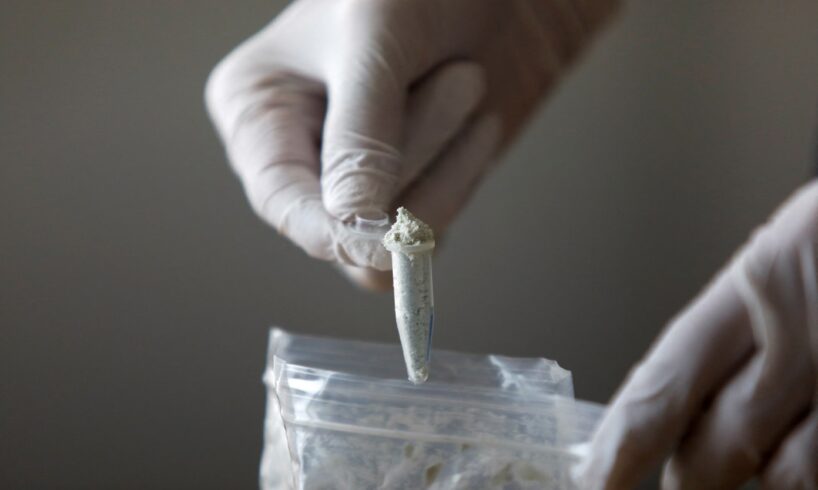
Open this photo in gallery:Open this photo in gallery:
Fentanyl can be shaped into small pieces for smoking, but users should beware: Even small amounts are enough to potentially cause overdoses.Chad Hipolito/The Globe and Mail
In the past, both Ottawa and Washington have warned of fentanyl precursors making their way from India and China to North America. The U.S., in particular, has been aggressive in sanctioning Chinese and Indian companies and pressing Beijing and New Delhi to take action. Canadian law enforcement has also sought to disrupt criminal syndicates involved in shipping the illegal chemicals and busting labs that turn them into fentanyl.
This has had some effect: China said in November it will further tighten controls on precursor chemicals by adding the U.S., Mexico and Canada to a list of countries requiring special export licenses for 13 chemicals used in the manufacture of fentanyl (many of which have other, benign uses, making them hard to ban outright). New Delhi, too, has pledged to crack down on the sale of precursors, though experts warn the Indian chemical market is tougher to regulate and more prone to corruption than China’s.
In response to a series of questions from The Globe, the RCMP said it currently has no evidence to suggest the shipment of precursor chemicals “from India or China for the purposes of synthetic drug production is an increasing threat to Canada.”
Data from the Canada Border Services Agency (CBSA) show, however, an increase in 2025 compared with the year before in the number of seizures from those countries of “other controlled drugs,” a category that includes most precursor chemicals. There was also a significant jump in the amount of two specific fentanyl precursors, 1,4-butanediol and Gamma butyrolactone, seized by border agents in shipments from China in 2025.
Asked about the RCMP’s threat assessment, spokesperson Robin Percival said in an e-mail that “precursor chemicals from countries such as China and India remain an ongoing concern and priority for the RCMP,” but current intelligence “does not indicate an increase in activity, and therefore the threat level remains stable.” This assessment was based on “operational data, intelligence inputs and collaboration with domestic and international partners,” Ms. Percival said.
As the Carney government spent 2025 trying to improve ties with China and India, law enforcement in those countries have also tried to work more closely on anti-drug efforts.
Adrian Wyld and Sean Kilpatrick/The Canadian Press
U.S. President Donald Trump has cited the “flow” of fentanyl from Canada as justification for tariffs on some Canadian goods. In an effort to appease the White House – and despite law-enforcement data showing only a minuscule amount of fentanyl is, in fact, being seized at the U.S. northern border – Ottawa last year committed $1.3-billion to a border plan aimed at preventing fentanyl trafficking.
At the same time, Canada has recently been attempting to improve relations with both India and China – including greater co-operation on law enforcement matters such as curbing shipments of fentanyl and its chemical precursors.
The Globe’s investigation, however, points to how difficult it may be to truly crack down on the shipment of fentanyl precursors and related chemicals to North America. Unlike heroin or cocaine, which derive from opium poppies and coca plants, respectively, fentanyl can be produced entirely in a lab from precursor chemicals, and is consumed in minuscule amounts compared with other drugs – users often buy 0.1-gram doses – making it one of the hardest narcotics to effectively police.
While international controls have largely stopped the illicit shipment of fentanyl itself from Asia, what is being sent from Asia to North America today is more likely to be fentanyl precursors. Or, in cases where these have also been banned, shipments may include what are known as “pre-precursors” – chemicals further down the manufacturing chain – or analogues, variants of existing precursors modified enough to be legally distinct but still effective.
Canada’s fentanyl czar, Kevin Brosseau, described the sale of fentanyl precursors on Indian and Chinese marketplaces as a “serious and growing enforcement challenge,” particularly because these chemicals often have legitimate industrial and pharmaceutical uses.
Mr. Brosseau, who was appointed in February as part of Ottawa’s effort to demonstrate to the U.S. that it is actively working to disrupt the illegal production and distribution of fentanyl, noted that Canada’s ramped-up detection and enforcement efforts have recently resulted in major seizures of precursors. In May, for example, Canadian border officers in British Columbia examined two marine containers from China – both of them destined for Calgary – and found a large volume of precursor chemicals, including 500 litres of propionyl chloride.
Open this photo in gallery:
Under fentanyl czar Kevin Brosseau, left, border officials have caught several major shipments of precursors.Spencer Colby/The Canadian Press
New fentanyl precursors are constantly emerging, so even if one chemical is scheduled – added to a list of banned substances – and more tightly controlled, another one will inevitably appear. As part of Canada’s border plan, Ottawa announced last week that it had finalized regulatory amendments aimed at increasing oversight of precursors and decreasing the availability of drug-manufacturing equipment, such as pill presses and encapsulators.
“We’ve seen the use of pre-precursors or non-controlled chemicals really take off the past six or seven years as the trade in controlled primary precursors has tightened and supplies have been limited,” said Jeremy Douglas, a senior official with the United Nations Office on Drugs and Crime. “The shift is really pronounced in Asia and taking hold globally, and the international control system is struggling to keep up.”
Since 2019, CBSA has noted a decrease in seizures of finished fentanyl, but a massive spike in the amount of precursors making their way to Canada, where organized crime groups have in recent years formed alliances with Mexican cartels and are now mass-producing the opioid at clandestine labs.
Vanda Felbab-Brown, an expert on organized crime and a senior fellow at the Brookings Institution, told The Globe domestic production of fentanyl and meth is happening in Canada in a way that it’s not in the U.S. This, she said, is owing to a number of factors, including regulatory and law-enforcement tactics in the mid-2000s that forced meth production out of the United States. Fentanyl production, she said, has never occurred on any significant scale in the U.S.
“Canada has production of both fentanyl and methamphetamine that supplies Canadian markets,” said Ms. Felbab-Brown, who testified earlier this month before the U.S. Senate Caucus on International Narcotics Control, and spoke about the challenges of cracking down on online marketplaces selling precursor chemicals.
She said that while China has long been a known source of precursor chemicals, India has increasingly come up in her conversations with Canadian and American law-enforcement authorities. “All the problems you have with China, you have magnified with India – very loose postal shipping services, old-fashioned law enforcement that’s not designed to deal with synthetic drugs, an extremely powerful and sprawling chemical and pharmaceutical industry with very poor monitoring, and very poor regulation.”
Many precursors have legitimate uses, meaning regulations need to be stringent enough to curb imports by organized crime while at the same time allowing companies to access them for above-board purposes. It can also be extremely difficult to trace the origin of the drugs, because of limitations in forensic chemistry and the proliferation of sophisticated transit routes designed to evade authorities.
Precursors can be shipped in small quantities through international mail or in larger volumes via shipping containers. The chemicals are often mislabelled in an apparent attempt to elude authorities; in 2022, border officers in the Metro Vancouver area examined a shipment from China that had been declared as “toys” and found 1,133 kilograms of a fentanyl precursor with the potential to produce more than a billion doses of the synthetic opioid.
Customs data examined by The Globe, from shipments implicated in subsequent criminal cases, show the presence of non-controlled chemicals that the authorities have since said were of illegal narcotics. Exporters have also taken advantage of the ever-changing legal situation around precursors and the grey area of molecularly similar but legally distinct chemicals.
Nick Souccar, an Ottawa-based inspector with the RCMP, said “criminal networks frequently circumvent regulations by using analogs or modified versions of” fentanyl ingredients.
“Organized crime groups have unlimited funds facilitating research and development in support to their illicit activities and leverage advanced chemical synthesis techniques to modify compounds,” he said in an e-mail. “Furthermore, most of the chemicals used in the production of illicit drugs have legitimate industrial uses. As such, their movements, both domestically and globally, are constant and difficult to track and regulate.”
Open this photo in gallery:
When Reuters purchased precursors from a Chinese seller in 2024, some boxes came with fake labels or bags to pass off their contents as something else.Shannon Stapleton/Reuters
Prospective manufacturers or distributors in North America can easily connect with India and China’s sprawling chemical industries online on specialized marketplaces, buying narcotic ingredients in the same way that a tool manufacturer might source screws on AliExpress, the Chinese everything marketplace.
Efforts by Beijing to control this trade – in response to pressure and sanctions from Washington – have had some success: The Globe’s searches on a number of leading Chinese chemical marketplaces did not return results for major fentanyl precursors, such as 4-ANPP, with one website warning it was “prohibited from sale according to relevant laws, regulations and policies.”
However, legal or less tightly regulated pre-precursors are often available, as are other dangerous chemicals that police in North America have been seeking co-operation in cracking down on.
When a Globe reporter reached out to a dozen Chinese suppliers to enquire about purchasing medetomidine, a veterinary tranquillizer that is often mixed with fentanyl, making the drug more potent but also more dangerous, responses were almost immediate, with customer-service representatives sending e-mails in English and offering to connect over WhatsApp or Zoom.
One company offered to ship a kilogram of medetomidine – which is not tightly regulated in China, but is a controlled-use substance in Canada – from Shanghai to Canada for around $3,700. Another said it had a warehouse in Canada already, which would make it “easy to post to you,” and would accept payment in cryptocurrency.
“We expect to build a good and long relationship with you,” the latter company said in an e-mail. “Any news from you will be highly appreciated.”
The Globe is not identifying these companies as the sale of medetomidine is not illegal in China. But the search showed how easy it is to connect with sellers in China’s vast chemical industry, and potentially acquire products that exist in the grey area of legality, a constantly moving target as chemists tweak recipes to avoid regulation.
Connecting with Indian suppliers of medetomidine and the related drug xylazine is similarly easy, as is finding companies exporting internationally criminalized fentanyl precursors and highly regulated chemicals involved in the drug’s production.
As well as the singing bowl exporter, The Globe found a “fertilizer company” based in Tamil Nadu advertising the “best range of specialty chemicals.” This included 4-Piperidone Hydrochloride and 1-Boc-4-piperidone, both used in the manufacture of fentanyl. The latter was listed under a slightly different spelling, offering shipment to Mexico, Canada and the United States.
Like the singing bowl supplier, the fertilizer company’s store on IndiaMART lists an address and business registration number linked to a real business. It is unclear whether the online stores are related, or have co-opted the names of legitimate companies. The Globe attempted to contact both businesses by e-mail addresses listed on their websites and marketplace pages to inquire whether they were aware of the IndiaMART store, but did not receive a response.
IndiaMART also did not respond to multiple requests for comment.
Indian law enforcement – increasingly visible in major cities after an alleged terrorist attack last month – is defending its approach for policing online spaces where precursors are bought and sold.
Channi Anand/AP; Francis Mascarenhas/Reuters
In September, the U.S. added India to a list of “major drug transit or major illicit drug producing countries,” following indictments of Indian chemical companies for their role in shipping fentanyl precursors to North America.
Neeraj Kumar Gupta, a deputy director-general at India’s Narcotics Control Bureau, said India had tightened regulation of fentanyl precursors and was working with the U.S. to crack down on their sale.
“We have a robust system and our actions are commensurate with the problem,” Mr. Gupta said. “There are naturally growing concerns on how the internet can be misused to trade in illicit substances. However, we need to look at the larger picture: Not every chemical, like pre-precursors that can be used to make substances like fentanyl, are banned as they have other industrial uses.”
Nevertheless, Mr. Gupta added, the Indian authorities “regularly patrol online spaces to crack down on the illegal trade of banned or controlled substances and unlicensed sellers.”
Data from ImportGenius, a global trade data platform which aggregates customs and other shipping data, appears to show chemicals shipped from India to North America being mislabelled or with information left off customs declarations. Exporters, it seems, hope to be overlooked because of the sheer quantity of shipments and the difficulty of both parsing the complicated names of chemicals and testing whether a particular powder or liquid is what it says it is.
The identity of an importer is often missing from customs data. A search for shipments linked to Vasudha Pharma Chem Ltd., a Hyderabad-based company indicted by the U.S. Department of Justice this year for exporting fentanyl precursors, turned up numerous shipments with unspecified recipients, mixed in with apparently legitimate North American chemical companies.
Vasudha did not respond to a request for comment. Two of the company’s top executives are currently facing criminal charges in the U.S.
Sometimes the product itself was equally ambiguous, listed only as an “active pharmaceutical ingredient.” In one case, however, The Globe found a shipment – without a customer named, and from another Indian manufacturer – listing the product as 1-BOC-4-Piperidone, a United Nations-scheduled fentanyl precursor.
Open this photo in gallery:
Because fentanyl precursors can have legitimate uses, restrictions can only do so much in stopping drug makers from acquiring them.Claudia Daut/Reuters
Brookings Institution senior fellow Ms. Felbab-Brown said countries around the world have tightened regulation of precursor chemicals amid pressure from the U.S. to crack down on the opioid crisis. The problem, she said, is that scheduling a drug and enacting controls will only push drug-trafficking networks toward using basic chemicals that have many legal uses.
“You can’t schedule your way out of the precursor problem,” she said, adding that online marketplaces introduce another layer of complexity. “If it’s easy to buy precursor chemicals, then you don’t only need to worry about the large producers and brokers but also the small producers and brokers, which makes things much harder for law enforcement.”
Along with services such as IndiaMART, drug traffickers and manufacturers are known to use marketplaces on the dark web, and anonymized apps like Telegram, to connect with prospective buyers, meaning products listed openly on legitimate websites or shipped with the correct customs data are likely just the tip of the iceberg.
“Organized crime specializes in identifying vulnerabilities and weaknesses in regulations to access and traffic chemicals, to work around controls at borders,” said Mr. Douglas, the United Nations official. “The backbone of the synthetic drug business is the chemical trade, and traffickers will do what it takes to access and maintain supplies.”
With reports from Alexandra Li in Beijing and Neha Bhatt in New Delhi
Poisoned: More from The Globe and Mail
The Decibel podcast
Death is an immeasurable loss to the families of Canadians killed by overdoses. Because so many are full-time tradespeople, the costs to their employers are real and quantifiable. Reporter Jason Kirby investigated the problem spoke with The Decibel about what he learned. Subscribe for more episodes.
More from this series
After taking drastic steps on opioids, Barrie struggles to find its footing
Have Victoria’s millions made a difference on Pandora Avenue? The Globe returns to check
Why are fentanyl deaths in Europe a fraction of those in North America?