“Our team of investigative journalists dives deep to tell stories about the natural world in Canada you can’t find anywhere else.”
That’s how we at The Narwhal introduce ourselves, right at the top of our “about us” page.
It means, in part, that we peel back the curtains in halls of power — revealing how politicians, corporations and institutions make big decisions impacting natural resources and landscapes. It also means, just as significantly, that we send journalists to the hard-to-reach places where some of the most important stories are unfolding, and would otherwise go untold.
We take this commitment seriously, and won’t compromise on the stunning photography, immersive storytelling and in-depth reporting it takes to bring them to life. For example:
The Blackfoot Confederacy is working toward having buffalo across the Canada-U.S. border once again — and revitalizing traditional hunts. Photo: Gavin John / The Narwhal
Reporter Jimmy Thomson and photojournalist Gavin John travelled across Montana and southern Alberta for three days to tell the story of the Blackfoot Confederacy’s effort to restore free-roaming herds of buffalo on the prairie. It’s this kind of unique, gorgeous storytelling that The Narwhal does so well. This year it won the top prize for the best feature story at the cross-border Indigenous Media Awards, as well as the silver in the same category at Canada’s Digital Publishing Awards.
At the National Magazine Awards, photojournalist Amber Bracken’s compelling portraits of Fort Chipewyan residents in a fight for life downstream of Alberta’s oilsands took silver for the best photo essay and photojournalism.
This kind of journalism is expensive and time consuming, and it’s the first thing that most newsrooms pull back as purse strings tighten. But as they lean out, we lean in. Our non-profit, reader-supported model requires that we make good on our promises.
Every year, nearly 10,000 people step up to support The Narwhal, each of them casting a vote that says: these stories are worth telling. Will you join them? Every dollar you give today will be matched — donate now to make twice the difference.
Near Cambridge Bay, Nvt., researchers are pumping sea water onto the sea ice in an effort to thicken it, and delay its melt. Photo: Gavin John / The Narwhal
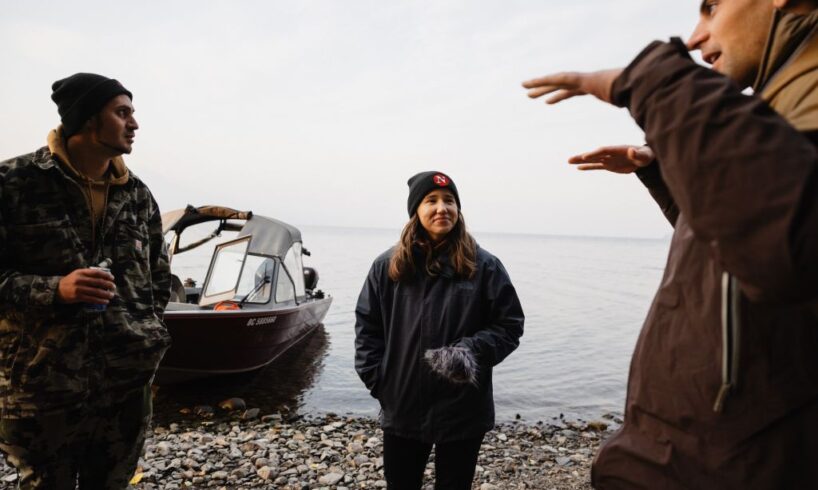
This year, we sent Gavin and freelance reporter Chloe Williams to Cambridge Bay, an Inuit community of about 2,000 people in Nunavut. They spent five days with people on the frontlines of the warming Arctic — and returned with an incredible story about an audacious pitch to bring back the disappearing sea ice and a way of life that depends on it.
Photojournalist Paige Taylor White made four trips to Joffre Lakes Provincial Park, north of Whistler, B.C., between April and September. She documented what the famous park looks like when it’s bustling with tourists — and also during a temporary closure, when the land was given a moment to rest and members of the Líl̓wat and N’Quatqua nations had a chance to reconnect. Reporter Steph Kwetásel’wet Wood joined Paige on two of those trips; they were the only journalists invited into the park to witness the reconnection period.
On Blackfoot territory in Alberta, journalist (and Kainai Nation member) Joy SpearChief-Morris reported on the first-ever Indigenous fire guardians program in Canada and Kainai Nation’s effort to restore the landscape in the traditional way, by embracing fire.
Your support means we can invest in more stories like these in the year ahead. We’re two-thirds of the way to our new goal of raising $300,000 this month to keep going. Help us cross the finish line? A donation today makes twice the impact — and qualifies for a 2025 charitable tax receipt.