At The Narwhal, our goal is to tell stories, even ugly ones, beautifully. This year we sent photographers to capture the adaptation of provincial parks and beaches, the disappearing joy of playing pond hockey on a frozen lake, the reality of old-growth logging, the resilience of an Arctic community adjusting to climate change and so much more. Here are our favourite photos of 2025.
sánəsaʔł stáʔləw (Alouette River) in q̓ic̓əy̓ (Katzie) territory, B.C.
Photo: Isabella Falsetti / The Narwhal
The sánəsaʔł stáʔləw (Alouette River) flow has been reduced by 86 per cent due to the Alouette Dam, operated by BC Hydro. q̓ic̓əy̓ (Katzie) First Nation is calling on the energy utility to let more water through for the survival of salmon and their eggs. q̓ic̓əy̓ citizens Rick Bailey and Mike Leon took photographer Isabella Falsetti and reporter Stephanie Kwetásel’wet Wood to the river to talk about its importance and the changes they would like to see, such as a fish ladder that would allow salmon to bypass the dam. Falsetti’s moody photos capture the misty, lush depth of the forest and give a sense of the relationship Leon and Bailey have with the water.
Wasaga Beach, Ont.
Photo: Carlos Osorio / The Narwhal
The popular tourist destination of Wasaga Beach, Ont., could change significantly in coming years as a portion of it comes under the control of the municipality, which means losing provincial park status and all the protections that come with it. Ontario reporter Fatima Syed and photojournalist Carlos Osorio went to Wasaga to hear more about what was going on and capture the beauty of the beach.
Vancouver, B.C.
Photo: Jesse Winter / The Narwhal
In the summer, biodiversity reporter Ainslie Cruickshank and photojournalist Jesse Winter dropped by the bustling Vancouver Aquarium Marine Mammal Rescue Society for the morning feed. The rescue responds to sea lions, sea otters, small cetaceans like dolphins and even sea turtles in distress, but it’s mostly harbour seals that wind up here. By mid-August, nearing the end of pupping season, the rescue had more than 60 seals in its care. Pups are tube fed when they first arrive, but after a few weeks they’re hand-fed frozen herring, until they can confidently eat on their own. Eventually, they’re released back into the wild.
Toronto, Ont.
Photo: Sid Naidu / The Narwhal
The year saw several governments — both provincial and federal — pass sweeping laws to speed development, arguably at the expense of consultation with Indigenous communities. One of those was Ontario’s Bill 5, which saw swift public response and demonstrations from First Nations leaders and communities at Queen’s Park. Photographer Sid Naidu captioned the action outside the buildings, as well as the tense discussions inside: one rally saw drummers and dancers form a drumming circle inside the legislative building as hearings over the bill were underway.
Walbran Valley, B.C.
Photo: Mike Graeme / The Narwhal
In September, B.C. politics reporter Shannon Waters and photojournalist Mike Graeme travelled to the Walbran Valley on Vancouver Island. There, amid hills patched with clearcuts dating back decades, a group of people had set up camp on a logging road in an effort to prevent logging. Later that week, a B.C. Supreme Court judge granted an injunction to Tsawak-qin Forestry Limited Partnership, a joint partnership between the Huu-ay-aht First Nations and Western Forest Products that set the stage for the RCMP to remove people from the area. In late November, people were removed and arrests were made.
Warburg , Alta.
Photo: Isabella Falsetti / The Narwhal
Eighty-four-year old Karl Zajes took Prairies reporter Drew Anderson and photojournalist Isabella Falsetti to meet other rural Alberta landowners, as well giving them a tour of the oil and gas wells on his land. Karl bumped along in his pickup truck, Drew trying to keep up behind. Speaking to people personally affected by the issues we report on is often tricky, but that was particularly true for this story, as Karl doesn’t have the internet. Drew would have never met him — or been able to report the story so deeply — had it not been for his tenacity in seeking out sources. When the story was published, Drew sent it to the local print shop so Karl could go pick it up. The photos were so good he sprung for colour printing.
Pipi7íyekw (Joffre Lakes Park), B.C.
Photo: Paige Taylor White / The Narwhal
Photographer Paige Taylor White made four visits to Líl̓wat territory to report on Pipi7íyekw, also known Joffre Lakes Park. It’s Instagram-famous and very busy, and so the province, Líl̓wat and N’Quatqua have led temporary closures, bringing floods of misinformation that often racially target the First Nations. White and reporter Stephanie Kwetásel’wet Wood sought to understand the goal of the closures, rather than focus on the hateful backlash. The nations granted them access to capture intimate moments of connection between community members and the land, with many seeing the lakes for the first time. The photo essay also delves into how rest keeps the park healthy, and what care all people owe to natural spaces that bring them enjoyment.
Cambridge Bay, Nvt.
Photo: Gavin John / The Narwhal
In May 2025, photojournalist Gavin John accompanied freelance reporter Chloe Williams to Cambridge Bay, Nvt., to report on disappearing sea ice and its impacts on Inuit communities, as well as an ambitious scientific idea to thicken it. As the Arctic warms three times faster than the rest of the world, residents in the North are seeing climate change happen before their eyes. In photos and videos, John documented an 1,800-person community on the frontlines of climate change, as residents worry about what the thinning ice means for travel, culture and food security. In this photo, Cían Sherwin walks on water pumped onto the sea ice outside of Cambridge Bay.
Thunder Bay, Ont.
Photo: David Jackson / The Narwhal
Canada geese fly above Thunder Bay’s shoreline on Lake Superior. Reporter Fatima Syed and photographer David Jackson visited the site of a massive remediation project to restore the state of the shoreline, even as industry continues to use it. The remediation project seeks to reverse some of the damage done by industry, including mining and forestry.
Delta, B.C.
Photo: Isabelle Groc / The Narwhal
A proposed expansion at Canada’s busiest port could be fast-tracked by the federal government. The impact could be felt by many species, including the tiny but mighty western sandpiper, whose food is uniquely plentiful in the Fraser estuary of Metro Vancouver, B.C. Microscopic organisms make up the superfood — called biofilm — which fuels the round, fluffy shorebird, including on its epic journey between Peru and Alaska. But Roberts Bank Terminal 2 is set to double the size of Canada’s biggest container terminal, to bring in large cargo ships and even more imports. It’s a development scientists conclude will weaken the estuary’s ability to be a wildlife refuge. Photographer Isabelle Groc captured the little bird and came to The Narwhal with her beautiful photos.
Minnedosa Lake, Man.
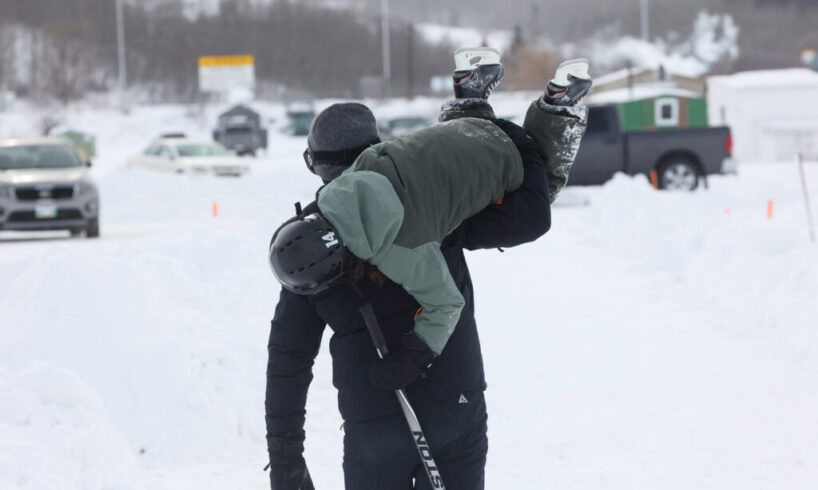
Photojournalist Tim Smith and Manitoba reporter Julia-Simone Rutgers bundled in February to report on the annual Skate the Lake pond hockey tournament on Minnedosa Lake in southwestern Manitoba. The assignment was to document a classic winter pursuit — and talk players, families and fans about if and how climate change was impacting it. This year, the weather was extremely cold, -35 C to be exact. It meant the ice was nice and solid, but people still had things to say about the challenges as weather becomes more unpredictable across the Prairies. These photos capture the joy of toughing it out in Canadian winters.
Elk Valley, B.C.
Photo: Leah Hennel / The Narwhal
Each year, scores of wild animals are hit by trains, but poor tracking makes it challenging to know exactly how many deer, moose, elk or bears are killed in B.C. each year. In the spring, biodiversity reporter Ainslie Cruickshank and photojournalist Leah Hennel traveled to the Elk Valley in southeastern B.C. to work on a story about the railway’s toll. Leah captured this portrait of two deer near the railway tracks in the waning evening light in Sparwood, B.C.
Fort St. John, B.C.
Illustration: Nora Kelly / The Narwhal
Sometimes, we aren’t able to take photos to accompany a story, especially when it’s an investigation companies and governments might prefer we didn’t publish. That was the case when The Narwhal obtained B.C. Energy Regulator inspection notes through freedom of information legislation, which included vivid descriptions of problems at oil and gas facilities. Nora Kelly’s compelling illustration captured details found in the records about how wildlife were accessing dormant, active and polluting sites in B.C.’s northeast.