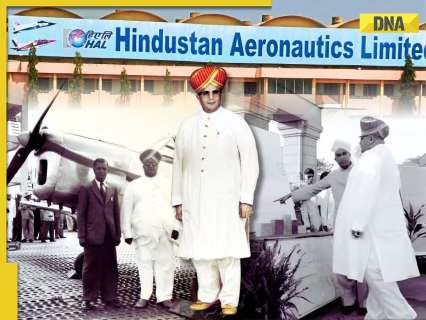
India celebrates HAL’s Foundation Day on December 23, marking the birth of a company that transformed the nation’s aerospace capabilities. Founded in 1940, HAL’s journey began with the vision, courage, and patriotism of a young Maharaja, whose bold dream laid the foundation for one of India’s most i
Hindustan Aeronautics Limited (photo credit Royal family of Mysore)
Every year on December 23, India celebrates a milestone that changed the nation’s destiny forever—the foundation day of Hindustan Aeronautics Limited, or HAL as we know it today. But behind this giant of India’s aerospace industry lies an extraordinary story of vision, courage, and patriotism that began 86 years ago in 1940. At the heart of this story stands a young Maharaja who dared to dream when others refused to take risks.
Picture this: It’s 1940, and the world is burning in the flames of World War II. Bombs are falling across Europe, and the entire planet is gripped by uncertainty. In the middle of this chaos, a 21-year-old prince named Jayachamarajendra Wadiyar has just become the Maharaja of Mysore after his uncle’s sudden death. Most young rulers in his position would focus on simply maintaining their kingdoms safely. But this young king had different plans—plans that would transform India’s future in ways nobody could imagine.
The story begins with a chance encounter on a Pan Am Clipper flight in October 1939. American businessman William Douglas Pawley met Indian industrialist Walchand Hirachand somewhere over the skies between continents. Pawley had been running the Central Aircraft Manufacturing Company in China, building fighter planes for the Chinese Nationalist government. But with Japanese forces advancing aggressively, he desperately needed a new location to continue his work. That casual conversation sparked an idea—why not build aircraft in India?
By July 1940, Pawley arrived in India with his ambitious proposal. He needed land, capital, and most importantly, someone willing to believe in a vision that seemed almost impossible. Walchand Hirachand took up the challenge of finding backers. He first approached his own shareholders at Scindia Steam Navigation Company, but they flatly refused. Undeterred, he toured several princely states—Baroda, Gwalior, Bhavnagar—presenting his proposal. Every single one turned him down. The risk seemed too great, the idea too farfetched, especially during wartime.
Then came the moment that changed everything. In October 1940, Walchand and Pawley reached Bangalore and met the young Maharaja of Mysore. Unlike the cautious rulers who had rejected the proposal, Jayachamarajendra Wadiyar saw beyond the immediate risks. He saw India’s future. He understood that aviation would be crucial for the nation’s development and independence. Within an astonishing 72 hours, the Mysore government promised 700 acres of land absolutely free, invested twenty-five lakh rupees in shares, and offered complete support for the project.
This wasn’t just a business decision—it was an act of pure patriotism. The Maharaja was only 21 years old, barely two months into his reign, yet he showed the foresight of a seasoned statesman. While other rulers worried about protecting their wealth, he chose to invest in India’s dreams. On December 23, 1940, Hindustan Aircraft Company was officially registered under the Mysore Companies Act, with Walchand Hirachand as Chairman. The foundation stone was laid the very next day, marking the beginning of organized aviation industry in India.
The young Maharaja’s vision didn’t stop there. His contributions to India’s defence and aerospace ambitions were remarkable. Mysore State donated one lakh pounds to form the Royal Air Force’s No. 129 Squadron, famously known as the “Mysore Squadron.” Flying Supermarine Spitfires during World War II, this squadron fought bravely in the Battle of Britain and other crucial missions. Their badge proudly displayed Mysore’s mythical two-headed bird, the Gandabherunda, with the inspiring motto “I will defend the right.”
In a touching personal gesture, the Maharaja sent each pilot a Gandabherunda badge along with a heartfelt message expressing his wishes for their victory. He even built Mandakalli Airport in Mysore and donated 211 acres of land for the Government Flying School at Jakkur in Bangalore, which opened in 1948. His personal Dakota DC-3 aircraft was gifted for pilot training, showing his complete commitment to building India’s aviation capabilities.
The factory that started with such bold vision began manufacturing aircraft in 1942, producing trainers like the Harlow PC-5, Curtiss P-36 Hawk fighters, and Vultee A-31 Vengeance bombers for the Indian Air Force during the war years. In March 1941, the Government of India became a shareholder, and by 1942, completely took over management to support Allied war efforts. The company continued to grow and evolve, and on October 1, 1964, it merged with Aeronautics India Limited to become Hindustan Aeronautics Limited—the name that stands tall today.
But there’s a tragic oversight in how this history is often told. Many people incorrectly credit others for founding HAL, completely ignoring the crucial role of Maharaja Jayachamarajendra Wadiyar. While Walchand Hirachand certainly deserves recognition for his entrepreneurial drive, the Maharaja’s contribution was driven purely by patriotic vision, not profit. He was the one who took the real risk, who provided the land and capital when everyone else refused.
Today, HAL stands as a giant in India’s aerospace and defence sector, designing and manufacturing everything from fighter jets like the Tejas to helicopters like Dhruv and Prachand. It has production facilities across India and works with global aerospace companies. HAL’s achievements in indigenous aircraft development represent the dreams of that young Maharaja who gave India its wings when the nation needed them most.
As we celebrate HAL Foundation Day every December 23, let’s remember the complete story—the story of a 21-year-old king who showed extraordinary courage and foresight at a time when India desperately needed both. Jayachamarajendra Wadiyar didn’t just help establish an aircraft company; he invested in India’s future independence and self-reliance. His vision transformed Bangalore into an aerospace hub and laid the foundations for India’s journey toward becoming a global aerospace power. That young Maharaja truly gave India its wings, and for that, our nation remains forever grateful.
(Disclaimer: The views expressed above are the author’s own and do not reflect those of DNA)
(Girish Linganna is an award-winning science communicator and a Defence, Aerospace & Geopolitical Analyst. He is the Managing Director of ADD Engineering Components India Pvt. Ltd., a subsidiary of ADD Engineering GmbH, Germany.)