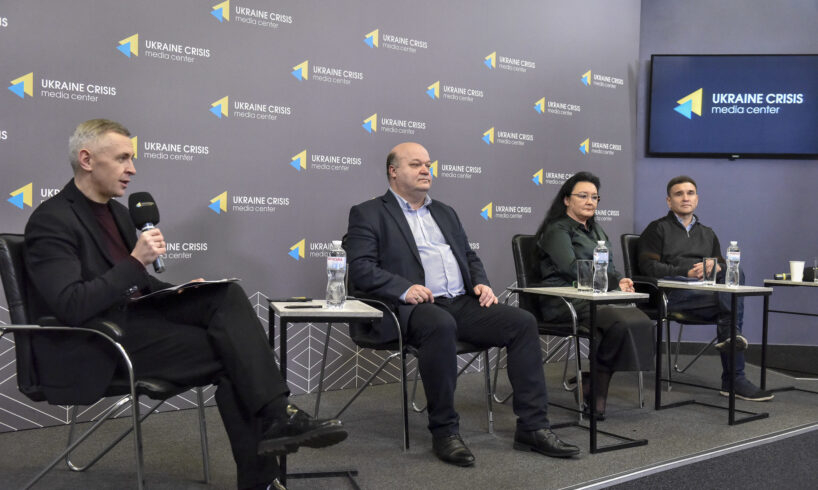
On December 5, 1994, Ukraine signed the Budapest Memorandum, which enshrined a number of mutual obligations that are clearly not being fulfilled, or not being fully fulfilled, by the parties. Against the backdrop of a certain silence on this topic, the Ukraine Crisis Media Center initiated a professional discussion entitled “Anniversary of the Budapest Memorandum: Time to Remind the Nuclear World of Its Commitments to Ukraine.”
The discussion was attended by Ms. Olha Butkevych, President of the Ukrainian Association of International Law, Doctor of Law, Professor of the Department of International Law at the Educational and Scientific Institute of International Relations of Taras Shevchenko National University of Kyiv; Mr. Valeriy Chaly, Chairman of the Board of the Ukrainian Crisis Media Center, member of the Ukrainian Association of International Law, Ambassador of Ukraine to the United States in 2015-2019, Mr. Pavlo Klimkin, senior researcher at the Carnegie Foundation, Minister of Foreign Affairs of Ukraine in 2014-2019, and Mr. Viktor Shlinchak, Chairman of the Board of the Institute of World Policy.
Where did the Ukrainian authorities go wrong?
Assessing the Budapest Memorandum, Valeriy Chaly called it an agreement, but not a complete one: “If it had been drafted correctly, its procedures would have been different. And although we can talk about the legal nature of this document and its capacity as an instrument, the memorandum remains a political declaration. In the minds of citizens, this is a lesson when words about security guarantees put on paper did not become real guarantees for the country,” he said.
The head of the UCMC board is convinced that after Ukraine broke away from the Soviet Union, security should have been a key priority, and therefore the responsibility lies with many politicians who at that moment showed weakness, focusing instead on the development of current issues.
“The mistake was in setting priorities for the country’s development. The country’s leadership decided that the nation’s survival depended on feeding its people. If we had prioritized security in 1991 and 1992, and if we had non-communist or post-communist political leadership, then we could have discussed another option, up to and including the possibility of joining the European collective security system,” Valeriy Chaly added.
Olha Butkevych stated that, if she had been in the shoes of the leaders at the time, she would not have signed the Budapest Memorandum: “Under the pretext that Ukraine could not use nuclear weapons, a document was imposed on the country that was completely disadvantageous. Today, we must take this lesson into account, as we are once again talking about security guarantees. Ukraine is being asked to take certain positions that may be economically advantageous in peacetime, but are currently disadvantageous from a security perspective,” emphasized the President of the Ukrainian Association of International Law.
According to Pavlo Klimkin, the key problem with this document is that at that time, the main idea on the Ukrainian side was not security guarantees, but food aid from the US: “The Foreign Ministry archives contain letters from Leonid Kravchuk, which state explicitly that we are in a critical situation and lack what is needed to protect us from destabilization. In other words, food aid dominated the negotiations, rather than the logic of guarantees and preservation.”
Was it possible not to give up nuclear weapons?
During the Soviet era, Ukraine had two important components: tactical and strategic nuclear weapons. Pavlo Klimkin believes that, from a technological point of view, it is much easier to maintain and support tactical weapons: “It is still possible to move forward with this. It requires certain elements of the nuclear cycle, but ones that we could theoretically create. However, could we withstand such a financial burden? I have heard figures of 40 billion, 50 billion. Therefore, in 1992, all the tactical weapons, which in principle could have been an element of deterrence, were removed, and when negotiations on the Budapest Memorandum began, we no longer had them. As for strategic nuclear weapons, as a physicist, I can tell you that at that time we did not have the technology to maintain them. They had to be developed. These elements required quite significant investments, not only intellectual and financial, but in principle for the whole country.”
Valeriy Chaly noted that tactical nuclear weapons were stolen from Ukraine when the central Ukrainian government did not control this process, and today it seems logical to raise the question of whether Ukraine needs to take stock of those agreements.
“We committed ourselves to joining the nuclear non-proliferation treaty at the time, and now this system is being destroyed at a frantic pace. I’m not saying we should withdraw from the treaties, but let’s at least talk about the fact that Ukraine took on these obligations and did so for a reason,” he suggested.
What will make Ukraine safe
Speaking about what should form the basis of future security guarantees for Ukraine, Olha Butkevych emphasized that it is not enough to rely solely on a legal document. There must also be physical guarantees, plus, possibly, the presence of foreign troops, Ukraine’s participation in NATO or other alliances that provide security for Ukraine.
She also noted that there should be a document on the creation of a security system in the European region.
Pavlo Klimkin added that guarantees themselves are essentially declarations in today’s reality: “When it comes to guarantees, I always say that there must be three convictions. We, the recipients of the guarantees, must believe in them. Those who give the guarantees must believe in them. And thirdly, our enemies must believe in them. Until these three convictions exist, talking about any guarantees is a bad idea, regardless of the legal form of the document.”
Valeriy Chaly has three points of his own. First, the document must be backed up by something tangible and more understandable, such as troops, because in such a situation Ukraine would benefit from the presence of foreign troops who, in accordance with the UN Charter, would form a military coalition to force the aggressor to make peace, as was the case in Korea.
“Secondly, this should not be at the end of the process, but should be understood immediately, to the extent that Ukraine will be forced to do everything and then nothing. And thirdly, when history has turned in such a way that the nuclear powers, which are considered great, want to break the system again, Ukraine must unite with those countries that do not want to allow such a redistribution of the world. In this regard, unfortunately, I do not see any ideas from our diplomacy at the moment,” he admitted.
The expert called for a realistic approach. Russia will not comply with anything if it does not want to, and the US National Security Strategy that has been published shows their priorities, and Ukraine is not very present there. Therefore, we must take into account not desires, but realities. And not wait for others to decide for us.
“We no longer have just a Russian-Ukrainian war; we now have a European war. It is turning into a hybrid war with operations in the air, at sea, and on land. Our task now is to wake everyone up in Europe and tell them that it may be too late. Let’s work together today to resolve these issues. Ukraine must clearly emerge from this very weak historical period, not only as a sovereign and independent country, but without any skeletons in the closet or weights on its feet that will prevent it from developing as a center of regional influence in the future, when we somehow pull ourselves out of this war,” Valeriy Chaly urged.
The event was held as part of the United for Truth project with the support of the Canada Ukraine Foundation #unitedfortruth