2025-12-23T23:00:05+00:00
font
Enable Reading Mode
A-
A
A+
Shafaq News
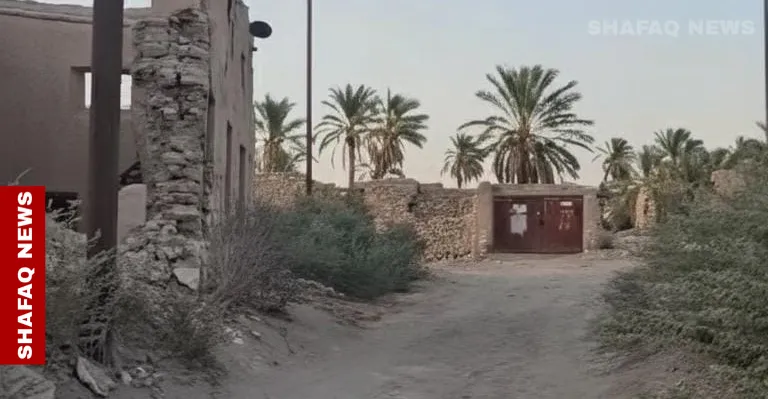
On a bend of the Euphrates River in western Iraq, an island
sits wrapped in water and silence. Palm trees sway above abandoned houses, a
school building still stands, and electricity lines and water pipes remain in
place. Yet no one lives there.
The island, known as Alus Island, lies in the middle of the
river near Haditha. Once home to a close-knit community, it has been emptying
for nearly two decades. Its intact infrastructure and overgrown orchards give
it the appearance of a place paused in time, raising a question that has
lingered along this stretch of the Euphrates for years: how did a functioning
settlement simply fade away?
Alus was not a marginal outpost; for generations, families
lived from farming and river trade, passing homes and land down through
decades. The island housed one of the earliest primary schools in the area and
a small health clinic, signs of a settled community integrated into the life of
the wider district rather than isolated from it.
According to Amer Abdul Razzaq, a researcher and
archaeological expert, Alus Island is part of a broader pattern of river
islands that formed where the Euphrates widens, creating fertile ground for
settlement. He told Shafaq News that evidence on the island suggests human
presence extending far earlier than the modern village, giving it historical
value beyond its abandoned houses.
“Settlement here goes back more than half a century, and
possibly much further,” Abdul Razzaq said. “There are remains that indicate
older periods, which makes the island important not only socially, but
historically.”
At its height, Alus supported a stable population, Abdul
Razzaq said, with institutions that reflected long-term habitation rather than
temporary use. That continuity, he added, is what makes its abandonment
striking. Today, more than 100 houses stand empty, surrounded by neglected
groves of lemon, olive, and date palms.
For local officials, the disappearance of Alus’s population
is less mysterious than cumulative. Ammar Ali Hamdi, director of antiquities in
Anbar, told our agency that the island’s decline was driven by a series of
practical pressures that slowly made life there untenable.
Repeated flooding of the Euphrates damaged homes and
farmland, and the bridge connecting the island to the mainland collapsed more
than once, cutting residents off for extended periods. Access to schools beyond
the primary level, healthcare, and jobs required daily travel that became
increasingly difficult.
“People did not leave overnight,” Hamdi explained. “They
moved gradually, especially families whose children needed to continue their
education. Many relocated to Haditha, Ramadi, or Baghdad.”
The island’s architecture reflects its layered past. Most
homes were built from mud brick, with stone added in later periods. Among the
remaining landmarks are an old mosque and the shrine of Sheikh Abdul Qader
Al-Alusi, a religious figure whose presence once gave the island particular
cultural standing. Alus was known locally for producing teachers, engineers,
doctors, and scholars, a reputation that contrasts sharply with its current
emptiness.
Today, although the island is largely uninhabited, it still
draws occasional visitors. Some come out of curiosity, others for quiet picnics
among the palms, and a few to see the historic buildings that remain officially
registered as heritage sites. But there is no formal conservation work, no
visitor infrastructure, and no permanent oversight.
That has not stopped talk of revival – both Hamdi and Abdul
Razzaq pointed to discussions with local authorities and visits by tourism and
antiquities officials exploring the possibility of rehabilitating Alus as a
heritage and tourism site.
For now, Alus Island remains suspended between past and
possibility. Its houses still stand, its school still bears its name, and its
orchards still root into fertile soil. What is missing is not stone or timber,
but the continuity of daily life.
Along the Euphrates, the island waits, intact and empty, a
reminder that what disappears first is often not buildings, but communities.
Written and edited by Shafaq News staff.