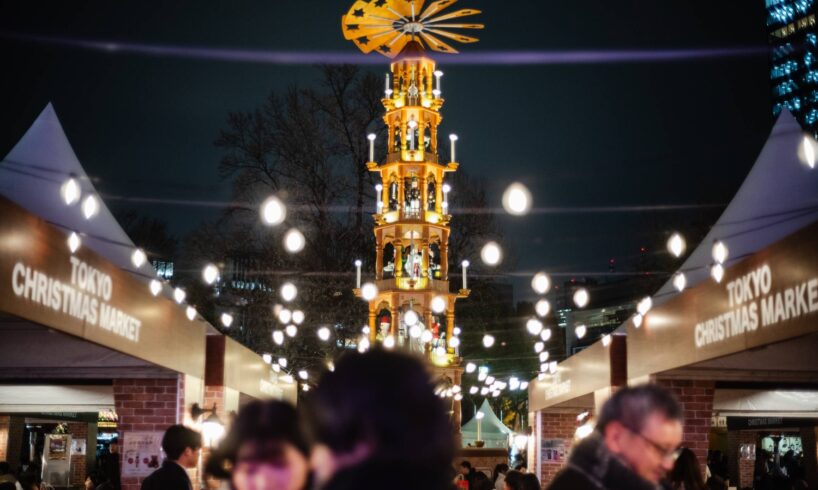
Christmas markets have become one of the nation’s favorite ways to celebrate the holiday, with many major shopping complexes and public spaces hosting such events in recent years.
The markets are heavily inspired by German Christmas markets and primarily feature booths selling food served during the holiday season — including German drinks and hot wine, pretzels and sausages. There are also holiday trinkets, as well as brightly lit decorations that transform the venue into something magical.
The atmosphere and aesthetics of the markets is a major attraction for domestic and foreign tourists alike.
“I came here just to visit the Christmas markets,” said Dragomir Petkov, a 25-year-old from Bulgaria visiting the market at Azabudai Hills commercial complex in Tokyo.
A Christmas market at Azabudai Hills commercial complex in Minato Ward, Tokyo, on Monday
| JOHAN BROOKS
Decorations at the Christmas market at Shiba Park
| JOHAN BROOKS
Petkov, who was on his third trip to Japan, said he was in Osaka earlier but made a detour for several days to Tokyo before Christmas ended just so he could visit some of the markets in the capital.
“It also brings me nostalgia because I visited (the market) in 2023, and I just came here to experience all the memories from then again,” he said. Although there are some markets back home in Bulgaria, he said there aren’t as many and they don’t offer the variety of food and decorations that the ones in Japan do.
Since Christmas markets first started to pop up in Japan about 10 years ago, they have expanded in terms of scale, popularity and numbers over the years.
Some of the largest ones in the country include the market at the Yokohama Red Brick Warehouse, which has been held since 2010, and the Tokyo Christmas Market in Hibiya Park, first held in 2015.
Holiday trinkets are displayed for sale at Shiba Park’s Christmas market.
| JOHAN BROOKS
Visitors enjoy Christmas treats at the Christmas market at Azabudai Hills on Monday.
| JOHAN BROOKS
Mori Building launched its latest Christmas market in 2023 in Azabudai Hills, right after the shopping complex itself opened. The company, which has been holding a Christmas market at Roppongi Hills since 2006, said there were few comparable events at other venues when it first launched the event.
However, with similar markets popping up in a wide range of locations over the past several years, event operators are sensing the culture is starting to take root in Japan.
For the Christmas markets held at Roppongi Hills and Azabudai Hills, Mori Buildings said the biggest pull is accessibility, with people able to casually stop by after work.
“We had a shorter school day today so we wanted to do something Christmassy,” said a first-year high school student who only offered her first name, Mayuka, as she munched on a pretzel with her classmate in Azabudai Hills on Tuesday afternoon.
Two days before Christmas, she said she wanted to squeeze in something festive before the season ended. “Everything is shiny — puts you in a festive mood.”
Other foreign visitors noted the difference in how Christmas is celebrated in Japan.
Azabudai Hills’ Christmas market on Monday. Mori Buildings said the biggest pull of its Christmas markets is accessibility, with people able to casually stop by after work.
| JOHAN BROOKS
A Christmas tree at Azabudai Hills’ Christmas market. Mori Building launched its latest Christmas market in 2023 in Azabudai Hills, right after the shopping complex itself opened.
| JOHAN BROOKS
“It’s more commercial to me,” said Jennifer Garcia, from Toronto, Canada, who was visiting the market in Shiba Park on Tuesday evening. “I think (since) we came here, we’ve already spent at least $100.”
The Tokyo Christmas Markets, held this year from late November across two venues in Shiba Park and Meiji Jingu Gaien, require a ¥2,000 ($13) fee to enter for the five days leading up to Christmas Day, and ¥1,000 on other days.
“It’s more about a profitable holiday than (what we’re used to) — like we’re Christian, right? So for us, it’s the birth of Jesus, our family,” Garcia’s partner, Anthony Fontana, said. But they added that they felt more “Christmas cheer” in Japan than back home.
“It’s nice, though. It’s nice to see Christmas in Tokyo.”