Mr. Sato bypasses the high-priced sushi that’s become the neighborhood’s new normal and finds a super-cheap, super-tasty bowl of ramen.
It’s now been over a month since the Chinese government issued a travel advisory telling citizens to avoid traveling to Japan. Since then, we’ve been heading out to check on the current conditions at some of Japan’s most popular destination districts for inbound international travelers, since Chinese tourists have been the single largest nationality within the demographic for some time.
For our latest on-site check, our ace reporter Mr. Sato headed to Tsukiji, the Tokyo neighborhood so famous for sushi and seafood that it’s sometimes referred to as “Tokyo’s kitchen.”
After making his way up to the street after getting off the subway at Tsukiji Station, Mr. Sato passed by Tsukiji Honganji Temple. While an important cultural site, this temple doesn’t really get a ton of international tourist attention, and with renovation work going on that won’t be finished until a year from now, the crowds were especially sparse.
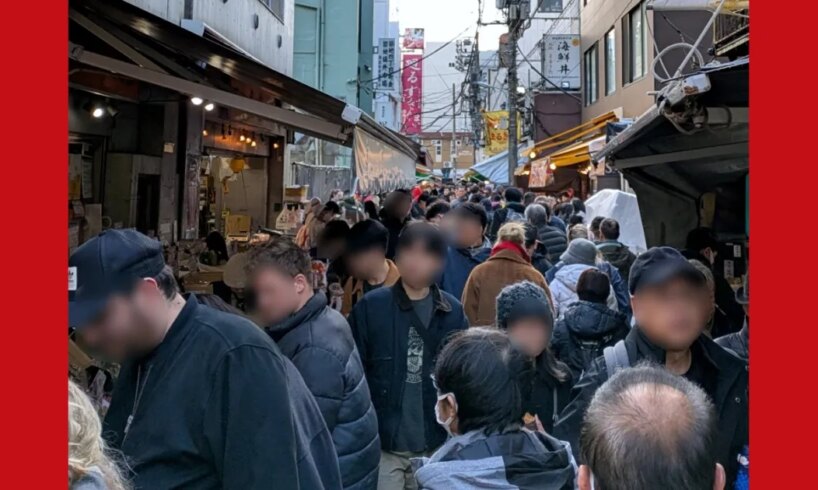
It wasn’t long at all until the crowds started getting thicker, though. Standing on the corner of the intersection that’s right in front of Tsukiji’s “outer market,” the collection of restaurants and shops that remained in the neighborhood following the wholesale market’s move to the Toyosu area in 2018, Mr. Sato wasn’t feeling at all lonely.
It was about 11 in the morning when he rolled up, and the place was packed. Walking forward in a straight line was impossible, and Mr. Sato had to weave around stopped or slower-moving pedestrians as he made his way down the sidewalk.
This was to be expected, though. After all, the Tsukiji Food Town Development Council recently put out a notice asking guided tour groups to avoid visiting the outer market this month, so as not to create dangerously overcrowded conditions during the annual New Year’s shopping surge from non-tourist shoppers. Independent travelers aren’t barred from the neighborhood, though. Mr. Sato saw people from all over the world here this day, and also heard snippets of Chinese conversation from people in the crowds.
Honestly, the total tourist crowd size didn’t feel like it had gone down at all, but there was another reason Mr. Sato was here.
Because of how suddenly the Chinese government’s travel advisory was issued, odds are its full effects are likely going to be somewhat delayed, which seems to be happening with hotel prices. Anecdotal evidence suggests that in Kyoto, where hotel prices have skyrocketed during Japan’s inbound tourism boom, nightly rates are starting to dip back down following the loss of demand from Chinese travelers.
What does that have to do with Tsukiji? Until not so long ago, Tsukiji had a reptation as a place where you could go to get great-tasting sushi at very low prices. However, as Tsukiji receives more and more foreign tourists, who are more and more flush with yen thanks to the to-them favorable exchange rate, restaurants have adjusted their menus to focus on more luxurious, more expensive items.
It used to be that you could get a very tasty mixed sashimi bowl in Tsukiji for about 1,000 yen (US$6.50). Now you pretty much need to be prepared to pay double that, and the overall offerings lean much more heavily towards premium-priced ingredients like uni (sea urchin) and ikura (salmon roe).
So though Tsukiji is still crowded, Mr. Sato wondered if maybe it had become a little less expensive, returning, or at least getting closer to, affordability for regular, non-tourist diners. Unfortunately, nothing of the sort seems to be happening. If anything, prices have gotten even higher than they were a year ago, Mr. Sato reports.
▼ The cheapest sashimi bowls this restaurant offers are 1,900 yen, and they’re all ones that make use of a lot of inexpensive whitebait. Their standard tuna and salmon bowls, meanwhile, are 2,400 and 3,500 yen.
It’s not that Tsukiji never had high-priced menu items, but they used to feel more like the exception than the norm, especially in the casual ground-floor restaurants of the outer market. Now, though, the “Inbound Don” phenomenon we observed in Toyosu has spread throughout Tsukiji as well.
▼ This Tsukiji restaurant’s prices for uni don’t seem too bad, until you notice that they’re all for mini-sized (ミニ) bowls…
▼ …and they also have a single bowl that costs 22,000 yen.
Feeling a little empty, both emotionally and in his stomach, Mr. Sato trudged past these wallet-busting options, until he found himself in front of a ramen restaurant.
With the name Menya Nobunaga Shogun (“menya” meaning “ramen restaurant”), it certainly sounded like it could be another restaurant with big-spending tourists as its target market. And yet, when Mr. Sato looked at the signs posted outside the entrance…
…he saw that there were charging only 600 yen (US$3.90) for a bowl of ramen!
According to the sign, this was a special price that day, but as Mr. Sato would find out later, there’s a way to get an even better deal on this ramen. Still, even 600 yen was too good a price to pass up, so into the restaurant he went.
Looking at the menu, he saw that the special-price ramen, the “Nobunaga Ramen,” is usually 980 yen, which still isn’t that bad in today’s restaurant climate. And if you actually are in the mood to splurge on something touristy, Menya Nobunaga Shogun can whip you up a bowl of ramen with wagyu beef with black truffle and gold leaf, and then charge you 9,500 yen for it.
Don’t assume, though, that this means their budget-friendly Nobunaga Ramen is some chintzy low-grade ramen, though, because nothing could be further from the truth.
The broth is a mixed chicken/fish stock, which is balanced to the perfect place where it’s both incredibly flavorful but has no unpleasantly clingy aftertaste, and each sip quickly enticed Mr. Sato into taking his next. According to the restaurant, the broth takes 48 hours to make, simmering slowly to unlock its full flavor, but with results like this, it’s time well spent.
Likewise, the wavy noodles have a great not-too-soft, not-to-firm density. As a classy touch, instead of the typical chashu roast pork you get a slice of chashu-style chicken, and everything is tied together nicely with a touch of lemon added to the broth.
And while there’s no set pattern to the discounted 600-yen price for the Nobunaga ramen, that’s not really such a bummer since it’s discounted to 500 yen on the first of every month (with the exception of January 1).
Menya Nobunaga Shogun has two sister shops, Menya Nobunaga Kyobashi and Menya Nobunaga Kayabacho, in Tokyo’s Kyobashi and Kayabacho neighborhoods. Note that the Tsukiji branch only takes walk-in customers between 11 a.m. and 2:30 p.m. (dinner is by reservation only). The Tsukiji branch is also closed on Sundays, but provided you’re in the neighborhood and looking for lunch on any other day of the week, it can be a delicious palate cleanser if Tsukiji’s sushi bowl prices are leaving a figurative bad taste in your mouth.
Restaurant information
Menya Nobunaga Shogun / 麺屋NOBUNAGA ‐SHOGUN‐
Address: Tokyo-to, Chuo-ku, Tsukiji 6-23-2
東京都中央区築地6丁目23-2
Open 11 a.m.-2:30 p.m., 5 p.m.-10 p.m. (dinner by reservation only)
Closed Sundays
Website
Photos ©SoraNews24
● Want to hear about SoraNews24’s latest articles as soon as they’re published? Follow us on Facebook and Twitter!
[ Read in Japanese ]
Like this:
Like Loading…