Historian and political scientist Herfried Münkler recently summed up what he sees as the core foreign policy problem for Germany’s government: “The liberal idealism of a rules-based international order has turned out to be an illusion.”
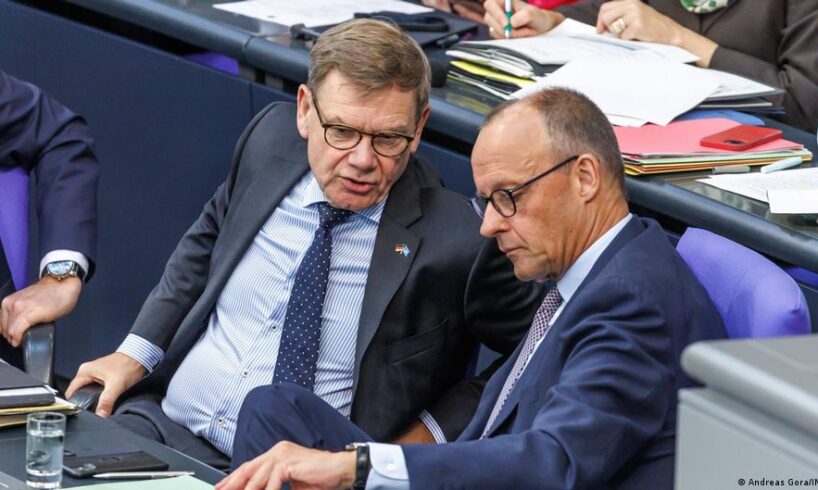
At the same time, the government continues to view the preservation of multilateralism and a rules‑based international order as its overarching goal. Foreign Minister Johann Wadephul, of the conservative Christian Democrats (CDU), warned that “China and Russia are attempting to rewrite the international order that is based on international law.”
CDU Chancellor Friedrich Merz said the rules‑based order was not only being called into question by governments long considered authoritarian. “Unfortunately, this also applies to America,” he said, referring to President Donald Trump. A recent US strategy paper sharply criticizing European allies and the EU has reinforced this impression.
‘Pressure on Europeans’
A major concern among German political and military leaders is that the United States may be distancing itself from Europe on security matters. In early December, General Christian Freuding told the magazine The Atlantic that direct contact with his US counterparts had been “cut off.”
In the past, Freuding told the magazine, communication had been possible “day and night.” He called the loss of rapid-contact channels a “warning sign” — especially in light of the potential for an attack by Russia on eastern NATO states.
Germany’s high-stakes EU gamble over Russia
To view this video please enable JavaScript, and consider upgrading to a web browser that supports HTML5 video
Europeans are also feeling the consequences of the US’s shift in policy on Ukraine. Trump sought a peace arrangement that would accommodate many of the demands made by Russian President Vladimir Putin. And the US security strategy released in late 2025 sought “strategic stability” with Russia — to the dismay of governments elsewhere in Europe.
“If it comes to the point that the Americans somehow bow out, the pressure on Europeans to be capable of acting and to form a strong counterweight will increase once again,” Henning Hoff, of the German Council on Foreign Relations, told DW.
Merz has worked with French President Emmanuel Macron and British Prime Minister Keir Starmer to counterbalance the US’s declining commitment to Ukraine. “No one should doubt support for Ukraine,” Merz declared at a trilateral meeting in London in early December. Yet all three leaders face tight budgets, domestic pressure from the political right and waning public support for Ukraine in their own countries, as well.
Dependent on China
WithGerman industry reliant on the rare earth elements controlled by China, Berlin has become increasingly dependent on Beijing.
“The Chinese are very successful at becoming leaders in many technological fields and taking positions that traditionally belonged to German industry,” Hoff said. “And, at such a moment, Germany also becomes not quite so important anymore.”
Wadephul: ‘We want to be reliable trading partners’
To view this video please enable JavaScript, and consider upgrading to a web browser that supports HTML5 video
Merz plans to visit China in early 2026. At the G20 summit in Johannesburg, Merz told DW: “China could exert a little more pressure on Russia to end this war [in Ukraine]. If necessary, this will also be raised in my talks with the Chinese president [Xi Jinping] next year.” So far, nothing suggests that this hope will be fulfilled.
Germany and Israel
During his December visit to Israel, Merz said: “I come as a friend of Israel who knows that the friendship between Germany and Israel is infinitely valuable and precious.”
Following the Hamas terror attack on October 7, 2023, Israel began a two-year war in Gaza that has killed more than 70,000 people. Standing alongside Israeli Prime Minister Benjamin Netanyahu, Merz acknowledged that the war has confronted Germany with “some dilemmas.” Merz invoked Germany’s responsibility for the Holocaust in saying his government sought to uphold Israel’s security, but he added that he would voice criticism where necessary.
Notably, Merz no longer uses the formulation of his predecessor, Angela Merkel : “The security of Israel is Germany’s reason of state.” Instead, he said, supporting Israel’s existence and security belongs “to the unchangeable core of our relations.”
German Chancellor Merz reaffirms support for Israel
To view this video please enable JavaScript, and consider upgrading to a web browser that supports HTML5 video
On key issues, however, the two governments remain far apart — especially on the two‑state solution. Germany continues to support the idea of a future Palestinian state alongside Israel. Netanyahu rejects this, saying: “The purpose of a Palestinian state is to destroy the only Jewish state.”
Hans‑Jakob Schindler, a Middle East and security analyst, said the two‑state solution was “possibly a very, very distant future vision whose practical feasibility is increasingly in question.”
Schindler said Germany and the European Union had largely lost their role as mediators in the Middle East. “It is clear that both the Palestinians and the Israeli side look to Washington as the central mediator and not to Europe,” Schindler said. The European Union will play an important role in reconstruction in Gaza and in humanitarian aid, he said “but, as a central mediator, Europe has, in part, really said goodbye over the last 10 years.”
Germany’s uneasy alliances
Germany must decide how to conduct foreign policy in a world where geopolitical weight is shifting and international rules are increasingly ignored.
Johannes Varwick, a professor of international relations at the University of Halle, told DW via email that seeking partners who still value multilateralism — including difficult partners — is the right approach. “Germany is trying to maintain old alliances while also forging new partnerships and expanding networks with other middle powers worldwide,” Varwick wrote, citing Brazil, Mexico and Vietnam as examples. “Remaining in critical dialogue with one another” is essential, Varwick wrote. “Only talking to those who already agree makes one quite lonely in the reality of international politics.”
How Merz aims to regain Germany’s standing on foreign issues
To view this video please enable JavaScript, and consider upgrading to a web browser that supports HTML5 video
Merz has emphasized foreign policy right from the start — and, because of his many trips abroad, he has at times been mockingly referred to as the “foreign-policy chancellor.”
“Overall, one can indeed speak of a certain revitalization,” Hoff said.
He added, however, that “Berlin’s foreign policy is still too slow to respond to this new global situation.” Changes are expected at the Foreign Ministry; among other things, a commission will take up the issue of dependence on China in 2026. “All of this is good,” Hoff said, “but it comes two, three, four, five years too late. And, if they don’t manage to inject more speed into the process, things will get difficult.”
This article was originally written in German.
While you’re here: Every Tuesday, DW editors round up what is happening in German politics and society. You can sign up here for the weekly email newsletter, Berlin Briefing.