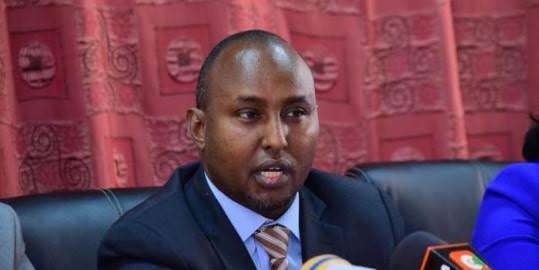
NAIROBI, Kenya, Dec 25 – National Assembly Minority Leader Junet Mohamed has alleged that former President Uhuru Kenyatta is behind a plan to inject more than Sh1 billion into the Orange Democratic Movement (ODM) in an effort to politically re-energise the party ahead of the 2027 General Election.
Junet, who is also the Suna East MP, made the claims while addressing residents in his constituency on Wednesday, December 24, linking the alleged plan to growing internal manoeuvres within ODM aimed at pulling the party out of its broad-based political arrangement with President William Ruto.
According to Junet, the alleged plot was revealed to him during a recent meeting in Kisumu, where he was invited by a senior party figure amid rising tensions within ODM. He said the individual urged him to abandon the party’s cooperation with President Ruto’s administration.
“Recently, one of the people making noise within the party invited me to Kisumu. He told me, ‘my brother, there are good plans of our party I want to inform you about. There is no need of us continuing supporting President William Ruto. Let’s leave these broad-based issues,’” Junet told locals.
Junet claimed that the proposal included significant financial backing from the former Head of State to reposition ODM as a dominant opposition force.
“He told me: ‘We have a very good plan. Former President Uhuru Kenyatta wants to help us in our ODM party. He is ready to invest over Sh1 billion in our party so that it can become solid and vibrant politically. We shall emerge the winner in the next elections if we join the United Opposition,’” Junet said.
He further alleged that the pitch involved persuading ODM leaders to rally behind Uhuru Kenyatta and an emerging opposition alliance while distancing themselves from certain political figures.
“He told me that he knows many of us in ODM do not want Wamunyoro. Let’s leave Rigathi and follow Uhuru to join the United Opposition,” Junet said.
Junet linked the claims to his recent fallout with Vihiga Senator Godfrey Osotsi, one of ODM’s deputy party leaders, whom he accused of pushing the idea.
Cracks within the party are continuing to emerge.Two factions are becoming apparent: one insisting that the party remain in the broad-based setup following the death of former Prime Minister Raila Odinga, and a separate faction opposed to this, advocating for ODM to continue its role in opposition and resistance.
Homa Bay Governor Gladys Wanga, who also serves as the party chairperson, has consistently insisted that ODM remain in the broad-based arrangement and support President William Ruto for his reelection in 2027.
She has maintained that the party should either form the next government or be part of the coalition that forms the government.
The Orange Democratic Movement (ODM) is grappling with internal divisions and an uncertain political future following the death of its long-serving leader, Raila Odinga, according to a new national survey by TIFA Research.
Findings released on Tuesday by TIFA Research depict a party at a strategic crossroads, struggling to define its identity in the post-Raila era amid its uneasy cooperation with President William Ruto’s Broad-Based Government.
The poll suggests that while ODM remains single most popular party, its internal cohesion has weakened, exposing sharp disagreements between its leadership and grassroots supporters over the party’s direction ahead of the 2027 General Election.
According to the survey, ODM’s national popularity has risen to 20 per cent, overtaking President Ruto’s United Democratic Alliance (UDA), which stands at 16 per cent.
Indication show, that the surge may be driven largely by post-Raila sympathy rather than genuine endorsement of the party’s current political posture.
Despite ODM leaders’ engagement with the Kenya Kwanza administration, expectations among the public and within the party remain divided.
Half of all respondents expect ODM to return to the opposition by 2027, while 38 per cent believe it will remain part of the Broad Based Government.
Among ODM supporters themselves, the split is equally stark, highlighting the party’s internal dilemma.