Open this photo in gallery:
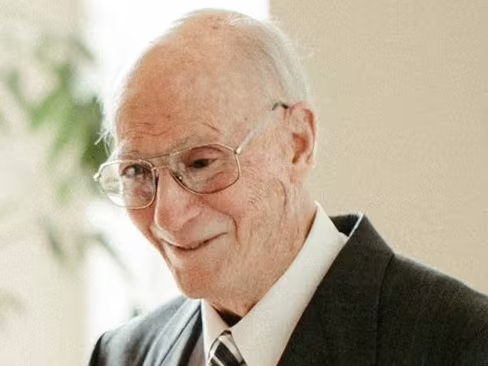
Stan Shillington, a B.C. lacrosse statistician.Michelle Chartrand Photography/Courtesy of family
Stan Shillington, a police reporter turned police spokesman, liked to play the numbers.
As a young man, he was pressed into service as a scorekeeper for box lacrosse, a rough-and-tumble indoor game also known as boxla. On the West Coast, he became the sport’s official statistician and unofficial historian, logging numbers as well as lore.
Mr. Shillington, who has died at 90, spent more than half his life recording shots, goals, assists, saves, turnovers, faceoffs and penalties — so many penalties — at boxla games.
He worked as an official scorer on the timekeeper’s bench or high in the rafters of overheated arenas. One time, he had his head down in the penalty box to record the punishment administered to a pair of scofflaws when the rivals renewed their stick-swinging fight with him in the middle.
As sports reporter John Wawrow once noted, the federal government had Stats Can, while the lacrosse community had Stats Stan.
Mr. Shillington was the Boswell of boxla, preserving the stories of contemporaries and reviving anecdotes about the stars of yore. In doing so, he was vital in preserving the history of one of Canada’s two official sports.
His “Down Memory Lane” columns profiled Ontario and British Columbia lacrosse greats including Jack Bionda, Archie Browning, and Jim (Peewee) Bradshaw, who was killed in a car crash on Vancouver Island’s notorious Malahat Highway. Other columns highlighted notable events and teams, as well as other players including Joe Cheevers, the father of Hockey Hall of Fame goalie Gerry Cheevers.
Over the years, he amassed boxes of statistics and game reports, which he stored in the basement of his home in the Vancouver suburb of Coquitlam. (“Better there than upstairs,” said his wife.)
He also made it his ambition to collate statistics from games played even before he was born. He leafed through yellowed newspaper clippings and endured the nausea-inducing practice of scrolling through rolls and rolls of microfilm.
In the end, he preserved the history of a sport originally played on wide fields before it moved indoors into rinks and arenas during the Depression.
“He set a standard that is unmatched by any other sport,” said Casey Cook, an inductee in the Canadian Lacrosse Hall of Fame. “If you set foot on the floor for one second, your name would be in his book.”
Stanley Stephen Shillington was born in Vancouver on Jan. 21, 1935, an only child for the former Annie Fedychyn and George Stanley Shillington, who worked over the years as a driver, custodian and prison guard. The boy’s first home was an apartment above a furniture store on hardscrabble East Hastings Street, later a local landmark as Ted Harris Paints.
The boy lost his right eye at age nine in a playground accident when struck by a discarded curtain rod used as a spear. Despite the injury, he played softball, as well as both field and box lacrosse.
After graduating from Britannia High, Mr. Shillington took a job as a copy boy for the Vancouver Sun. He earned $24.25 per week (about $287.40 today), augmenting his earnings by writing lacrosse game accounts at 25 cents per column inch. His first byline was on an account of a 15-0 bantam game.
In 1953, Mr. Shillington was a co-founder and served as secretary for a revived Renfrew Athletic Club to promote minor sports in eastside Vancouver. The club was formed in part to address juvenile delinquency.
“Kids who go in for sports don’t get involved in crime,” he told Star Weekly magazine in 1971. “The group of fellows I went to school with has produced a number of alcoholics, several thieves and a few drug pushers. But there have been few social casualties among the fellows who went in for sports.”
From keeping statistics for minor lacrosse, he was then asked to handle Junior-A numbers and, by 1957, was the chief statistician for the Inter-City Lacrosse League and, later, the Western Lacrosse Association.
Over the decades, he scrutinized the play of Shamrocks, Salmonbellies, Adanacs, Timbermen and Burrards, as well as, once breweries became involved in sponsorships in the 1960s, Labatts, Carlings and O’Keefes.
By 2014, Stan Shillington’s Who’s Who in Lacrosse counted 3,162 players, including the likes of Kevin Alexander, who once had a 48-game consecutive scoring streak; Paul Parnell, who somehow avoided injury or suspension to play 195 consecutive games from 1961 to 1965; and goaltender Stan Joseph, a member of Squamish Nation who managed to survive facing 18,456 shots of solid vulcanized rubber. (He stopped more than seven of every 10 shots.)
Mr. Shillington said the greatest all-round boxla player he ever saw was Wayne Goss, who had “a small body hiding a huge heart, a happy smile masking fierce competitiveness, friendly eyes camouflaging an unbending determination to succeed.”
The statistician was credited with having been the official scorer of 971 games, including playoffs and Mann Cup championships.
Away from the arena, Mr. Shillington spent 21 years as a reporter covering the police beat for Vancouver’s largest daily newspaper. There was no shortage of stories in a port city with organized gangs and a history of police corruption, as well as a growing youth subculture keen on exploring marijuana use.
In April 1965, Mr. Shillington wrote a long feature headlined, “Don’t flirt with the green goddess” warning about the dangers. Incredibly, it was illustrated with a reproduction of a letter from the city’s chief constable lauding the reporting.
“One of the worst reactions of this drug,” Mr. Shillington wrote, “is that, during the periods of temporary insanity which frequently follow its use, the addict can easily become obsessed with a murderous frenzy and will attempt to kill anyone his fancy so directs.”
A few months later, Mr. Shillington reported on the formation of a two-man squad to crack down on the use of the “green, tea-like narcotic.” Though unnamed in the article, one of those officers was RCMP Const. Abe Snidanko, later to be lampooned as Sgt. Stadanko on stage, on record and in the movies by the stoner comedy duo of Cheech (Marin) and (Tommy) Chong, the latter a Vancouver musician and marijuana aficionado.
Mr. Shillington later served as a manager and spokesperson for the Coordinated Law Enforcement Unit, a joint RCMP and Vancouver police operation targeting organized crime.
In 1971, Mr. Shillington received the Art Daoust Merit Award from the BC Lacrosse Association for promoting the sport and improving its stature. Nine years later, he won the Norm Kowalyk Trophy as the Western Lacrosse Association executive of the year.
In 1977, he was inducted into the Canadian Lacrosse Hall of Fame in New Westminster, B.C., and to the Coquitlam Sports Hall of Fame in 2011. The 1964 Mann Cup-winning Vancouver Carlings, for whom Mr. Shillington served on the executive, were named to the BC Sports Hall of Fame in 2005.
The regular-season champion of the Western Lacrosse Association is now awarded the Stan Shillington Trophy. The winners of league play previously received the CKNW Top Dog Trophy from a sponsoring Vancouver radio station until renamed in 2009.
Away from the arena, the same desire to accumulate statistics found expression in collections of postage stamps and swizzle sticks.
After retiring, he and his wife devoted themselves to travel, visiting all 10 provinces, 31 American states and another 88 countries.
Mr. Shillington died of complications from dementia on Dec. 8 at the George Derby Centre in Burnaby, B.C. He leaves the former Barbara Ann Nyberg, his wife of 68 years who was the sister of his best friend in high school. He also leaves three daughters, as well as grandchildren and great-grandchildren. He was predeceased by a son, David Shillington, who died in 1986 at age 26 of cerebral vasculitis, an inflammation of blood vessels.
Mr. Shillington donated his boxes of statistics and game sheets to the B.C. Lacrosse Association. All the numbers had been meticulously recorded in his hand. It took three people many hours to input his work into computers, preserving the records of the 20th century for the 21st and, hopefully, beyond.
You can find more obituaries from The Globe and Mail here.
To submit a memory about someone we have recently profiled on the Obituaries page, e-mail us at obit@globeandmail.com.