At a sweeping bend in the mighty River Murray, history is being brought back to life at a heritage-listed 175-year-old former sheep and cattle station.
Nor’ West Bend Station marks the spot where the river runs south after flowing into South Australia from the east.
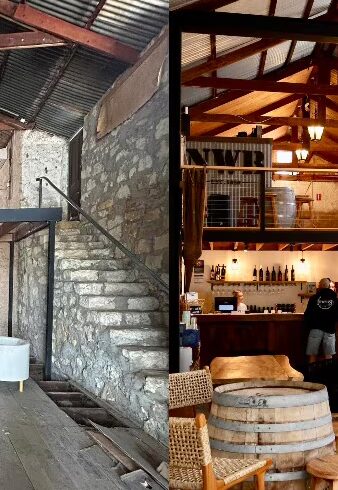
The barn at Nor’ West Bend before and after its most recent renovations. (Supplied: Lisa Goodland)
It has now reopened to the public for the first time in more than a decade, after being lovingly restored by its previous owners, Kevin and Sue Pedder, who researched and recorded the history of the property.
Nor’ West Bend station homestead has been a home to many families over the years. (ABC Open Riverland)
New co-owners Lisa and David Goodland have taken the Pedders’ efforts to the next level, modernising and refurbishing it into a cafe and bar venue.
Mr and Mrs Pedder bought the station and an attached 260 hectares in 2002.
They were handed the keys and “two books’ worth of problems”, which held the site’s dilapidation survey.
“It was like our Bible to restore the place because it gave us everything that was wrong with [it],” Mr Pedder said.
The couple had always enjoyed holidaying by the river and, after retiring, decided to move there permanently, taking on the restoration project as a “full-time job”.
“It took us eight years before we could actually shift into the main homestead and do all the outbuildings and get it all back to [being] liveable,” Mr Pedder said.
The old roof on the Nor’ West Bend homestead was falling down when Kevin and Sue Pedder bought the property in the early 2000s. (Supplied: Kevin Pedder)
Restoration station
Nor’ West Bend features a main homestead, a two-storey woolshed and wool store, shearing shed, and stables on the property.
Kevin and Sue Pedder owned Nor’ West Bend for almost 20 years and enjoyed special moments at the station, like their daughter’s wedding. (Supplied: Kevin Pedder)
“It was like a mini town because it was there about five years before [the town of] Morgan existed … which was called North West Bend at the time,” Mr Pedder said.
When the Pedders arrived, most of the roof on the main homestead had been destroyed by the weather and white ants.
The couple outsourced about half of the restoration work and did the rest themselves, staying on the property for almost 20 years.
Nor’ West Bend Station was established in 1850. The original lease was for 43 square miles of land by the River Murray. (Supplied: Lisa Goodland)
“We tried to keep it as close to original as possible … right down to the original stove that we found in the dump and had restored and put back into the kitchen,” he said.
With the property being heritage-listed and with previous links to the National Trust, Mr Pedder said every adjustment was run by the organisation to ensure renovations were historically accurate.
“We had the 150th anniversary [while we owned it] and thought if we can get this to last another 150 years, it would be fantastic,” Mr Pedder said.
Stepping back in time
Nor’ West Bend has seen droughts, floods, prosperous years, and everything in between since its establishment in 1850.
Its early days as a cattle and then sheep station were tough for some and rewarding for others, with six different owners in the first 30 years of its establishment.
A sketch of the main homestead at Nor’ West Bend from 1909, by Mrs L Hines. (Supplied: State Library of South Australia B 9915)
“The station went from famine in the drought, where it got down to hardly any sheep left, to people who made absolute millions of dollars out of the place,” Mr Pedder said.
“Some people had to walk off because there wasn’t enough water to sustain the place. Others made huge fortunes.”
One notable owner was Alexander Hay, a prominent South Australian merchant, pastoralist and politician, who purchased the station in 1876.
“He built the mansion down at Victor Harbor called Mount Breckan out of one year’s wool clip from Nor’ West Bend,” Mr Pedder said.
Charles Campbell, an early settler of Adelaide whom the suburb of Campbelltown is named after, also owned the station for the last years of his life in the late 1850s.
He died there in 1859 after an infection and complications from a minor cut on his hand.
David and Lisa Goodland have built on Kevin and Sue Pedder’s restoration work, making it into a cafe and bar venue. (Supplied: Lisa Goodland)
New beginnings
Nor’ West Bend changed hands another 10 times before Mr and Ms Goodland bought the property, together with Ms Goodland’s parents, in 2020.
Lisa and David Goodland’s son, Harry, helping with renovations. (Supplied: Lisa Goodland)
“The original plan was to have it as a holiday house … [but] the barn is so unique … we wanted to fix it,” Ms Goodland said.
“My husband and I quit our jobs, moved here full time about a year ago, and thought we’d be open by Easter.
“It’s been a lot of work, but we tried to do as much as possible ourselves.”
She said the station was special to many of its visitors.
“Lots of people have been here and told me their stories … or their grandparents’ stories, so it’s great they can come back now and see what we’ve done,” Ms Goodland said.
The PS Canally and its crew are some of the many visitors to Nor’ West Bend now it has reopened to the public. (Supplied: Gordon Johnston)
National Trust SA branch chief executive Nicolette Di Lernia said preserving historic sites like Nor’ West Bend was vital to preserving history and allowing people to understand it.
“[Sites] that are used and loved tend to be the ones that are successful and which have a long and exciting future,” she said.
“The way we have settled across SA is a pretty impressive story with a lot of good parts to it.
“It’s also really important to balance that with the impact it’s had on the traditional owners in those places, by changing the way in which the land is used and occupied and farmed.”
Many people have passed through the doors at Nor’ West Bend Station, now known as “NWB”, since it opened in November 2025. (Supplied: Lisa Goodland)
Mr Pedder said he was proud of his contributions to preserving a “slice of history” and applauded the new owners for inviting people back in.
“Once it’s gone, you never get it back,” he said.