Several clashes between Israeli forces and Syrian citizens were reported in southern Syria over the past few weeks as Syria marked a year since former dictator Bashar al-Assad was deposed.
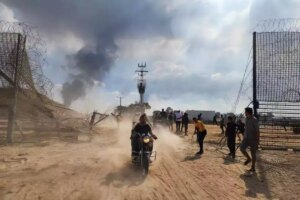
About two weeks ago, three IDF soldiers were seriously injured, and at least nine Syrians were killed, and several more were injured after a firefight erupted in the town of Beit Jann, near the Syrian-Israeli border.
The Israeli troops reportedly entered the village to arrest two suspects for questioning concerning suspected terrorist activity. The two were allegedly involved in firing rockets towards Israel in the past. The forces were ambushed by members of the Jamaa Al-Islamiya (Islamic Group) terrorist group, the Lebanese branch of the Muslim Brotherhood, which operates in both Lebanon and Syria.
According to Israeli reports, Israeli intelligence was unaware of the presence of dozens of terrorists in the town and only discovered it after the ambush.
Last week, Israeli forces faced another clash while setting up a checkpoint on a road in Quneitra, near the border between the two countries. The IDF fired on rioters, shooting two in the legs, and dispersed the riot before withdrawing from the scene.
Footage reportedly from the area before the incident showed a convoy of vehicles belonging to the Syrian government’s internal security forces driving through the Israeli checkpoint.
Additionally, during a military parade last week meant to mark the anniversary of the revolution, Syrian soldiers chanted slogans in support of Gaza and against Israel.
פרסמנו אצל @efitriger
תיעודי חיילי הצבא הסורי קוראים נגד ישראל, הדיונים במערכת הביטחון – והדרישה הישראלית מהמשטר: ״מצפים מכם לגנות״
כל הפרטים >>
ביום השנה לנפילת משטר אסד והקמת המשטר הסורי החדש אתמול – במערכת הביטחון ניטרו מהרשתות הגלויות תיעודים, שבהם נראים חיילי צבאו של… pic.twitter.com/uSZDe5XYY8
— דורון קדוש | Doron Kadosh (@Doron_Kadosh) December 9, 2025
“Gaza, Gaza, Gaza, our banner, night and day, bombing and ruin. We will not collapse. We are coming for you, our enemy, coming, coming for you, even if you were a mountain of fire, I will make from my blood ammunition, and from your blood rivers,” the soldiers chanted. Variants of the same slogans have been used by Hamas’s al-Qassam Brigades and by the Algerian army in the past.
How we got here
In 2011, Syria erupted into civil war when mass protests erupted against Assad, who had ruled the country since 2000. Assad’s government responded with a violent crackdown, sparking the creation of several armed rebel groups.
While the war began as an internal Syrian conflict, it quickly expanded into an international war.
Several of the rebel factions began receiving support from Turkey, while others received support from the U.S. Foreign fighters from around the world also came to join the rebel groups.
Meanwhile, Assad received backing from Russia and Iran, who established major presences in Syria.
The situation was further complicated after ISIS was formed and began seizing large areas of land in Syria and Iraq in 2014. This drew even more foreign involvement as the U.S. formed a coalition with other countries and with several rebel groups to fight the terrorist group.
In 2020, the fighting in the civil war largely subsided after a ceasefire was reached in northwest Syria, although there were still clashes between the various sides. That relative calm continued until November 2024, when Hay’at Tahrir al-Sham (HTS), the movement led by Syria’s new president, Ahmed al-Sharaa, launched an offensive on Aleppo. Less than two weeks later, HTS and its allies reached Damascus, and Assad fled the capital, marking the end of his regime.
In the following months, al-Sharaa worked with other communities and factions in Syria, including officials from the previous regime, to prevent further fighting and form a new government. In March, a transitional government was formed by al-Sharaa and his partners, and a temporary constitution was adopted. The temporary constitution leaves the current government in power for the next five years, during which a permanent constitution will be drafted, and subsequently, an election will be scheduled.
Israel’s intervention after the revolution
As the Assad regime fell, the IDF entered southern Syria in the areas near the Syrian-Israeli border. Over the following weeks, a series of Israeli airstrikes targeted military facilities across the country to destroy advanced military equipment, aircraft, tanks, and chemical weapons, and to prevent any potential threat to Israel.
In the year since, Israeli forces have maintained their presence in southern Syria near the border and on the Syrian side of Mount Hermon. The IDF has also conducted raids into villages further in Syrian territory and arrested individuals suspected of preparing terrorist attacks against Israel, including those accused of working with Iran-backed terrorist groups. Many of these suspects have later been released after questioning.
Israel also intervened in July after clashes erupted between Druze militias and Bedouin tribes in the area near Al-Suweyda in southern Syria. Syrian government forces entered the area in a bid to stop the fighting, but many then joined the clashes on the side of the Bedouin tribes, slaughtering Druze citizens.
Israeli airstrikes subsequently targeted government forces, with Israeli officials saying they were acting to protect the Druze, partially out of a sense of duty to the Druze community in Israel, and to prevent the entry of heavy weapons into southern Syria in general. Further airstrikes targeted government sites in Damascus, with Israel presenting the move as a warning against further action by the Syrian government.
Israel has also expressed concerns about Turkey’s role in Syria. Turkey was a central backer of al-Sharaa throughout the Syrian Civil War and has attempted to leverage that relationship to hold influence over Syria and increase Turkey’s regional power since Assad’s fall. As Turkish leaders, including President Recep Tayyip Erdoğan, have taken an increasingly hostile stance against Israel throughout the war in Gaza, Israeli officials have cautioned that Turkey could aid or even direct attacks against Israel through Syrian territory.
Israel and Syria attempt to reach an agreement on security issues
With both Israel and the new Syrian government concerned about the continued instability in southern Syria, the two countries entered talks earlier this year to try to reach an agreement that would address both of their security concerns.
However, in recent months, those negotiations have hit a brick wall, with little progress reported. Israel has demanded that Syria establish a demilitarized zone in a large part of its southern region, stretching from the Israeli border to the Damascus area. Israel has also demanded the establishment of a humanitarian corridor between Israel and the Druze communities in southern Syria. In turn, Syria has demanded that Israel withdraw from the areas it’s occupied in the country since December 2024.
U.S. President Donald Trump has worked to develop close ties with the al-Sharaa government over the past year, including by lifting sanctions that had been placed on Syria up until the revolution. Al-Sharaa has also worked to develop close ties with the Gulf states, including the United Arab Emirates and Saudi Arabia, and even with past enemies, like Russia.
After the recent clashes in southern Syria, Trump appeared to rebuke Israel, warning two weeks ago that “It is very important that Israel maintain a strong and true dialogue with Syria, and that nothing takes place that will interfere with Syria’s evolution into a prosperous State.”
Trump stressed that the Syrian president “is working diligently to make sure good things happen, and that both Syria and Israel will have a long and prosperous relationship together. This is a historic opportunity, and adds to the SUCCESS, already attained, for PEACE IN THE MIDDLE EAST!”
A day after Trump’s comments, Israeli Prime Minister Benjamin Netanyahu stressed that Israel would only agree to a security deal with Syria that includes the establishment of the demilitarized buffer zone.
“We hold these territories to ensure the security of Israeli citizens, and that is what obliges us. In good faith and understanding of these principles, it is also possible to reach an agreement with the Syrians, but we will stand by our principles in any case,” Netanyahu said, adding that “After October 7, we are determined to protect our communities on our borders, including on the northern border, and to prevent the entrenchment of terrorists and hostile actions against us, to protect our Druze allies, and to ensure that the State of Israel is safe from a ground attack and other attacks from the areas adjacent to the border.”
Syrian and American officials have expressed concerns that Israel’s demand for a demilitarized zone is excessive, according to Al-Monitor. Some U.S. officials are reportedly concerned that Israel is intentionally undermining the talks to maintain freedom of operation in Syria.
On Monday, Netanyahu met with Tom Barrack, the U.S. special envoy to Syria and ambassador to Turkey, to discuss the situation between Israel and Syria.
According to N12 news, Netanyahu told Barrack that Israel would appoint a new representative to renew negotiations for a security agreement with Syria within the coming days. “The meeting was the complete opposite of what we expected. Both sides thought there would be tension, but it didn’t happen,” a senior American official told N12. “The Israeli side presented its concerns – both about Syria and about Turkey, and we presented our concerns about the IDF’s actions in Syria. We now understand each other much better.”
Barrack has been viewed with suspicion by some Israeli officials due to his ties with Syria and Turkey. “Barrack is the one who is always against us,” a source close to Netanyahu told Al-Monitor this week. “In every conflict between Israel and Turkey, he will side with Turkey’s position. Between Israel and Syria, he will side with Syria’s position and so on.”
Syrian leaders reject Israeli demands, warn of further tensions
In an interview with The Washington Post in November, al-Sharaa insisted that “The advances that Israel made into Syria are not coming from [their] security concerns but are coming from their expansionist ambitions.”
“Israel occupied the Golan Heights [in the 1967 Six-Day War] in order to protect Israel, and now they are imposing conditions in the south of Syria in order to protect the Golan Heights,” al-Sharaa said. “So after a few years, maybe they will occupy the center of Syria in order to protect the south of Syria. They will reach Munich on that pathway.”
“We are engaged in direct negotiations with Israel, and we have gone a good distance on the way to reach an agreement. But to reach a final agreement, Israel should withdraw to their pre-Dec. 8 borders,” al-Sharaa added. The president noted that the U.S. has been supportive of Syria’s position and that he had been informed by Trump that the U.S. would “push as quickly as possible in order to reach a solution for this.”
Al-Sharaa rejected Israel’s demand for a demilitarized zone in southern Syria, explaining that “To talk about an entire region demilitarized, it will be difficult, because if there is any kind of chaos, who will protect it? If this demilitarized zone was used by some parties as a launching pad for hitting Israel, who is going to be responsible for that? And at the end of the day, this is Syrian territory, and Syria should have the freedom of dealing with their own territory.”
Earlier this month, at the Doha Forum in Qatar, al-Sharaa downplayed Israel’s concerns about Syria, saying “Israel has become a country that is in a fight against ghosts.”
“I believe that since we arrived in Damascus, we sent positive messages regarding regional peace and stability, and we’ve said very frankly that Syria will be a country of stability and we are not concerned with being a country that exports conflict, including to Israel,” the Syrian president said. “However, in return, Israel has met us with extreme violence. Just a reminder, it is Syria that is being attacked by Israel and not the opposite, and therefore, who has more right to claim a buffer zone and a pullout?”
The Syrian president accused Israel of trying to “export” its crises to other countries and of trying to “run away from the horrifying massacres it committed in Gaza.”
Al-Sharaa reiterated his rejection of Israel’s demand for a new buffer zone and insisted that the basis of any agreement should be the already existing armistice agreement reached in 1974. The 1974 agreement established a narrow buffer zone along the Syrian-Israeli border monitored by a U.N. observer force. “I believe these attempts [to secure a new buffer zone] will send us into a serious and dangerous place, and we don’t know what the result may be.”
Syrian Foreign Minister Asaad al-Shaibani told Al Majalla in November that he expects there will be a security agreement with Israel by the end of this year. Al-Shaibani stressed that any new deal would be almost identical to the 1974 ceasefire agreement. Any new deal would include only slight, temporary adjustments concerning other areas further in Syrian territory, according to the foreign minister.
“The 1974 agreement included provisions designating areas where military forces would be absent, where only police and observation posts were permitted, and where a military presence would be established at a set distance. The new agreement would closely follow this structure, with minor amendments,” al-Shaibani said.
“We are open to limited arrangements, such as military restrictions in the south. That is not problematic for us, provided it does not affect our national sovereignty, invite foreign interference, or compromise the current security structure. Any security failure in the south will be blamed on the Syrian government. No one else will be held accountable.”
Al-Shaibani described the possibility of an agreement as an “opportunity” for Israel. “Today, there is a Syrian government that openly declares that it is negotiating with Israel and openly calls for a security agreement, in stark contrast to the former regime. This is a real challenge, but one we are willing to take on. We must return to the 7 December 2024 line and reach a security agreement. We are prepared to address Israeli security concerns directly. Our primary focus is rebuilding Syria. If a peace treaty is desired, that can be discussed after a security agreement is reached, but the Golan Heights will remain the central issue in any such treaty.”
Israeli analysts split on how Israel should move forward in Syria
IDF Lt. Col. (res.) Eyal Dror, who commanded Israel’s “Good Neighbor” initiative that provided humanitarian aid to Syrians during the civil war, argued that it was only a matter of time before the Syrian government attacked Israel.
“History shows that when the IDF is in the territory of another country for a long time, it ends less well – both with the population and in the area of shaping narratives,” Dror told Makor Rishon. “What has been happening in Syria over the past year does not create a relationship of trust with the Sunnis. They see us as an occupier who is undermining stability.”
Dror explained that a gradual withdrawal from Syrian territory in exchange for a security agreement could be advantageous, as Israel could easily reenter these areas in the future if need be. Nevertheless, he argued in favor of the current policy toward Syria, stressing that all threats against Israel must be acted against proactively. Dror warned that while the threat posed by Iran and its proxies has decreased over the past two years, a new threat was forming from Sunni leaders in Syria and from Turkey.
“The government in Syria is weak and needs peace, so it does not challenge us,” Dror added. “The IDF said that indeed there are no signs of government involvement in Beit Jann. But in four years, when the government is stronger and more established, when it feels stable, al-Sharaa will decide to confront Israel. You would have to be blind not to understand that.”
Dror also argued that Israel wasn’t thinking strategically concerning its intervention for the Druze. “When Israel attacked al-Shara’s men on the road to al-Suwayda, it was perfectly fine because they were terrorists, but why did it have to be framed as helping the Druze and not as enforcing the demilitarization in southern Syria? Because of what we did, the Druze were ‘burned’ in Syria for years to come, and they are perceived by the regime and the population as collaborators of Israel.”
Dr. Carmit Valensi and Amal Hayek, researchers at Tel Aviv University’s Institute for National Security Studies, argued that Israel needs to change its approach toward Syria. They noted that the international community is increasingly building ties with al-Sharaa’s government, at odds with Israel’s hostile approach to Syria.
They warned that continuing the current policies would increase hostility against Israel in Syria. This in turn would heighten the risk of frequent military clashes, erode the new government’s legitimacy in Syria, and strengthen extremist groups calling for stronger action against Israel, including Iran-backed groups like Hezbollah.
The two researchers added that if Israel didn’t increase efforts to reach a security agreement with the Syrian government, it could end up being forced into an agreement later by Trump instead of on Israel’s own terms. They stressed that an agreement could still protect Israel’s security interests in the area as long as any withdrawals from the buffer zone were carried out in a controlled manner alongside clear commitments and guarantees from Syria and the U.S.
Valensi and Hayek cautioned, however, that Israel must also prepare for the possibility that an agreement could collapse, either because of continued instability in Syria or because of a change in policy by the Syrian government. “In such a case, Israel would have greater legitimacy and freedom of action to respond. Conversely, if trust develops between the parties, Israel could use the momentum to promote a gradual normalization process with Syria — an approach that would underscore Israel’s strategic value in the region, weaken extremist actors in Syria and the broader Middle East, and promote long-term regional stability,” they wrote.
Jacky Hugi, the Arab affairs editor for Israel’s Army Radio, argued that Israel and Syria would need to decide soon whether to agree to a security deal or not, as tensions were quickly reaching a point of no return.
Hugi noted that southern Syria is a tense region, filled with competing communities like the Druze, Sunni Muslims, and Bedouin tribes. These communities started fighting each other more intensely after the fall of the Assad regime, attempting to gain what power they could amid the instability in the region.
In light of this instability, Israel entered the area in order to ensure terrorist groups wouldn’t use the opportunity to attack. Since then, Israeli officials have repeatedly expressed concerns that the Syrian government may not be able to handle the instability and potential terrorist threats in the area on its own, or that it may even actively work against Israel on its own.
“Israel has found itself in a trap: If it signs a security agreement with Damascus and withdraws the IDF from the buffer zone, a host of wrongdoers could seize the area and carry out attacks from there. If it does not sign, resistance to the IDF forces could develop there due to their establishment in the buffer zone. In both cases, we are faced with a gamble,” Hugi wrote.
“The Israeli logic is clear. Who knows what character the new king will have? There is a golden opportunity to neutralize his military capability, so let’s go for it. That’s all well and good, but scorched-earth warfare also has a price. Imagine a foreign army destroying our military depots. Who would want peace with it?” Hugi added. “These are weeks of decision-making. The negotiations themselves have been exhausted, and both sides know very well what each wants.”