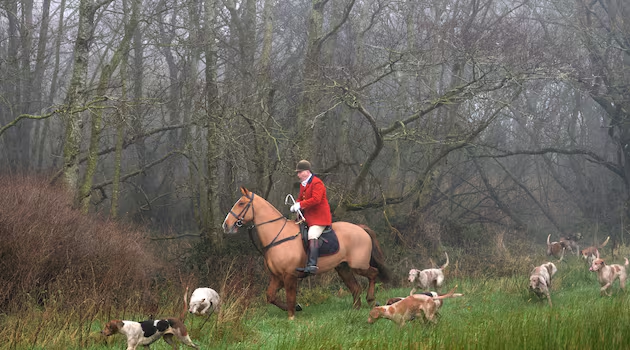
“I love foxes. I’m not out to kill them but I’m not going to lie, it happens sometimes,” prominent former Meath huntsman John Henry says.
A huntsman with the Meath Hunt for 35 years, he is adamant that “healthy” foxes are never caught as he expresses relief that a proposed Bill to ban fox hunting was defeated earlier this month in the Dáil.
On St Stephen’s Day, the Meath Hunt traditionally meets in Kells to chase foxes through private holdings. However, the pursuit divides opinion locally.
Lord Dunsany Randal Plunkett, who owns the 1,600-acre estate surrounding Dunsany Castle in Co Meath, strongly supports a ban on fox hunting – and he is not the first within his family to do so.
“My great-grandfather allegedly rode up to one of the hunts on a zebra – wherever he got that from – at the turn of the century but it was my grandfather who deviated from hunting in the latter end of his life,” says Plunkett.
“My grandfather Randal and my father Edward kicked out the hunt from our estate and my mother Maria famously threatened them with a blunderbuss in 2004.
“Fox hunting is an imported imperial sport from the UK, which is now banned in the UK but we are still celebrating it as a pastime, though I believe it is really perverse abuse of the animal.”
Rejecting claims from huntsmen that killing foxes is justifiable to protect other wildlife, Plunkett says growing fox numbers on his estate hasn’t affected the number of ground birds, which are increasing in numbers in rewilded areas.
Plunkett claims he has had numerous issues with various hunts over the years on entering his lands without permission.
“I’ve asked them to be respectful of the nature reserve I’m trying to build for the sake of Irish ecology.”
Randal Plunkett, Baron of Dunsany: ‘If we can simply do a little bit and allow nature to have a space, I think we’d cure a lot of the problems we have in society today.’ Photograph: Paul Faith/AFP via Getty Images
The Meath Hunt, which has over 100 members, meets twice a week from November 1st until the first week in March.
One of Henry’s main responsibilities as a “countryman” was to meet farmers in advance of hunts to seek permission to enter their land.
“Very seldom we stray on to land without permission but it can happen. I call to about 60 farmers before the Christmas meet to get permission and find out which fields are not accessible. I think in 35 years, we have only had to pay for damage to land once.
“I’m not going to lie. Foxes have been got by hounds but a healthy fox will never be caught,” Henry said, adding that up to 20 foxes get killed in a year.
John Henry of the Meath Hunt
“Most of the hounds are only interested in the chase. If a fox is caught, most of our dogs will just walk away.
“The hounds seldom see a fox at all. It’s just scent that the hunt is based on and conditions have to be right to even pick up a scent. It has to be an overcast and mild day.
“I love foxes. I’m not out to kill them. We have received calls in the past from farmers about orphaned fox cubs and we have taken them, reared them and let them back out into nature.”
He says he doesn’t believe the hunt will turn to trail hunting, which mimics traditional hunting without chasing a live animal.
“I think that would be like playing football without the ball.”
Including the work of his late father Johnny and brother Kenny, the Henry family has been breeding modern fox hounds for the hunt for over 70 years.
Pups are usually born in March and are socialised on farms before they train to pick up a scent from older dogs after a year. The hounds are trained with sheep in order to omit any threat to livestock they meet during a hunt.
Of the Private Members’ Bill proposed by People Before Profit Solidarity TD Ruth Coppinger to ban foxhunting, Henry says: “I didn’t sleep for a long time before the vote.”
The Bill was defeated by 124 votes to 24 with Fianna Fáil, Fine Gael and Sinn Féin opposing the proposed legislation.
“The hunt gives employment to so many people in tourism and hospitality who travel here for a meeting or any of our shows or annual hunt balls. There are 30 people directly employed by various hunt groups in the county,” Henry says.
“We are not elitists. Most of us are hardworking middle-class people from all walks of life and about 20 children and teenagers regularly take part.”
Plunkett campaigned at the Dáil in advance of the vote in early December and described the Bill’s defeat as “diabolical”.
[ Urban foxes no more cunning than rural ones, researchers findOpens in new window ]
He estimates that he has released up to 60 foxes into his estate in the last few years to add to the population already breeding there.
The numbers of foxes, he says, has not affected the population of ground-nesting birds.
“We now have more ground-nesting birds than ever before, especially our numbers of snipe, corncrake and pheasants, which have been spiralling upwards in the last two years,” says Plunkett, who is rewilding 600 acres of his estate as part of the European Rewilding Project – which is bidding to restore nature across the continent.
[ Rewilding: A meaningful response to tackling the biodiversity crisisOpens in new window ]
“The fox is a native Irish creature, like the hare, and is essential to our ecosystem and biodiversity,” says Plunkett.
“We have destroyed the habitats of the fox and other animals and completely collapsed our ecosystem. The fox has nowhere to go. They are victims of development.”