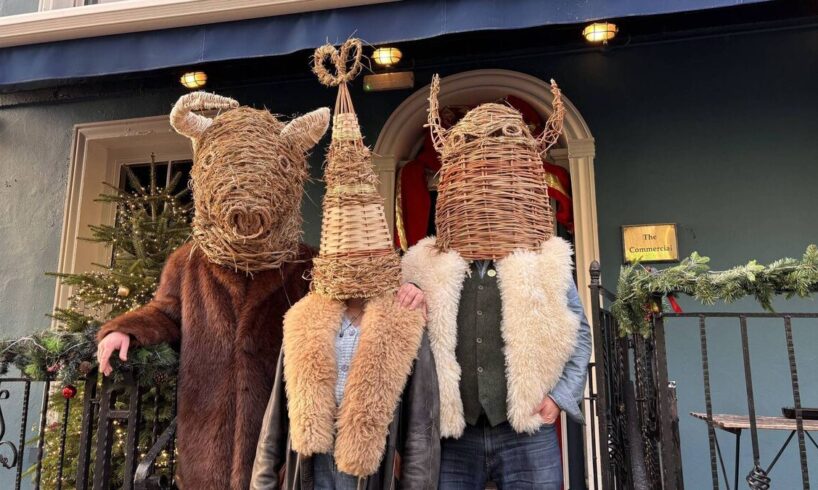
On St Stephen’s Day, crowds gathered in Limerick City to “revive” a centuries’ old tradition that is synonymous with Munster — the Wren Boys, Hunting the Wren, the Wran, or simply the Wren, depending on where the celebrations take place.
A longstanding mid-winter tradition, the Wren is particularly celebrated in pockets of Cork, Limerick, and Kerry, as well as in parts of Dublin.
While some believe the story emerged from pagan times, the origins of the celebration are unknown. With costumes made of straw, the Wren Boys are known to parade locally while gathering money for charities.
In Carrigaline, south of Cork City, and Ballydehob in West Cork, the Wren Boys tradition has become a staple over the decades. It is not quite Christmas in these parts unless the Wren Boy costumes appear and vital funds are raised for organisations such as Marymount Hospice and Cork Simon.
Lumen Street Theater helping to make the masks for The Wren celebration in Limerick City.
In Limerick on December 26, crowds led by Irish tradition and cultural promotion organisation Trad Folkin’ Rocks gathered to “bring back” the Wren to the Treaty City, from St Mary’s Men’s Shed to The Commercial on Catherine Street.
Co-organiser Sean Flynn said the event was a “massive collaboration” between creatives.
“A lot of people have come together to try to revive the tradition. It’s wonderful to see the amount of support around the city, and the excitement when people in the city see that new life is being breathed back into the Wren,” he told the Irish Examiner.
The story of the Wren is so ancient it is often difficult to pinpoint when exactly it came to life. And from generation to generation, the stories seem to have evolved.
Members of the Dingle Green & Gold Wren. Picture: Domnick Walsh
Back in the days, Wren Boys were said to be parading around towns with dead wrens attached to their costumes, demanding contributions in the form of food or money. If they did not receive a contribution, they threatened to bury a wren — which was believed to be a sign of bad luck.
Another story goes like this: In a contest to see which bird could fly the highest, the wren hid in an eagle’s wing. Once the eagle flew high above all others, the wren seized the moment and came out of hiding to fly higher.
While the celebration now mixes the old with the new, its essence remains the same — it’s all about community and “inclusivity”.
George Evangelou, Richelle Clancy, Cleopatra Evangelou and Niamh Clancy dressed as astronauts at the Wren Boys Street Festival on St. Stephen’s day in Carrigaline, Co Cork.
Owner of The Commercial bar and co-organiser Rocky O’Shea said the idea to bring the Wren Boys back in the city came from a resurfaced video from 1954.
Mr O’Shea hosts the Tinteán sessions, where trad musicians gather to play every Tuesday.
“You look at how big it is elsewhere in the country, and we thought, ‘Wouldn’t it be lovely?’. The trad scene in Limerick is thriving at the moment, and we thought it’d be a lovely way to kind of bring it back [the Wren tradition],” he said.
Trad sessions are popping up in pubs where they would not have happened before, Mr O’Shea said, adding combined with the Wren, it is a “nod back” to heritage.
“At Christmas, people are coming in to hear traditional music playing in the pub. It’s massive for people coming back from London and Australia.
“My little fella came to it last year, and it was very interesting when we went home; he wanted to know about it. It was lovely to see him learn, it has become so lost, and now it’s kind of coming back a little bit,” he said.
One of the organisers, West Cork native Meadhbh Hayes, felt lonely when she first moved to Limerick two years ago.
“I started going to the Tinteán almost every week. It was just so inclusive, nice, and everyone was welcoming and kind.”
The Dance of the Wren performed by Pat McEvoy from Dublin and Mick Lacey from Clare, in Sandymount, Dublin.
Over the last couple of years, there has been a “revival” of trad and folk music, with bands such as Amble and Kingfishr leading the Irish charts.
Ms Hayes, who is a musician herself, said the genre was “rooted in our soul”.
“It resonates a little bit more with what it is to be Irish. It’s like ‘Now we’re back at home’. I think there’s something ingrained in all of us, it’s part of our tradition.”
She first heard of the Wren Boys because of her cousins in West Limerick.
“They do it every year on St Stephen’s Day, but their version is they go from house to house in the local community, playing trad music and raising money for a local charity or maybe for the local school.”
Straw Boys on Main Street, Carrigaline.
While the tradition is deeply rooted in rural areas, Mr Flynn is hoping to keep the celebration going every year in Limerick City.
“We are so lucky that across Ireland, many people have been keeping the Wren alive in their own communities. Each of these communities has its own take on the Wren.
“While we’ve been inspired by other communities around Ireland that do the Wren, it’s something that we’re learning to do here in Limerick. None of us were expert mask makers. We’ve had friends and other volunteers make them. Lumen Street Theatre has taken the lead on some of the more complicated masks,” he said.
This year, the group raised money for MidWest Simon Community and Milford Care Centre.
The event was in collaboration with Trad Folkin’ Rocks, The Commercial/Record Room, Lumen Street Theatre, St Mary’s Parish Men’s Shed, Winner Flags, and Limerick City and County Council.