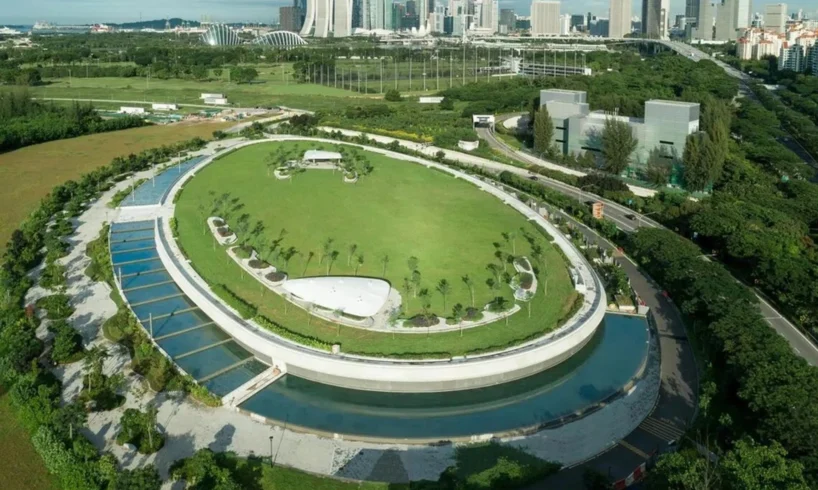
PUB says a tender will be called on Dec 26 for a study for such a facility.
[SINGAPORE] The Republic is studying the feasibility of building a sixth desalination plant to boost the security of its water supply.
National water agency PUB said a tender will be called on Dec 26 for a study for such a facility.
The study, which is expected to take about 10 months to complete, will assess the viability of a plant that can treat both seawater and freshwater like the Marina East Desalination Plant.
Such flexibility to switch between both kinds of water will enhance the resilience of Singapore’s water supply to the weather, PUB said in a statement.
The study will also entail the development of various plant design options, and assessments on their technical feasibility and economic viability.
The agency said it will also be exploring multi-functional designs that maximise land-use and lower the new plant’s footprint.
“This considers lessons learnt from existing desalination plants, such as incorporating higher multi-storey buildings and deeper basements to house treatment facilities,” it said.
For instance, the Marina East Desalination Plant has treatment facilities underground.
The Jurong Island Desalination Plant is integrated with Tuas Power’s Tembusu Multi-Utilities Complex, making it about 5 per cent more energy-efficient than conventional desalination plants.
Both facilities share seawater intake and water-discharge facilities. The electricity generated in the Tuas Power complex also goes to the desalination facility.
These features result in annual energy savings sufficient to power nearly 1,000 Housing Board households.
Singapore relies on four sources of water, two of which are dependent on how much rain falls over the catchment area.
They include water imported from Malaysia’s Johor River, which makes up the bulk of water used here, as well as rainwater captured in Singapore’s waterways and reservoirs.
But changing weather patterns due to climate change run the risk of disrupting the supply.
The two more weather-resilient sources of water are recycled used water – dubbed NEWater – and desalination.
The energy-intensive process of desalination produces drinking water by pushing seawater through membranes to filter out dissolved salts and minerals. Because of this, desalination is the most expensive way to produce water.
Since desalination was first introduced in Singapore in 2005, the island-state has built five desalination plants.
PUB previously said the plan is for recycled water and desalination to meet up to 85 per cent of Singapore’s future water demand, which is set to double by 2065.
Currently, Singapore’s daily water demand is about 440 million gallons, which is sufficient to fill 800 Olympic-sized swimming pools.
The Republic’s desalination plants can meet up to 43 per cent of current water demand, with a total capacity of 190 million gallons of water.
Total water demand in Singapore is projected to rise on the back of its industrial growth. Non-domestic demand is expected to account for more than 60 per cent of water demand in 2065, up from the current 55 per cent.
Meanwhile, household water consumption has also inched upwards. In 2024, each resident used 142 litres of water a day, up from 141 litres in 2023. This was comparable to usage in 2017.
Under the Singapore Green Plan 2030, the goal is to reduce household water consumption to 130 litres per person a day. THE STRAITS TIMES
Decoding Asia newsletter: your guide to navigating Asia in a new global order. Sign up here to get Decoding Asia newsletter. Delivered to your inbox. Free.