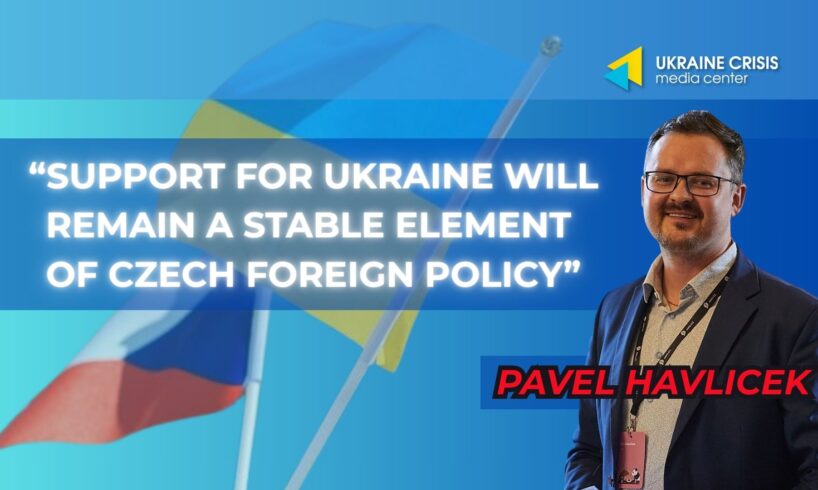
On December 16 at 12:00 a.m., a briefing “Future of Czech Support for Ukraine: Challenges and Prospects” at the UCMC press center was held with representatives of Czech civil society organisations.
Hybrid Warfare Analysis Group spoke with Pavel Havlíček, Research Fellow at the Association for International Affairs, about the current challenges facing Ukrainian-Czech cooperation in the context of the change of government in Czechia.
Pavel Havlíček
How is support for Ukraine positioned within the foreign and security policy priorities of the new Czech government?
The new Czech government signals a partial reshaping of foreign and security policy priorities. While value-driven principles such as democracy and human rights remain present, the program declaration indicates a stronger emphasis on regional cooperation, particularly within the Visegrad format, and closer alignment with the United States.
Despite political changes, continuity in security policy is likely. The President Peter Pavel is expected to safeguard Czech defence commitments, including long-term targets agreed at the NATO summit in The Hague. These include increased defence spending covering both direct military capabilities and related infrastructure.
Czechia is also bound by existing international obligations, such as major defence procurement projects, including F-35 aircraft. Together with pressure from international partners and domestic accountability, these factors significantly constrain any policy reversal. As a result, support for Ukraine is likely to remain a stable element of Czech foreign and security policy.
Which concrete Czech–Ukrainian initiatives could serve as a foundation for sustained support for Ukraine?
Czech–Ukrainian cooperation already relies on several concrete initiatives. A key example is the bilateral Programme Ukraine, reaffirmed by the government, which allocates approximately €500 million for the upcoming year, alongside an additional €500 million in investment guarantees. These guarantees are designed to unlock larger financial resources through the EU’s Ukraine Facility.
Funding is directed at specific reconstruction projects, including hospitals, while facilitating Czech private-sector participation. This approach strengthens long-term engagement rather than short-term assistance.
Equally important are bottom-up initiatives such as the Business Club Ukraine, coordinated by the Ministry of Industry and Trade. It brings together over a hundred Czech companies already active in Ukraine and interested in reconstruction, joint ventures, and sustained economic cooperation. Combined, these frameworks form a solid backbone for continued Czech support.
President of the Czech Republic Petr Pavel and Prime Minister Andrej Babiš with the newly appointed members of the Czech government, Prague, Czech Republic, December 15, 2025
How can Czech political actors be constrained from exploiting support for Ukraine for short-term electoral gain?
Czechia’s institutional system provides important safeguards against excessive politicisation. The Senate, the presidency, and an active civil society function as counterweights to potentially destabilising rhetoric from the lower chamber of parliament.
Civil society plays a particularly important role in holding political actors accountable and preventing foreign policy from becoming purely an electoral instrument. Economic realities also impose constraints: Czech–Ukrainian trade has grown rapidly and now exceeds trade with Russia, creating strong incentives to maintain constructive relations.Taken together, institutional checks, societal pressure, and economic interests make a fundamental rollback of support for Ukraine unlikely, regardless of political rhetoric.
What practical measures can be taken to counter anti-European and anti-Ukrainian disinformation?
Disinformation in Czechia has become heavily politicised and is often framed as a debate on freedom of speech rather than national security. Some political actors have undermined strategic communication and questioned regulatory efforts, including the implementation of the EU’s Digital Services Act, which remains incomplete.
As a result, much of the burden has shifted to civil society. NGOs lead in media literacy, fact-checking, and non-formal education. Initiatives such as Czech Elves, the Czech version of StopFake, and organisations like Demagog have strengthened societal resilience and contributed to regional cooperation.
Although vulnerabilities remain, Czech society is comparatively resilient. Continued support for civil society and closer cooperation with Ukrainian partners are essential to counter hostile narratives effectively.
Why should disinformation be addressed within a broader framework of hybrid threats?
Disinformation cannot be treated in isolation. Czechia has experienced tangible hybrid threats, including sabotage attempts and cyberattacks, such as operations targeting hospitals during the COVID-19 pandemic and incidents affecting public infrastructure.
These cases demonstrate that hostile activities extend beyond the information space into physical and cyber domains. Addressing them requires a comprehensive national security approach, including crisis preparedness, crisis communication, and resilience against hybrid threats.
Reframing the issue in this way helps move the debate beyond politicised arguments about censorship. Ensuring national security is a core responsibility of the government, and countering hybrid threats must be treated as a strategic priority.