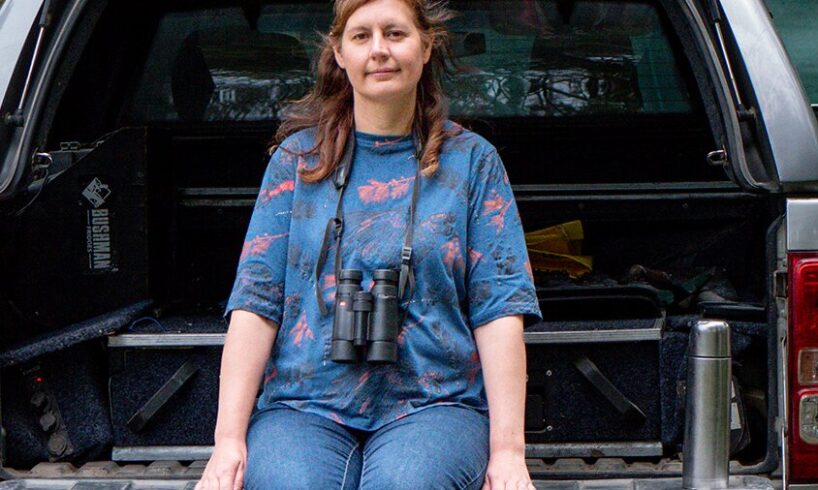
Cassie Hlava sits on the boot of her ute in the Victorian town of Nelson. (ABC News: Daniel Miles)
Australia’s renewable energy boom is reshaping the landscape. But when new green energy projects threaten the wildlife they are meant to save, who decides what gets sacrificed?
Cassie Hlava has an answer for most questions about the birds in her backyard.
The one question that almost stumps her? Picking a favourite.
She stares into space for a moment, genuinely contemplating the question, a mixture of concern and amusement crossing her face.
“It’s like picking a favourite child,” she says.
Cassie Hlava keeps a running tally of all the birds spotted in her backyard.(ABC News: Daniel Miles) Cassie Hlava’s bird senses are highly attuned for new visitors to her Nelson home.(ABC News: Daniel Miles) Cassie Hlava is an ecologist and bird lover from south-west Victoria.(ABC News: Daniel Miles)
Her home, nestled at the end of a dirt road in the tiny town of Nelson near the Victoria–South Australia border, doubles as an avian observation post for the family of three.
In the living room, a giant canvas photograph of a scarlet robin commands the centre of the room. A small TV sits off to the side, tucked in a corner.
She always has a Word document on the go, ready to add to the list of birds she has officially spotted in her backyard — 84 so far.
Cassie Hlava’s home is surrounded by nature.(ABC News: Daniel Miles) Cassie Hlava and her family moved to Nelson six years ago. (ABC News: Daniel Miles) The lounge room is Rocky’s domain.(ABC News: Daniel Miles)
A wallaby stealthily hops the fence and moves across the lawn before pausing, caught in the act, a few bounds from the kitchen window.
The family dog, Rocky, still sleepy from a mid-morning nap, barely bats an eyelid.
Cassie shrugs and smiles. She is more surprised by the fact that the wallaby’s baby joey is not here today as well.
The appearance is no biggie, really. This is a natural place, where wildlife can roam free.
A curious wallaby bounded through Cassie Hlava’s backyard in Nelson.(ABC News: Daniel Miles)
But Cassie is worried.
Less than a year after her family moved to Nelson in 2019, plans emerged for a 105-turbine wind farm called the Kentbruck Green Power Hub.
The wind farm’s placement — between a Ramsar-protected wetland and national parks — has prompted concerns that endangered birds could collide with the turbines and die or avoid flying through the development to vital habitats.
Environmental experts warn it could set a dangerous precedent for developments across Australia.
Cassie Hlava’s balcony is a beautiful bird-spotting site.(ABC News: Daniel Miles)
Mark Bachmann chats easily as he steers his four-wheel drive ute down a bumpy access route towards the ocean.
The vehicle is covered in beige stucco-like paint — a home job, courtesy of his son — which hides the dirt and sand it is regularly splattered with.
He comes to a stop at a small clearing surrounded by coastal shrub and soft sand.
The fire-engine red interior of Mark Bachmann’s ute is in stark contrast to its dust-coloured exterior.(ABC News: Jean Bell) Mark Bachmann’s son painted the exterior of his trusty ute.(ABC News: Jean Bell) Mark Bachmann packed all the essentials for a trip to the wetland.(ABC News: Jean Bell) Mark Bachmann drags his canoe across “kangaroo paths”.(ABC News: Jean Bell)
Mark throws the vehicle door open and begins pulling on his waders.
He smears sunscreen on his face before hoisting a canoe off his roof racks and charging down a narrow path, tackling wilderness head-on with dogged determination.
Mark knows these tracks by heart. He has been trekking them for more than a decade.
After about 15 minutes bashing through thickets and native scrub, Mark comes to a stop and smiles.
The wetlands are Mark Bachmann’s pride and joy.(ABC News: Daniel Miles)
Before him stretches an expanse of murky water, calm and still.
The Southern Ocean roars at his back.
Native aquatic plants burst through the two-metre-deep wetland, covering the pale skeletons of long-drowned trees
This is Long Swamp, an 18-kilometre stretch of native wetlands, situated on a sliver of land between the sea and the pine plantation that will house the proposed wind farm.
Mark has spent more than a decade trying to reverse the damage done when farmers drained the swamp into the ocean nearly 100 years ago.
He spearheaded a community effort to restore the wetland through Nature Glenelg Trust, a not-for-profit environmental organisation he founded in 2011.
Loading…
In 2018, the site was given Ramsar protection status, meaning it is one of 67 wetlands across Australia that are declared internationally important for conserving biological diversity.
Freshwater springs continually feed water into the wetland, so it remained inundated throughout the region’s recent crippling drought.
“In the face of climate change, drought-refuge habitats like this wetland are going to be vital for our biodiversity going forwards,” Mark says.
The proposed Kentbruck Green Power Hub would sit next door.
Up to 105 wind turbines, each standing 270m tall, could be dotted throughout a pine plantation beyond the swamp, just 300m from national parks and 500m from the protected wetland.
An image produced by the team behind the Kentbruck Green Power Hub showing how its wind turbines could look among pine plantations near Nelson.(Supplied)
The wetland is home to more than 90 waterbird species, including the endangered Australasian bittern, of which fewer than 2,000 remain worldwide.
One tracking study shows a bittern has flown directly over the proposed wind farm site.
Mark is all for renewable energy projects, just not anywhere near here.
“There is no way to avoid having an impact when you site a major development on the doorstep of a Ramsar wetland, wedged between national parks,” he says.
“If this wind farm were approved here, [is] there any situation where you wouldn’t approve a wind farm?” Mark Bachmann’s concern for the wetland is etched across his face.(ABC News: Daniel Miles)
The green boom
The proposed farm near Nelson, which is being put forward by ASX-listed company HMC Capital, could be a shot in the arm for Victoria’s energy supply as the nation’s aging coal-fired power stations are phased out.
It is expected to produce about 5 per cent of the state’s electricity needs over 30 years.
Loading…
The decision now rests with Victorian Planning Minister Sonya Kilkenny, who could approve the project any day.
It is a scary thought for those who have been obsessing over the plans and the wetland itself for the past six years.
But Australia’s shift to green energy doesn’t have to come at the expense of the environment, conservation ecologist Brendan Wintle says.
“This idea that it’s either nature or renewables is false,” he says.
The solution, he argues, lies in careful and regulated planning.
Professor Wintle, who leads the University of Melbourne’s Melbourne Biodiversity Institute, wants to see the government take the lead on implementing stronger national planning guidelines with clearly marked “no-go zones” around high biodiversity areas.
Brendan Wintle says careful planning is the key to ecological success.(Supplied)
A 2025 study of Australia’s east coast found that by avoiding just 30 per cent of the most ecologically important land, up to 90 per cent of habitat for threatened species could be protected.
The Kentbruck wind farm site is included in the areas with the highest biodiversity values.
“We can hit our targets for renewable energy generation at net zero, predominantly using wind and solar energy, without dramatically impacting on the habitat of our 2,500 endangered species,” Professor Wintle said.
Recent planning changes could give this idea some bite.
Last month, the federal government passed long-awaited environmental reform to the nation’s “broken” environmental regulations, to strengthen environmental protections and expedite environmental approval for major projects.
This is what HMC Capital says the wind farm would like from the sand dunes at Swan Lake, with the closest wind turbine about 3.5 kilometres away.(Supplied)
The reforms sparked fierce debate. The Coalition opposed the deal struck with the Greens, while some environmental groups argued the protections did not go far enough.
Regional planning was also bolstered to allow state governments to include “no-go zones”.
Professor Wintle says the changes are not perfect, such as allowing ministerial discretion to approve projects that are deemed of national interest.
But he is hopeful for the future.
“There is space for us to have economy-changing renewable energy infrastructure in this country without impacting in a really negative way on nature, losing species, and compromising our ability to grow food, or making communities really upset.”
This is how the company behind the Kentbruck Green Power Hub believes the farm would look from Nelson.(Supplied)
Unfavourable winds
Cassie Hlava is more than your average bird nerd.
She is also an ecologist and the deputy convenor for BirdLife Southeast South Australia.
Cassie Hlava has an official position with her local Birdlife Australia branch.(Supplied)
She says she is not anti-renewables.
She just believes this proposed wind farm is in the wrong spot.
BirdLife Australia is also worried the project’s location could spell disaster for the rare and endangered birds that pass through.
Environmental surveys for the wind farm found 24 endangered species in the area.
The project documents acknowledge some may collide with turbines, but argue the plantation itself is not a suitable habitat and most birds are “unlikely” to fly at blade height.
The pine plantation sits directly adjacent to the wetland habitat, a detail critics point to as undermining the wind farm’s argument.
The wind farm is proposed to be constructed within this pine plantation outside of Nelson.(ABC News: Jean Bell) Logs were lined up drying in the plantation near Nelson.(ABC News: Jean Bell) A lone tree had seemingly grown out of nowhere in a felled field. (ABC News: Jean Bell)
Cassie is concerned that the band of turbines running the length of the plantation would fragment the landscape.
This would block natural routes between habitats, forcing birds to either fly through the farm — risking collision — or detour around it, expending precious energy, she says.
“Birds generally follow the path of least resistance, which is the shortest distance between habitats, as well as with the most favourable winds,” she says.
Some wetland birds have already lost swathes of natural habitat, Cassie says, and can’t afford to lose access to what remains.
“If suddenly these large areas of habitat are unavailable, then their populations will decline,” she says.
Most vulnerable of all the region’s visitors is the orange-bellied parrot, a small, brilliant green-and-gold bird that breeds in Tasmania each summer before crossing Bass Strait to spend winter along the Victorian and South Australian coast.
A male orange-bellied parrot with its distinctive stomach colouring.(Supplied: Dejan Stojanovic) The orange-bellied parrot is critically endangered in Australia.(Supplied: Chris Farrell Nature Photography)
A single orange-bellied parrot was spotted in the region recently, the first time one had been seen in 22 years.
Fewer than 100 remain in the wild, and the population endures mainly thanks to the efforts of a captive breeding program in Tasmania.
The company behind the wind farm says the project is unlikely to affect the critically endangered bird.
There are also concerns for the southern bent-wing bat, a cave-dwelling, insect-eating creature whose population has plummeted in recent decades.
The Victorian Environment Department lists collision with wind turbines as one of the bats’ key threats. Project surveys found the bats routinely fly within the wind farm site, but at heights mostly below turbine blades.
The proposed wind farm’s location is surrounded by national parks and the Southern Ocean.(ABC News)
Planned turbines within 5 kilometres of bat caves have been removed, and the wind farm company intends to curtail turbines during low winds when bats are more likely to fly.
It has also pledged $1 million annually over the farm’s 30-year life for species protection and recovery.
But the Southern Bent-Wing Bat National Recovery Team, the group working to bring the bat back from the brink, says 5 kilometres is not far enough, and that no amount of money can compensate for the genetic diversity lost in a dead bat.
The southern bent-wing bat is known to fly in the area of the Kentbruck project.(Steve Bourne, Wikimedia Commons, CC BY SA 4.0) A southern bent-wing bat flies in Naracoorte’s bat cave just over the border in SA.(Supplied: Steve Bourne, Wikimedia Commons, CC BY SA 4.0)
The last thing it needs
Eric Woehler has spent more than 45 years studying birds from his home base in Tasmania.
He supports the transition to renewable energy, but not, he says, at the cost of the environments those projects are meant to protect.
Dr Woehler believes the Nelson proposal could set an “unwelcome precedent” that allows developments to edge closer to internationally significant ecological areas, like Ramsar-listed wetlands.
“The last thing a threatened species ‘needs’ is a novel threat to exacerbate the existing spectrum of threats it faces,” he says.
Eric Woehler has been studying birds for decades.(ABC News: Jake Grant)
Dr Woehler is blunt about the evidence: turbines do kill birds. It is what happens when you build turbines near avian flight paths.
HMC Capital stands by its investigations into the site’s biodiversity, which have been ongoing for five years.
“[This project has] involved some of the most significant and rigorous monitoring programs undertaken for a wind farm in Victoria,” a HMC Capital spokesperson said.
The wind farm proponents say there are no recorded bittern deaths at Victorian wind farms, but concede there is potential for birds to be impacted and “likely collisions”.
The wind farm’s design had been changed, including the removal of turbines within 500m of the Ramsar-listed wetland, as a result.
Regardless, Dr Woehler argues the only real safeguard is distance.
Lots of it.
The wind farm turbines would tower over the surrounding pine plantation. (ABC News)
Instead of a 500m buffer zone, Dr Woehler says turbines should sit at least 5 kilometres from protected sites.
This would allow migratory shorebirds and other birds, like the bittern, to gain altitude slowly and get high enough to avoid the turbines.
Dr Woehler has an ally in Hugh Possingham, a conservation scientist and University of Queensland professor who previously served as Queensland’s chief scientist.
Hugh Possingham at the Bullock Bridge property near Kingston South East.(Supplied: Andy Rasheed)
“Generally speaking, it would certainly not be sensible to put wind farms next to Ramsar wetlands because they have such high concentrations of waterbirds,” Professor Possingham says.
He says Australian green-energy companies should be learning from approaches used overseas.
That includes turning off turbines during key migration periods, or using detection systems that automatically pause blades when large flocks approach.
“There’ll never be zero impact [on birds] — but less impact is good,” he says.
Hugh Possingham is a former Queensland chief scientist, best known for his work in conservation biology.(ABC News: Christopher Gilette)
Bring it on
Dan McKinna’s footsteps echo through the cavernous Prince Engineering wind turbine factory in Portland, just outside of Nelson.
Things have been pretty quiet lately. Mr McKinna’s crew hasn’t made a wind tower since 2020.
Things have been quiet at the wind turbine factory recently. (ABC News: Jean Bell)
Cheaper, imported towers have trumped his company’s efforts, he says.
If a new farm were to be commissioned just 30km away, he is hopeful his company would be considered.
It would be big news for the town. About 100 new full-time jobs.
“The energy transition is the equivalent of the industrial revolution,” he says.
Dan McKinna is hopeful the proposed wind farm goes ahead.(ABC News: Jean Bell) The Portland factory’s wind tower facility has been “mothballed” in recent years.(ABC News: Jean Bell)
The energy-hungry Alcoa Aluminium Smelter in Portland is also keen to be involved.
The company says it has a memorandum of understanding with the proposed wind farm’s managers, as part of a plan to bring more renewable energy into the plant’s longer-term energy mix.
The wind farm says it is currently one of the “few options” the smelter has to source low-cost electricity and continue to operate.
“The project will also play a significant role in Victoria’s energy transition and decarbonisation, and to assist in the state’s efforts to combat the worst effects of climate change,” the HMC Capital spokesperson says.
A Victorian government spokesperson says the wind farm is still under consideration and that it could make no further comment.
Portland’s aluminium smelter is the largest consumer of electricity in Victoria.(Supplied: Alinta Energy)
The word around town
Nelson is so small that it does not have a supermarket, doctor or a hairdresser.
But it does have one place to get a good, sit-down meal for its population of about 190.
Things are relatively quiet at the Nelson Hotel on a Thursday afternoon.
The Nelson Pub is an inviting place.(ABC News: Jean Bell) Nelson is home to a few hundred people.(ABC News: Jean Bell) We think this kookaburra might have an identity crisis.(Supplied: Jenny Hill) Life on the water is important in Nelson.(ABC News: Jean Bell)
There is no lunch rush in establishments like this, just a gentle ebb and flow of a few passing tourists, a local or two every now and then.
In one corner, the establishment’s piano is getting tuned. The repetitive hammer of notes is a somewhat dissonant backing track to an otherwise quiet venue.
Those who are here take little notice. It is not dissimilar to the way some residents have approached the proposed wind farm.
“I haven’t had any real conversations about it,” says publican Robert Grant.
Robert Grant happily pours beers at the Nelson Pub.(ABC News: Daniel Miles)
Robert is not too fussed about the birds, but he does have some environmental concerns. He thinks the plan is “crazy”.
“With the recent bushfires around Victoria, I think it’s pretty ridiculous putting it in the middle of a forestry area,” he says.
The most recent blaze came in October when a bushfire sparked by lightning in the Lower Glenelg National Park burnt through more than 2,200 hectares of vegetation before being contained.
The team behind the farm says it has mitigation methods in place to reduce the risk of fire.
Fran Thompson stands windswept and wrapped in a scarf at the pale blue mouth of the Glenelg Estuary, watching birds bob in the water.
When she speaks about the wind farm, her shoulders drop.
“It’s a disaster waiting to happen for birds,” she says.
“In this rush to achieve what could be impossible [renewable energy] targets, what are we leaving behind? What are we losing?”
Fran Thompson is concerned about the future of Nelson.(ABC News: Jean Bell) Fran Thompson is a relative newcomer to Nelson.(ABC News: Jean Bell)
Fran and her husband moved to Nelson from New South Wales six years ago. The birds, the river and the growing eco-tourism all drew them here.
“It’s got a great little ecotourism thing happening,” she says.
Now she worries the turbines will drive that away, along with the wildlife that makes the area special to her.
The ‘new’ Nelson
Back in her home among the gum trees in Nelson, Cassie takes a beat when thinking about “what’s next”.
She loves her new home, and is among a handful of young families that have moved into the town in recent years.
“I’d seriously reconsider whether we can stay here long-term if the development was to go ahead, and I’m sure other people in the town feel the same way,” Cassie says.
Cassie Hlava is not sure about her future in Nelson.(ABC News: Daniel Miles)
The turbines, she says, would mark a transition of the area from a very natural, wild place into something marred by industrialisation.
On her doorstep, there would be a constant reminder of the threats to the birds she loves to watch.
She also thinks of her three-year-old son.
The Hlava family moved here to raise him close to nature, to give him a childhood where wallabies hop past the window and bird calls mark the rhythm of the day.
Cassie Hlava is an avid bird watcher. (ABC News: Daniel Miles) Cassie Hlava’s home has plenty of spots to bird watch. (ABC News: Daniel Miles) An eastern yellow robin, pictured with an insect to feed to its chicks in Campbell’s Creek in Central Victoria.(Supplied: Jane Rusden) Bird spotting is more than just a hobby to Cassie Hlava.(ABC News: Daniel Miles)
Summer ticks on. Nelson’s population will surge a little, thanks to the small influx of tourists.
For now, the Hlava family’s days will be about camping, kayaking and bird watching in their own quiet patch of town.
The wallaby that crossed the lawn earlier will likely return tomorrow.
Maybe the joey will join her, too.
Cassie will have her binoculars ready, keeping an eye out for the next bird to add to the list.
Oh, and as for her favourite bird?
It is the eastern yellow robin. A burst of bright yellow in the greenery, full of attitude, always around.
Credits
Reporting, photography and digital production: Jean Bell and Daniel Miles
Source