When a mob stormed a neighbourhood in Ballymena last summer to expel families from their homes, a chilling shout echoed around the narrow streets: “Where are the foreigners?”
The hunt for immigrants in the Northern Ireland town prompted Poles, Bulgarians, Filipinos, Nigerians and other nationalities to flee or barricade their doors. Police called the outburst of hate an attempted pogrom, one that made headlines around the world.
Six months later, several houses around Clonavon Terrace are still scorched, empty shells, and the homes that remain occupied tend to have curtains drawn even during the day.
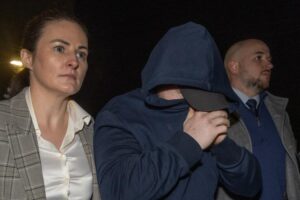
Houses in Ballymena targeted during riots in June 2025 remain boarded up six months later. Photograph: Rory Carroll/The Guardian
“Everybody is being very careful. It’s on a knife-edge,” said a health worker from Africa who declined to share his name or nationality. Another resident, from the Czech Republic, said he ventured out only when necessary. “Men with masks drive up and down. They slow down and look at you.”
It is a bleak aftermath to three nights of mayhem in June when hundreds of rioters hurled rocks and petrol bombs at phalanxes of police, leaving dozens injured and turning Ballymena, a predominantly Protestant working-class town 25 miles north-west of Belfast, into a byword for intolerance.
Many residents reject that description and say there is a misconception about what happened. The violence was not intended to terrorise all foreigners. Only the Roma.
Other nationalities were targeted in error, said Hugh, 61, a hotel worker. “When people are rioting, accidents can happen. Innocents get caught up in the crossfire.” It was “unfortunate” that the community had to resort to such methods, he said. “They needed them people out. It seemed the only way. I think it’s better they [the Roma] stay away.”
A “hardline” element lashed out at all foreigners but most in the mob were focused on the Roma, said another Ballymena native, a man aged 40. He was ambivalent about the riots. “Shameful, a sad thing, but that’s what happens when you try to mix people too quickly.”
Asked if the violence constituted ethnic cleansing, he nodded. “Yes. A certain group of people were made to feel not welcome. And the town is better for it. There used to be hundreds of Roma around here, now you don’t see any.” Residents who appreciated the outcome preferred to not dwell on the method, he said. “It will be swept under the rug. People don’t want to talk about it.”
A house in Ballymena remains in ruins six months after its Roma occupants fled a riot in June 2025. Photograph: Rory Carroll/The Guardian
It is a common refrain: the riots were ugly but an overdue response to antisocial and criminal behaviour. The “good” foreigners who remain are welcome to stay and continue working in healthcare, and meat and bus factories.
The sense of mission accomplished tinged with unease may partly explain why members of Mid and East Antrim borough council – the Guardian approached all the main parties and several independents – did not respond to requests for comment. Asked if any representative might speak, a council spokesperson responded: “The council will not be putting anyone forward for interview at this time.”
While 95% of Ballymena’s population is white, a disproportionate number of Northern Ireland’s 1,500-strong Roma population – 740 people, or almost half – lived in the town and nearby areas, according to the 2021 census.
Since then Ballymena’s Roma population more than doubled to between 1,500 and 2,000, according to one source with links to the community. “They want to build a life just like anyone else. They work hard in the factories.”
However, the concentration in the Clonavon area, where landlords packed tenants into terrace properties, and where there is a tendency for men to congregate on footpaths for much of the day, left local girls and women feeling intimidated. Many also complained that the clusters of men did not step aside and thus obliged passersby to step on to the road – an ostensibly minor grievance that nevertheless cropped up in several interviews.
The arrest of two men last year on suspicion of human trafficking and controlling prostitution fuelled overblown allegations of Roma criminality, creating a febrile mood. The rioting flared after two 14-year-old Roma boys were accused of sexually assaulting a teenage girl.
Unrest spread to Larne, Portadown and other towns, which led to a rise in race-hate incidents: the 347 incidents recorded in June were the second highest monthly level in Northern Ireland on record. The annual number of race incidents (2,048) and race crimes (1,280) for the 12 months preceding October are the third highest since the data series began in 2004-05.
Amnesty International called 2025 a “shameful year” for the region. Behind every statistic there was a real person or family left living in fear, said Patrick Corrigan, the organisation’s Northern Ireland director. “Yet too many politicians have echoed anti-migrant misinformation that provides the backdrop to these attacks, rather than stand with the victims of hate crimes.”
Last month the two Roma boys who were accused of rape were released from juvenile custody after prosecutors dropped all charges, saying: “The test for prosecution is no longer met on evidential grounds.”
Instead of prompting consideration that the boys might be innocent, in Ballymena the decision prompted accusations that the Public Prosecution Service was the “paedophile protection service”. A Facebook group with 10,000 followers dedicated to action against “Roma gang masters” said that if the boys’ families returned to Ballymena “we will find out”. It urged members to seek a third alleged attacker, who is no longer sought by authorities. “Maybe they’re not looking any more, but we certainly still are.”
A veteran loyalist activist in his 60s who has tried to calm tensions spoke of formidable obstacles. “Our biggest enemy is Facebook. It’s toxic. The war between republicans and loyalists is over but unfortunately this is a new war with a different set of warriors.”
Many loyalists, including those with a tradition of labour activism, are keen to counter misinformation, said Peter Shirlow, the director of the University of Liverpool’s Institute of Irish Studies, who found a receptive audience when he challenged myths about immigration at a workshop in Ballymena. “Some people are taking an awful lot of flak for standing up for migrant rights,” he said.
There are no official statistics but it is estimated that almost three-quarters of the Roma population fled after the riots – and that since September most have quietly returned but avoided the Clonavon area and dispersed across other neighbourhoods.
“They’re hoping for the best and doing what they can to keep their heads down,” said Jacqueline Monahan, coordinator of the Roma support hub in Belfast. Roma residents approached by the Guardian declined to speak.
A tense calm prevails. Rioters claimed victory after purging Clonavon of Roma but more than 90 people have been charged with riot-related offences, which has tempered calls for further all-out mobilisation. Instead, small groups patrol neighbourhoods to monitor and intimidate. The message is clear: they know where the foreigners are.