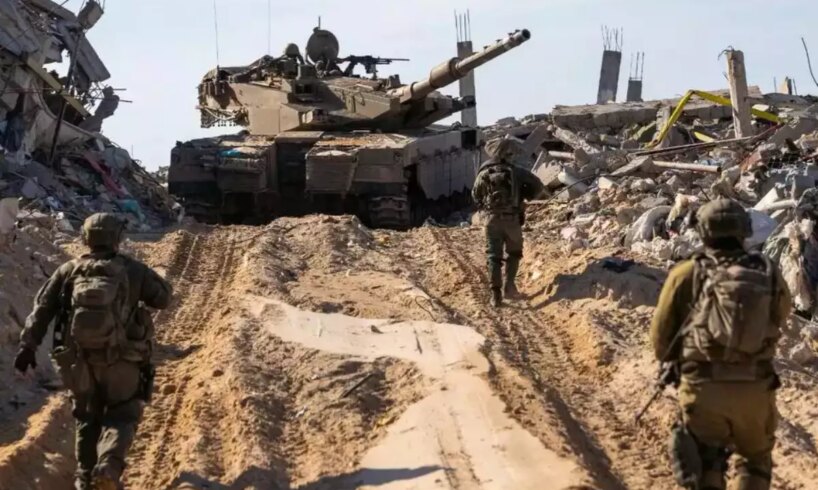
The deadly incident near Rafah serves as a warning light. If Israel fails to set strict and clear rules for dealing with Hamas, it risks sliding down a dangerous slope. The IDF’ immediate response—air and ground fire—was primarily aimed at creating a thick smoke screen to allow the evacuation of casualties. While Palestinians viewed it as an act of aggression, it was not a “response” in the expected sense of the word: a proper response should exact a price from Hamas and make it clear that Israel will not allow the ceasefire to dissolve.
The insistence by the IDF Spokesperson that the attack took place east of the “yellow line” was no coincidence. It was meant to clarify that Hamas had committed a double violation, both of the ceasefire and of the operational boundaries that were agreed upon. The implication is that if Hamas does not uphold its commitments, neither will Israel.
Over 100 Israeli Air Force strikes. Photo: Reuters
This is Israel’s first test following the hostages deal and Hamas’ reappearance in Gaza’s streets, and it has come sooner than expected. That could be bad news: the mediators, chiefly the US, will not want to see their diplomatic achievement collapse so quickly or the fighting resume. But it could also be good news: Israel now has an immediate opportunity to make clear that what was tolerated in the past with Gaza will no longer be.
Israel’s room for maneuver is not unlimited. Its ambition to “Lebanonize” Gaza, that is, to routinely eliminate terrorists, will not succeed, because Gaza is not Lebanon. In Lebanon, the government views Hezbollah as an enemy; in Gaza, Hamas is still the governing authority. And while the world pays little attention to Israel’s actions south of the Litani River, it monitors every move and strike in Gaza closely.
Israel must therefore respond firmly, but in coordination with the White House, to avoid an American brake on its actions. It can also use this incident as leverage to bring home more hostages’ bodies, following the return of Ronen Engel and Sontaya Oukarsri yesterday. Achieving that will require pressure on Hamas, both military and diplomatic, through the mediation of Qatar, Turkey and Egypt.
Hamas “police officers” on the streets of Gaza after the deal took effect. Photo: Arab networks
These countries have already made clear in recent days that they will act to prevent a renewed war. That could help, as it may restrain Hamas, but it also has a downside: their growing (and harmful) involvement in the Middle East in general, and in Gaza in particular. Hamas’ military capabilities, demonstrated yesterday, should not come as a surprise. Although the terrorist organization was badly damaged militarily, it still retains thousands of fighters and considerable weaponry. Its willingness to take risks at such an early stage should trouble Israel and should accelerate efforts toward implementing the second phase of the agreement—one that distances Hamas from centers of power in the Strip and establishes a new governing authority. Every party involved (except Hamas) has an interest in seeing that happen, and Israel would do well to strike while the iron is hot, before global attention shifts elsewhere.
For now, however, the government seems preoccupied with other matters—chiefly, its attempt to cement a new narrative for the October 7 war. This is a coordinated and political campaign, from renaming the war to efforts to set up a government-appointed inquiry committee. These are transparent and predictable moves, meant to deflect blame from the government, and particularly from its leader, for the worst failure in Israel’s history, which occurred on their watch.
That effort began as early as the black Saturday itself, with attempts to alter transcripts and protocols in the Prime Minister’s Office, and it has not stopped since. The 2,000 victims of the war, two more were added today, deserve far more than that, if only to prevent such a disaster from recurring. But it is doubtful this will come from those who have never taken responsibility for the catastrophe and are now seeking to appoint their own investigators to ensure themselves a favorable conclusion.