Nearly five months after Operation Rising Lion, the severity of the threat Israel poses to the Iranian regime has become deeply internalized. Despite the war’s short duration, it rattled the Islamic Republic and compelled it to reconsider its national security strategy.
The war damaged not only Iran’s missile and nuclear programs but also government and law enforcement institutions in Tehran. The regime is experiencing a trauma that it is trying to offset by repairing its image among the public. Yet this trauma is not driving Iranian leaders toward despair, at least for now. Instead, it has strengthened the motivation within the regime to revise its national security outlook.
Damage in Iran. Photo: AFP AFP
Iran is therefore restoring its missile program, expanding missile ranges, advancing a long-term plan to rebuild and strengthen the Lebanese Hezbollah terrorist organization, and seeing growing internal pressure on Khamenei to authorize the development of nuclear weapons.
One prominent point in the regime’s internal lessons-learned debate is the call by senior security analyst Mehdi Mohammadi to promote a multi-front massacre attack against Israel. Mohammadi, who also serves as an adviser to Mohammad Baqer Qalibaf, the speaker of the Majles and a member of Iran’s Supreme National Security Council, published a post on November 1 in Iranian media arguing that conditions are ripe for such an offensive.
He wrote that in “Lebanon, Yemen, Iraq and Iran a new generation of resistance fighters has emerged, one that is bold and willing to pay any price in the fight against Israel.”
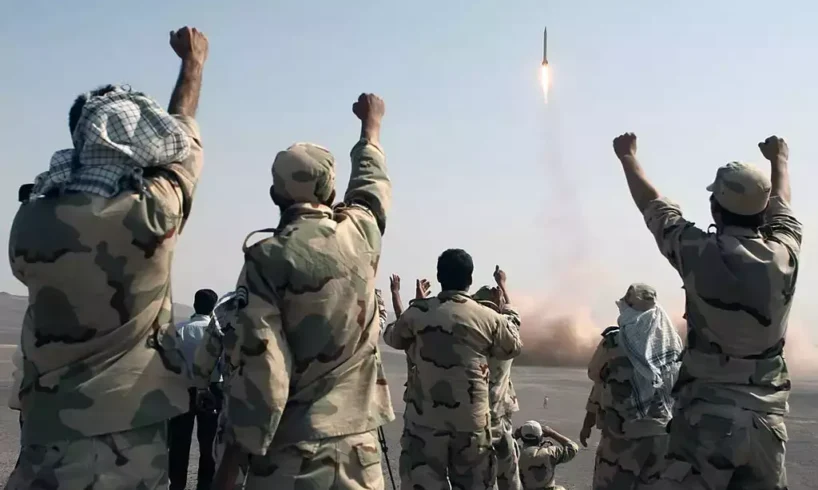
Missiles and Iranian flags . Photo: Reuters Reuters
Mohammadi added that this is a war of survival between Israel and Iran, which means the regime must “think in a more creative, large-scale and multidimensional way than it has over the past three decades.” His meaning was clear: a coordinated, multi-front massacre operation.
The headline of his article, “The next Octobers: the new nightmare of the Zionist regime” left little doubt about his intent. Last night he again pushed his call for a multi-front assault and urged the regime to prepare an operation in which every component of the resistance axis takes part together in a “decisive, prolonged and extensive battle.” A limited confrontation, he warned, would not achieve the desired result because it only benefits Israel.
Mohammadi is well known for the uproar he caused in July 2025 when he posted an Instagram story depicting a nuclear strike on Israel. After heavy criticism he claimed it had been uploaded by his page administrator without his knowledge.
The available information suggests that the 7 October attack was launched even though Yahya Sinwar did not tightly coordinate the timing with Hezbollah, Tehran or other components of the Iranian-led resistance axis. A series of recent reports underscores how feverishly the axis is now operating.
These include Defense Minister Israel Katz’s disclosure of Houthi presence in Syria; reports on the efforts by the Hamas and Palestinian Islamic Jihad terrorist organizations to establish a foothold in Syria; the Houthis’ plan to infiltrate Israel from the Jordanian border through Iraq or Saudi Arabia; and Hezbollah’s ongoing rehabilitation and force buildup.
As part of Israel’s own preparations for the threat posed by the Iranian-led axis, the IDF completed the establishment of Division 96 in September 2025. The division is intended to prevent the infiltration of Palestinians, Iraqi militias and Houthis into Israel through the Jordanian border. It will be deployed from Ein Gev to Masada. Even so, construction of the border fence in this area and the development of engineering barriers must be accelerated to prevent a possible incursion.
IDF troops operating in Syria, Gaza, and Lebanon. Photo: IDF Spokesperson’s Unit
At the same time, Israel must prepare for the emerging threat and closely monitor possible preparations by the Iranian regime and the resistance axis for a multi-front strike. Tehran must not be allowed to rebuild and rearm its proxy forces, since doing so could serve as a catalyst for such an attack. Statements by senior Iranian officials, from Khamenei to the spokesperson of Iran’s armed forces, Abu al-Fadl Shekarachi, show clearly that Tehran remains committed to its ambition of destroying Israel.
Therefore, alongside intelligence monitoring and defensive preparations, Israel would be better served by formulating a crushing, preemptive multi-front strike and applying it at the right moment. In addition, as long as elements of the resistance axis continue to foment instability in Syria and the Assad regime exhibits chronic weakness, a withdrawal from the areas Israel captured in southern Syria would be a dangerous move.