2025-12-01T05:58:56+00:00
font
Enable Reading Mode
A-
A
A+
Shafaq News
Iraq’s first national census in almost forty years has
delivered a stark demographic verdict: a country adding people faster than it
expands the systems needed to support them. Conducted on 20–21 November 2024,
the survey recorded 46,118,793 residents across more than eight million
households—a level of statistical clarity unavailable since the 1980s. What the
data reveals is both familiar and now indisputable: more than 60 percent of
Iraqis are aged 15 to 45, a youth-heavy society whose future hinges on whether
its institutions can keep pace.
For the Ministry of Planning, the census is not merely an
enumeration exercise but a national diagnostic. Ministry spokesperson Abdul
Zahra al-Hindawi told Shafaq News that the data “diagnoses reality with its
gaps,” giving the state a roadmap for redirecting investment and transitioning
from fragmented project-based development to coordinated national planning.
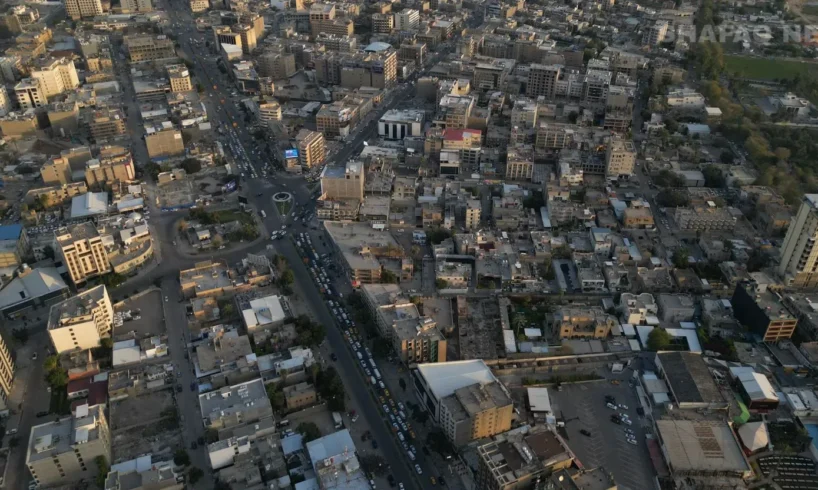
The numbers pinpoint geographic pressure zones that have
been visible for years but rarely quantified. Baghdad, Basra, Erbil, and Najaf
continue to absorb large internal migrations, pushing service networks and
infrastructure far beyond their design limits and accelerating unregulated
urban sprawl.
Behind the rising population lies a structural challenge: a
youthful demographic with limited economic channels. Iraq’s labor market
remains dominated by public-sector employment and oil revenue—an equation that
becomes increasingly unsustainable as the population climbs.
Member of Parliament Mohammed al-Baldawi told Shafaq News
that Iraq has yet to translate its demographic weight into economic momentum.
The country’s ability to diversify into agriculture, industry, and commerce
remains limited, constraining job creation at the very moment the workforce is
expanding. According to al-Baldawi, even Iraq’s intensifying housing
pressure—often framed as a pricing crisis—”is rooted in decades of
planning failures that kept new construction well below demographic demand.”
Property prices reflect this imbalance. Shafaq News
investigations show older residential units selling for 100–150 million dinars
(USD 70,000–105,000), while newer or centrally located homes can reach 250
million dinars (USD 175,000) or more.
Private-sector workers may earn 500,000 dinars per day,
al-Baldawi noted, but the irregular and unregulated nature of those jobs makes
mortgage participation difficult and keeps many households outside the formal
credit system.
Former Planning Minister Nouri al-Dulaimi cautioned that as
Iraq moves toward a population of 50 million, the divide between demographic
expansion and state readiness will grow unless investment-led development
accelerates. Overreliance “on public hiring, he warned, could intensify
unemployment, widen service shortages, and deepen housing pressures.”
The census also exposes the fragility of Iraq’s service
infrastructure.
Read more: Iraq’s population surges past 46M: Burden or opportunity?
Economic expert Ahmed Abdul Rabah told Shafaq News that
population growth itself is not the crisis—governance is. Electricity networks,
water and sanitation systems, hospitals, and schools are already operating
beyond capacity, particularly in crowded urban centers. He described housing
pressures, driven by land scarcity and insufficient lending pathways, as a
“time bomb.”
According to official data, classrooms in Iraqi public
schools are full with 50–70 students each, hospitals exceeding designed patient
capacity, electricity systems are faltering under rising consumption,
intensified by climate-driven heatwaves, and urban expansion outpacing
municipal services. Without rapid infrastructure expansion, demographic
pressure will continue to deepen Iraq’s structural vulnerabilities.
Beyond its statistical value, the census reveals a country
where population growth accelerates even as state capacity struggles to keep
up. This tension is magnified by Iraq’s fiscal architecture, which relies on
oil for over 90 percent of government revenue, limiting resilience against
market shocks and leaving long-term development tied to volatile energy
markets.
Iraq’s vocational training systems also remain modest,
private-sector credit flows are low, and regulatory barriers discourage
entrepreneurship—all factors that weaken the economy’s ability to absorb new
entrants into the workforce.
From the expert voices interviewed, one consensus emerges
clearly: the challenge is not Iraq’s population size—it is Iraq’s ability to
manage it. A youth-heavy society can be an economic driver only when paired
with disciplined planning, diversified investment, and political commitment.
Absent these, Iraq risks deeper unemployment, expanding
informal labor, unstable housing expansion, and service systems pushed toward
breaking points.
Written and edited by Shafaq News staff.