Ben Priceand
Tony Brown,BBC Wales
South Wales Police
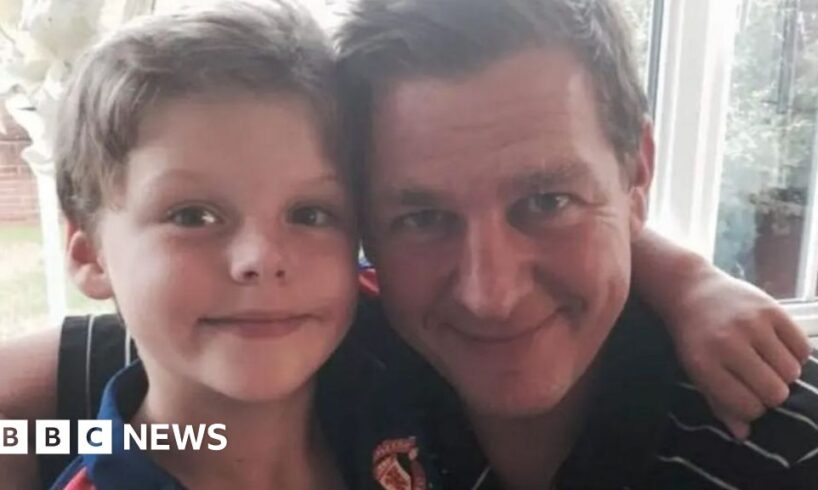
Fraser, seven, and dad Stuart were hit by a car after a Christmas party in 2015
A landmark law to increase the number of organ donors has had little impact 10 years after it was introduced, according to a charity and an academic.
Wales was the first UK nation to adopt the “soft” opt-out legislation on 1 December 2015, which presumes a person’s consent to donate their organs when they die, unless they or their family have indicated otherwise.
Conner Marshall’s mother said consenting to his organ donation wishes following his murder that same year had been “humbling” despite the “stomach-wrenching” thought of losing him.
The NHS Blood and Transplant service (NHSBT) said presumed consent was not a silver bullet to closing the gap between donation and transplantation.
The organ donor consent rate increased by about 15% during the first three years of the opt-out law, but dropped to its lowest level in a decade last year.
The Covid pandemic, fewer big media campaigns, limited resources and a possible distrust in the health service were some of the reasons provided for the reduction in recent years.
Leah McLaughlin, a healthcare scientist at Bangor University, Gwynedd, said: “We also need more messages embedded in day-to-day life so it becomes more of a normal expected end of life care, which is what NHSBT is trying to do, but we do need the infrastructure to support those messages.”
Family Photo
Three people benefited from Conner Marshall’s wish to donate his organs which his family decided to honour
When Conner was killed in Porthcawl, Bridgend county, his parents were asked whether they agreed with the 18-year-old’s wishes to donate his organs.
Despite an initial refusal to engage in the conversation with a specialist nurse, his mother, Nadine, recalled how he had previously discussed organ donation while applying for a motorcycle licence.
“We talked about it but, only briefly, what it meant to be an organ donor and he said ‘well, who wouldn’t want a piece of this?’.
“But he was quite emphatic that he didn’t want [to donate] his eyes.”
Ms Marshall said she could understand why families would be cautious or reluctant to allow a loved one’s organs to be donated, especially if they hadn’t discussed it or understood enough about the process.
“It was so dignified and so sensitive to Conner,” she said.
“It was truly a humbling experience to be able to do it.
“The little things that I wanted, I wanted to make sure that Conner was never left alone.”
Anna-Louise Bates has created a garden to honour donors after choosing to donate her seven-year-old son’s organs when he was killed
Anna-Louise Bates, who chose to donate the organs of her seven-year-old son, Fraser, and husband, Stuart, after they were hit by a car as they crossed the road following a Christmas party.
Ms Bates said it was “ground-breaking in Wales to be the first to adopt the soft opt-out, but everyone is still not educated in what that actually means”.
She set up charity Believe ODS which aims to support people on organ donation and remove the stigma around organ donations.
A memorial garden officially opens at Thornhill cemetery in Cardiff on Monday to honour donors and educate others on the law.
It will include a number of fruit trees and grass mounds created in the shape of organs such as a heart, liver and kidneys.
Sonsare Zabadi, 36, says his life-saving double lung transplant changed his family’s perception of organ donation
Sonsare Zabadi, 36, from Cardiff, signed the organ donor register years before he realised he’d need a life-saving transplant himself.
Having lived with a respiratory illness since the age of two, his health deteriorated and he was told he needed a double lung transplant.
A donor match was found which has since allowed him to see his son’s first birthday as well as the birth of his second child.
“I remember in 2012 when I signed up to the register… thinking it was a nice thing but I didn’t think much of it,” he said.
“One of my family members when she learned that I had signed up was very shocked that I’d made such a decision and asked me why I did that.
“Fast forward to 2023 when I had my transplant, I remember she visited the hospital and looked at me and said ‘I get it now, and I see why it’s important that we all look to do this’.”
What happens if I don’t sign the organ donor register?
Under the legislation, everybody is deemed to agree to organ donation after death unless they register a decision to opt-out.
If a decision isn’t registered then a relative has the right to object to the “deemed consent” rule.
The nature of the law also allows a relative to block a registered organ donation decision.
The deemed consent legislation has “helped to encourage” conversations according to Charlotte Charles-Williams, the lead organ donation nurse in south Wales.
She said discussions with a grieving family get “more difficult” if there hasn’t been a family conversation beforehand or a registered decision.
According to official data, the number of organ donations in recent months in Wales has reached its highest level since before the pandemic.
How many people are waiting for transplants?
As a result of the initial improvement in organ donor consent rates in Wales, other UK nations followed with their own presumed consent laws.
But consent rates across the UK have fallen to their lowest point in a decade and the number of people on the transplant waiting list has also reached a record high this year.
Debbie Statham from Swansea, who needs a new heart, is one of more than 8,200 people in the UK waiting for a transplant.
“To think that somebody is going to be able to provide me with a quality of life I’ve never ever been able to experience and I’d be able to do things that I’ve never ever been able to, well, it’s hard to sum it up really, isn’t it?” she said.
Debbie Statham, 59, was flown to Freeman Hospital, Newcastle-upon-Tyne, earlier this year for a new heart but final tests revealed the organ was unsuitable for transplant
Studies of the effectiveness of the opt-out laws in England and Wales have found the ambition of the policies have “not had the desired impact in practice”.
“You can attribute some of the issues to the pandemic but, overall, what’s happened is essentially we don’t have the resources we used to have,” said Ms McLaughlin.
“Nurses are understaffed and organ donation isn’t seen as a priority.
Research also found that support for organ donation in England was 20% lower among minority ethnic communities.
It’s a similar situation in Wales although the overall number of people within that group is smaller.
“What we saw was harmful targeted misinformation campaigns that were targeted at certain subgroups in our communities,” she said.
“The sad thing about that is people from black and Asian backgrounds are more likely to need a transplant, so they are over-represented on the transplant waiting list and they’re over-represented in terms of those who have opted out.”
NHSBT added that the number of people from minority ethnic backgrounds signing the organ donation register had slightly increased during the past five years, but there was “still more work to be done”.
The Welsh government said: “It is only natural that marketing activity is delivered at a steadier pace, particularly now other UK nations have introduced similar legislation.
“The pandemic affected public attitudes and donation rates but there are signs this year that the consent rate in Wales may be recovering.
“And there is a significant amount of work planned to continue to improve it.”